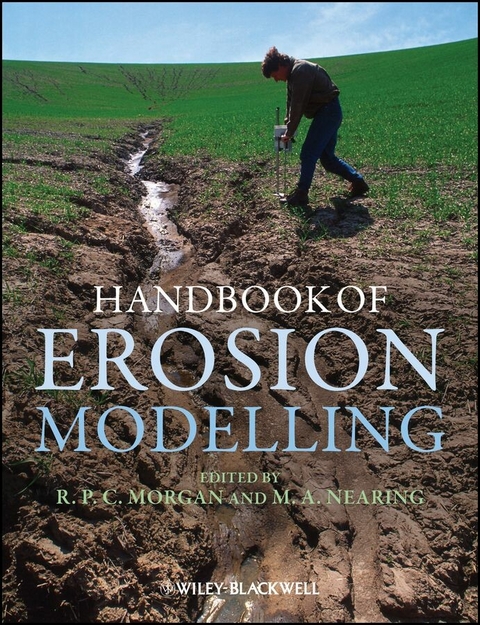
Handbook of Erosion Modelling (eBook)
416 Seiten
John Wiley & Sons (Verlag)
978-1-4443-4801-9 (ISBN)
landscape and into water bodies is of increasing concern with
respect to pollution control, prevention of muddy floods and
environmental protection. In addition, the loss of soil on site has
implications for declining agricultural productivity, loss of
biodiversity and decreased amenity and landscape value. The fate of
sediment and the conservation of soil are important issues for land
managers and decision-makers. In developing appropriate policies
and solutions, managers and researchers are making greater use of
erosion models to characterise the processes of erosion and their
interaction with the landscape.
A study of erosion requires one to think in terms of
microseconds to understand the mechanics of impact of a single
raindrop on a soil surface, while landscapes form over periods of
thousands of years. These processes operate on scales of
millimetres for single raindrops to mega-metres for continents.
Erosion modelling thus covers quite a lot of ground. This book
introduces the conceptual and mathematical frameworks used to
formulate models of soil erosion and uses case studies to show how
models are applied to a variety of purposes at a range of spatial
and temporal scales. The aim is to provide land managers and others
with the tools required to select a model appropriate to the type
and scale of erosion problem, to show what users can expect in
terms of accuracy of model predictions and to provide an
appreciation of both the advantages and limitations of models.
Problems covered include those arising from agriculture, the
construction industry, pollution and climatic change and range in
scale from farms to small and large catchments. The book will also
be useful to students and research scientists as an up-to-date
review of the state-of-art of erosion modelling and, through a
knowledge of how models are used in practice, in highlighting the
gaps in knowledge that need to be filled in order to develop even
better models.
Roy Morgan is Emeritus Professor at Cranfield University, Bedfordshire, UK. His research interests cover soil erosion processes, the role of vegetation in soil erosion control and soil erosion modelling. He was involved in the development of EUROSEM (the European Soil Erosion Model). He is a Past-President and Honorary Member of the European Society for Soil Conservation and the author of Soil erosion and conservation (3rd edition, Blackwell 2005). Dr Mark Nearing has authored more than 200 scientific papers on the subject of soil erosion over the past 25 years. He is Past President and serves on the Board of Directors of the International Soil Conservation Organization and has organized and presented keynote presentations at numerous international meetings.
List of contributors.
1 Introduction (R.P.C. Morgan).
PART 1 MODEL DEVELOPMENT.
2 Model Development: A User's Perspective (R.P.C.
Morgan).
3 Calibration of Erosion Models (V.G. Jetten and M.P.
Maneta).
4 Dealing with Uncertainty in Erosion Model Predictions (K.J.
Beven and R.E. Brazier).
5 A Case Study of Uncertainty: Applying GLUE to EUROSEM (J.N.
Quinton, T. Krueger, J. Freer, R.E. Brazier and G.S.
Bilotta).
6 Scaling Soil Erosion Models in Space and Time (R.E.
Brazier, C.J. Hutton, A.J. Parsons and J. Wainwright).
7 Misapplications and Misconceptions of Erosion Models (G.
Govers).
PART 2 MODEL APPLICATIONS.
8 Universal Soil Loss Equation and Revised Universal Soil Loss
Equation (K.G. Renard, D.C. Yoder, D.T. Lightle and S.M.
Dabney).
9 Application of WEPP to Sustainable Management of a
SmallCatchment in South west Missouri, US, Under Present Land Use
and with Climatic Change (J.M. Laflen).
10 Predicting Soil Loss and Runoff from Forest Roads and
Seasonal Cropping Systems in Brazil using WEPP (A.J.T. Guerra
and A. Soares da Silva).
11 Use of GUEST Technology to Parameterize a Physically-Based
Model for Assessing Soil Erodibility and Evaluating Conservation
Practices in Tropical Steeplands (C.W. Rose, B. Yu, R.K. Misra,
K. Coughlan and B. Fentie).
12 Evaluating Effects of Soil and Water Management and Land Use
Change on the Loess Plateau of China using LISEM (R. Hessel,
V.G. Jetten, B. Liu and Y. Qiu).
13 Modelling the Role of Vegetated Buffer Strips in Reducing
Transfer of Sediment from Land to Watercourses (J.H. Duzant,
R.P.C. Morgan, G.A. Wood and L.K. Deeks).
14 Predicting Impacts of LandUse and Climate Change on Erosion
and Sediment Yield in River Basins using SHETRAN (J.C.
Bathurst).
15 Modelling Impacts of Climatic Change: Case Studies using the
New Generation of Erosion Models (J.P. Nunes and M.A.
Nearing).
16 Risk-Based Erosion Assessment: Application to Forest
Watershed Management and Planning (W.J. Elliot and P.R.
Robichaud).
17 The Future Role of Information Technology in Erosion
Modelling (D.P. Guertin and D.C. Goodrich).
18 Applications of Long-Term Erosion and Landscape Evolution
Models (G.R. Willgoose and G.R. Hancock).
19 Gully Erosion: Procedures to Adopt When Modelling Soil
Erosion in Landscapes Affected by Gullying (J.W.A. Poesen, D.B.
Torri and T. Vanwalleghem).
PART 3 FUTURE DEVELOPMENTS.
20 The Future of Soil Erosion Modelling (M.A. Nearing and
P.B. Hairsine).
Index.
Colour plates.
| Erscheint lt. Verlag | 9.6.2011 |
|---|---|
| Sprache | englisch |
| Themenwelt | Naturwissenschaften ► Geowissenschaften ► Geologie |
| Technik | |
| Weitere Fachgebiete ► Land- / Forstwirtschaft / Fischerei | |
| Schlagworte | Bodenkunde, Geoarchäologie • Bodenkunde, Geoarchäologie • earth sciences • Geowissenschaften • Soil Science & Geoarchaeology |
| ISBN-10 | 1-4443-4801-9 / 1444348019 |
| ISBN-13 | 978-1-4443-4801-9 / 9781444348019 |
| Informationen gemäß Produktsicherheitsverordnung (GPSR) | |
| Haben Sie eine Frage zum Produkt? |
 EPUB (Adobe DRM)
Kopierschutz: Adobe-DRM
Adobe-DRM ist ein Kopierschutz, der das eBook vor Mißbrauch schützen soll. Dabei wird das eBook bereits beim Download auf Ihre persönliche Adobe-ID autorisiert. Lesen können Sie das eBook dann nur auf den Geräten, welche ebenfalls auf Ihre Adobe-ID registriert sind.
Details zum Adobe-DRM
Dateiformat: EPUB (Electronic Publication)
EPUB ist ein offener Standard für eBooks und eignet sich besonders zur Darstellung von Belletristik und Sachbüchern. Der Fließtext wird dynamisch an die Display- und Schriftgröße angepasst. Auch für mobile Lesegeräte ist EPUB daher gut geeignet.
Systemvoraussetzungen:
PC/Mac: Mit einem PC oder Mac können Sie dieses eBook lesen. Sie benötigen eine
eReader: Dieses eBook kann mit (fast) allen eBook-Readern gelesen werden. Mit dem amazon-Kindle ist es aber nicht kompatibel.
Smartphone/Tablet: Egal ob Apple oder Android, dieses eBook können Sie lesen. Sie benötigen eine
Geräteliste und zusätzliche Hinweise
Buying eBooks from abroad
For tax law reasons we can sell eBooks just within Germany and Switzerland. Regrettably we cannot fulfill eBook-orders from other countries.
aus dem Bereich