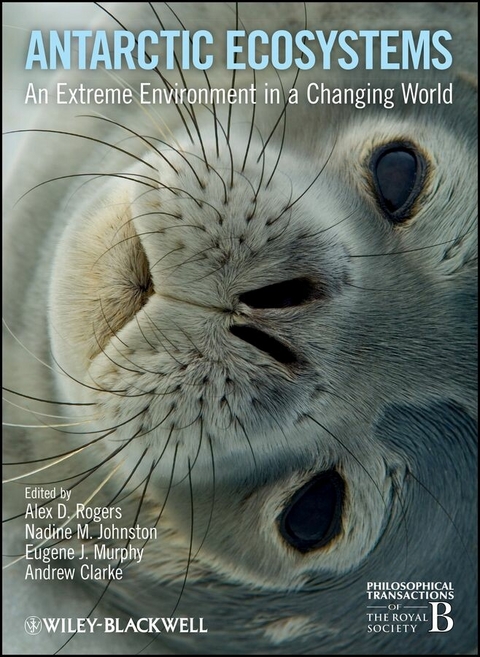
Antarctic Ecosystems (eBook)
756 Seiten
John Wiley & Sons (Verlag)
978-1-4443-4722-7 (ISBN)
biologists. Extreme environmental conditions, seasonality and
isolation have lead to some of the most striking examples of
natural selection and adaptation on Earth. Paradoxically, some of
these adaptations may pose constraints on the ability of the
Antarctic biota to respond to climate change. Parts of Antarctica
are showing some of the largest changes in temperature and other
environmental conditions in the world. In this volume, published in
association with the Royal Society, leading polar scientists
present a synthesis of the latest research on the biological
systems in Antarctica, covering organisms from microbes to
vertebrate higher predators. This book comes at a time when new
technologies and approaches allow the implications of climate
change and other direct human impacts on Antarctica to be viewed at
a range of scales; across entire regions, whole ecosystems and down
to the level of species and variation within their genomes.
Chapters address both Antarctic terrestrial and marine ecosystems,
and the scientific and management challenges of the future are
explored.
Alex Rogers is a marine biologist working on the ecology and conservation of marine ecosystem. Most of his research has focused on Antarctic and deep-sea habitats, including seamounts, hydrothermal vents and cold-water corals. He uses molecular tools to help investigate the diversity and evolution of species and connectivity of populations of marine organisms. He has also worked extensively on human impacts on the oceans and the development of policies for improved management of the oceans. Nadine Johnston is a marine ecologist. Her research is focused on the interaction of Scotia Sea species and their links to the circumpolar ocean (from a food web perspective) to understand the importance of spatial and temporal variability in the operation of this ecosystem. Eugene Murphy has spent over 25 years working on polar marine ecosystems, as a marine ecologist and ecological modeller. His major interests are in the structure and function of oceanic ecosystems, and how biological and physical interactions at different scales affect the dynamics of marine populations, the overall structure of marine ecosystems amd their response to change. Andrew Clarke has spent the over 40 years working in polar regions, principally as a marine ecologist. His major interests are the elationship between temperature and the physiology and ecology of organisms, and how changes in climate over geological time have influenced the distribution and diversity of organisms.
Contributors
Introduction: Antarctic ecology in a changing world
Andrew Clarke, Nadine M. Johnston, Eugene J. Murphy & Alex D. Rogers
Part I: Terrestrial and freshwater habitats
Chapter 1. Spatial and temporal variability in terrestrial Antarctic biodiversity Steven L. Chown and Peter Convey
Chapter 2. Global Change in a Low Diversity Terrestrial Ecosystem: The McMurdo Dry Valleys, Diana H. Wall
Chapter 3. Antarctic lakes as models for the study of microbial biodiversity, biogeography and evolution
David A. Pearce and Johanna Laybourn-Parry
Part II: Marine habitats and regions
Chapter 4. The impact of regional climate change on the marine ecosystem of the western Antarctic Peninsula
Andrew Clarke, David K. A. Barnes, Thomas J. Bracegirdle, Hugh W. Ducklow, John C. King, Michael P. Meredith, Eugene J. Murphy and Lloyd S. Peck
Chapter 5. The Marine Ecosystem of the West Antarctic Peninsula
Hugh W. Ducklow, Andrew Clarke, Rebecca Dickhut, Scott C. Doney, Heidi Geisz, Kuan Huang, Douglas G. Martinson, Michael P. Meredith, Holly V. Moeller, Martin Montes-Hugo, Oscar Shofield, Sharon E. Stammerjohn, Debbie Steinberg and William Fraser
Chapter 6. Spatial and Temporal Operation of the Scotia Sea Ecosystem
Eugene J. Murphy, Jonathan L. Watkins, Phil N. Trathan, Keith Reid, Michael P. Meredith, Simeon Hill, Sally E. Thorpe, Nadine M. Johnston, Aandrew Clarke, Geraint Tarling, Martin Collins, Jaume Forcada, Angus Atkinson, Peter Ward, Iain Staniland, David Pond, Rachel Cavanagh, Rachael Shreeve, Rebecca Korb, Michael J. Whitehouse, Paul G. Rodhouse, Peter Enderlein, Aandrew Hirst, Anthony R. Martin, I. D. Briggs, Nathan Cunningham and Andrew Fleming
Chapter 7. The Ross Sea Continental Shelf: Regional Biogeochemical Cycles, Trophic Interactions, and Potential Future Changes
Walker O. Smith, Jr., David G. Ainley, Riccardo Cattaneo-Vietti and Eileen E. Hofmann
Chapter 8. Pelagic ecosystems in the waters off East Antarctica (30°E-150°E) Stephen Nicol and Ben Raymond
Chapter 9. The dynamic mosaic: Disturbance and development of Antarctic benthic communities
David K.A. Barnes and Kathleen E. Conlan
Chapter 10. Southern Ocean deep benthic biodiversity
Angelika Brandt, Claude De Broyer, B. Ebbe, Kari E. Ellingsen, Andrew J. Gooday, D. Janussen, Stephanie Kaiser, Katrin Linse, M. Schueller, Michael R. A. Thomson, Paul A. Tyler and A. Vanreusel
Chapter 11. Environmental forcing and Southern Ocean marine predator populations: effects of climate change and variability
Phil N. Trathan, Jaume Forcada and Eugene J. Murphy
Part III: Molecular adaptations and evolution
Chapter 12. Molecular ecophysiology of Antarctic notothenioid fishes
C.-H. Christina Cheng and H. William Detrich III
Chapter 13. Mechanisms defining thermal limits and adaptation in marine ectotherms: an integrative view
Hans O. Pörtner, Lloyd S. Peck and George N. Somero
Chapter 14. Evolution and biodiversity of Antarctic organisms; a molecular perspective
Alex D. Rogers
Part IV: Conservation and management aspects
Chapter 15. Biogeography and regional classifications of Antarctica
Peter Convey, David K. A. Barnes, Huw J. Griffiths, Susie M. Grant, Katrin Linse and David N. Thomas
Chapter 16. Conservation and Management of Antarctic Ecosystems
Susie M. Grant, Peter Convey, Kevin A. Hughes, Richard A. Phillips and Phil N. Trathan
Index
"Overall, this book provides a comprehensive overview of
Antarctic ecosystems and the open access approach to publication
means this volume serves as an easy entre to that literature
- many ecologists will benefit from this
compilation." (Austral Ecology, 1 October
2013)
"As an institutional library purchase, I would recommend
this book." (Frontiers of biogeography, 5
January 2013
"This timely summary of the state of Antarctic ecological
science provides a springboard for an exciting future of Antarctic
research." (The Quarterly Review of Biology, 1
June 2013)
"Overall, I appreciated the book and found it to be a very
good synthesis especially of the marine information."
(Biodiversity and Conservation, 1 October 2012)
"The first of these two books is a good scientific
treatise on how snow and ice communities work at the moment, while
the second concentrates more on marine environments and their
likely future. Both are good and should be in the
library." (British Ecological Society Bulletin,
1 August 2012)
"This book is a must for senior undergraduates, graduate
students, and scientists interested in Antarctic ecosystems.
Summing Up: Highly recommended. Upper-division undergraduates
through professionals." (Choice, 1 September
2012)
| Erscheint lt. Verlag | 28.2.2012 |
|---|---|
| Sprache | englisch |
| Themenwelt | Naturwissenschaften ► Biologie ► Ökologie / Naturschutz |
| Technik | |
| Schlagworte | Ãkologie • Ãkologie / Salzwasser • Biowissenschaften • Geographie • Geography • Life Sciences • Marine Ecology • Ökologie • Ökologie / Salzwasser • Regionalgeographie • Regional Geography |
| ISBN-10 | 1-4443-4722-5 / 1444347225 |
| ISBN-13 | 978-1-4443-4722-7 / 9781444347227 |
| Informationen gemäß Produktsicherheitsverordnung (GPSR) | |
| Haben Sie eine Frage zum Produkt? |
 EPUB (Adobe DRM)
Kopierschutz: Adobe-DRM
Adobe-DRM ist ein Kopierschutz, der das eBook vor Mißbrauch schützen soll. Dabei wird das eBook bereits beim Download auf Ihre persönliche Adobe-ID autorisiert. Lesen können Sie das eBook dann nur auf den Geräten, welche ebenfalls auf Ihre Adobe-ID registriert sind.
Details zum Adobe-DRM
Dateiformat: EPUB (Electronic Publication)
EPUB ist ein offener Standard für eBooks und eignet sich besonders zur Darstellung von Belletristik und Sachbüchern. Der Fließtext wird dynamisch an die Display- und Schriftgröße angepasst. Auch für mobile Lesegeräte ist EPUB daher gut geeignet.
Systemvoraussetzungen:
PC/Mac: Mit einem PC oder Mac können Sie dieses eBook lesen. Sie benötigen eine
eReader: Dieses eBook kann mit (fast) allen eBook-Readern gelesen werden. Mit dem amazon-Kindle ist es aber nicht kompatibel.
Smartphone/Tablet: Egal ob Apple oder Android, dieses eBook können Sie lesen. Sie benötigen eine
Geräteliste und zusätzliche Hinweise
Buying eBooks from abroad
For tax law reasons we can sell eBooks just within Germany and Switzerland. Regrettably we cannot fulfill eBook-orders from other countries.
aus dem Bereich