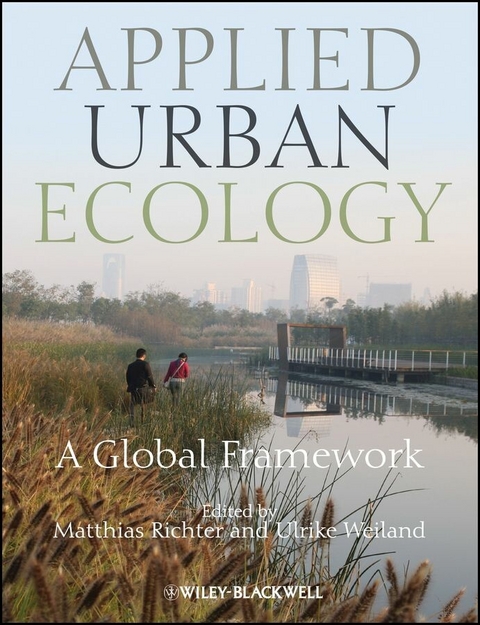
Applied Urban Ecology (eBook)
John Wiley & Sons (Verlag)
978-1-4443-4500-1 (ISBN)
Approaches chosen for the book are placed in the context of issues such as climate change, green- and open-space development, flood-risk assessment, threats to urban biodiversity, and increasing environmental pollution (especially in the “megacities” of newly industrialized countries). All topics covered were chosen because they are socially and socio-politically relevant today.
Further topics covered include sustainable energy and budget management, urban water resource management, urban land management, and urban landscape planning and design.
Throughout the book, concepts and methods are illustrated using case studies from around the world. A closing synopsis draws conclusions on how the findings of urban ecological research can be used in strategic urban management in the future.
Applied Urban Ecology: A Global Framework is an advanced textbook for students, researchers and experienced practitioners in urban ecology and urban environmental research, planning, and practice.
Matthias Richter, Environmental Scientist, Publicist and University Lecturer, Germany.
Ulrike Weiland is Professor of Urban Ecology at the Institute for Geography, University of Leipzig, Germany.
Matthias Richter, Environmental Scientist, Publicist and University Lecturer, Germany. Ulrike Weiland is Professor of Urban Ecology at the Institute for Geography, University of Leipzig, Germany.
FOREWORD Jürgen Breuste (Austria).
PART I: INTRODUCTION.
1. Urban ecology - brief history and present challenges - Ulrike Weiland & Matthias Richter (Germany).
PART II: URBAN ECOLOGY: RELATED DISCIPLINES AND METHODS.
2. Thematic-methodical approaches to applied urban ecology - Matthias Richter & Ulrike Weiland (Germany).
3. Monitoring urban land use changes with remote sensing techniques - Ellen Banzhaf & Maik Netzband (Germany).
PART III:SELECTED FIELDS OF APPLIED URBAN ECOLOGY.
A. Pathways of the ecosystem approach.
4. Quantifying spatiotemporal patterns and ecological effects of urbanization: a multiscale landscape approach - Jianguo Wu & al. (USA).
5. Designing urban systems: ecological strategies with stocks and flows of energy and material - Peter Baccini (Switzerland).
B. Socio-environmental threats.
6. Environmental and ecological threats in Indian megacities - Surinder Aggarwal & Carsten Butsch (India).
7. From wasteland to wilderness: aspects of a new form of urban nature - Dieter Rink & Harriet Herbst (Germany).
C. Flooding and climate adaptation.
8. Multi-scale flood risk assessment in urban areas - a geoinformatics approach - Norman Kerle & Dinand Alkema (Netherlands).
9. Urban open spaces and adaptation to climate change - Marialena Nikolopoulou (England).
D. Urban biodiversity.
10. Social aspects of urban ecology in developing countries, with an emphasis on urban domestic gardens - Sarel Cilliers, Stefan Siebert, Elandrie Davoren & Rina Lubbe (South Africa).
11. Plant material for urban landscapes in the era of globalisation: roots, challenges and innovative solutions - Maria Ignatieva (New Zealand).
E. Environmental urban design.
12. Ecological infrastructure leads the way: the negative approach and landscape urbanism for smart preservation and smart growth - Kongjian Yu (China).
13. Integrating science and creativity for landscape planning and design of urban areas - Antje Stokman & Christina von Haaren (Germany).
14. Landscape as a living system: Shanghai 2010 Expo Houtan Park - Kongjian Yu (China).
F. Environmental urban politics.
15. Geographical perspectives on a radical political ecology of water - Alex Loftus (England).
PART IV: SYNTHESIS.
16. Synthesising urban ecology research and topics for urban environmental management - Matthias Richter & Ulrike Weiland (Germany).
Index.
"In return it broadens our perspective on the pathways we
might follow in aiming to understand the complexities of urban
environments, and ultimately learn how to shape their future and
that of the majority of humanity." (Austral
Ecology, 1 October 2013)
"This book provides a wealth of information . . . It is a
book for the specialist rather than the generalist and is thus most
relevant for advanced undergraduates and postgraduates of ecology,
geography, environmental science and urban planning."
(Bulletin of the British Ecological Society, 1 June
2012)
"I am sure that anyone teaching in this area at undergraduate or
postgraduate levels will want it on their bookshelf." (Elsevier's
Biological Conservation, 1 January 2012)
"I highly recommend the very hands on and engaging book Applied
Urban Ecology: A Global Framework edited by Matthias Richter and
Ulrike Weiland, to any field researchers, scientists,
practitioners, urban planners, policy makers in government,
business leaders, educators, and students at all levels who are
seeking a clear and understandable guide to urban ecology, its
challenges, and its potential solutions. This book will transform
the way decision makers approach urban ecological issues, and
provide students with a firm foundation in applied urban ecology."
(Blog Business World, 4 January 2012)
"Nevertheless, each chapter is worth reading and I am sure this
book will become a primer for studies in urban ecology. I am sure
that anyone teaching in this area at undergraduate or postgraduate
levels will want it on their bookshelf." (Biological Conservation,
12 December 2011)
| Erscheint lt. Verlag | 19.9.2011 |
|---|---|
| Sprache | englisch |
| Themenwelt | Naturwissenschaften ► Biologie ► Ökologie / Naturschutz |
| Naturwissenschaften ► Geowissenschaften ► Geografie / Kartografie | |
| Sozialwissenschaften ► Soziologie | |
| Technik | |
| Schlagworte | Ãkologie • Angewandte Ãkologie • Angewandte Ökologie • Applied Ecology • biodiversity in towns, biodiversity in cities, urban planning, landscape ecology, city planning, city design, landscape geography, urban ecological projects • Biowissenschaften • Conservation Science • Environmental Management, Policy & Planning • Environmental Studies • Life Sciences • Naturschutzbiologie • Ökologie • Umweltforschung • Umweltmanagement, Politik u. -Planung |
| ISBN-10 | 1-4443-4500-1 / 1444345001 |
| ISBN-13 | 978-1-4443-4500-1 / 9781444345001 |
| Informationen gemäß Produktsicherheitsverordnung (GPSR) | |
| Haben Sie eine Frage zum Produkt? |
 EPUB (Adobe DRM)
Kopierschutz: Adobe-DRM
Adobe-DRM ist ein Kopierschutz, der das eBook vor Mißbrauch schützen soll. Dabei wird das eBook bereits beim Download auf Ihre persönliche Adobe-ID autorisiert. Lesen können Sie das eBook dann nur auf den Geräten, welche ebenfalls auf Ihre Adobe-ID registriert sind.
Details zum Adobe-DRM
Dateiformat: EPUB (Electronic Publication)
EPUB ist ein offener Standard für eBooks und eignet sich besonders zur Darstellung von Belletristik und Sachbüchern. Der Fließtext wird dynamisch an die Display- und Schriftgröße angepasst. Auch für mobile Lesegeräte ist EPUB daher gut geeignet.
Systemvoraussetzungen:
PC/Mac: Mit einem PC oder Mac können Sie dieses eBook lesen. Sie benötigen eine
eReader: Dieses eBook kann mit (fast) allen eBook-Readern gelesen werden. Mit dem amazon-Kindle ist es aber nicht kompatibel.
Smartphone/Tablet: Egal ob Apple oder Android, dieses eBook können Sie lesen. Sie benötigen eine
Geräteliste und zusätzliche Hinweise
Buying eBooks from abroad
For tax law reasons we can sell eBooks just within Germany and Switzerland. Regrettably we cannot fulfill eBook-orders from other countries.
aus dem Bereich