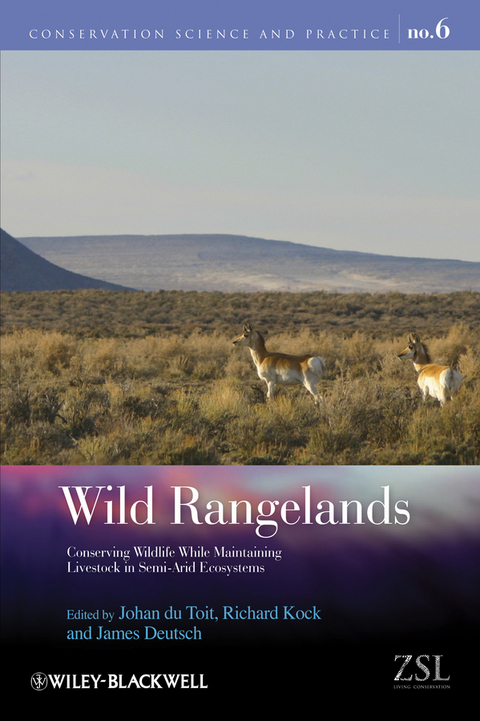
Wild Rangelands (eBook)
448 Seiten
John Wiley & Sons (Verlag)
978-1-4443-1710-7 (ISBN)
shrublands, savannas and semi-deserts, support half of the
world's livestock, while also providing habitats for some of
the most charismatic of wildlife species. This book examines the
pressures on rangeland ecosystems worldwide from human land use,
over-hunting, and subsistence and commercial farming of livestock
and crops. Leading experts have pooled their experiences from all
continents to cover the ecological, sociological, political,
veterinary, and economic aspects of rangeland management today.
This book provides practitioners and students of
rangeland management and wildland conservation with a diversity of
perspectives on a central question: can rangelands be wildlands?
* The first book to examine rangelands from a conservation
perspective
* Emphasizes the balance between the needs of people and
livestock, and wildlife
* Written by an international team of experts covering all
geographical regions
* Examines ecological, sociological, political, veterinary, and
economic aspects of rangeland management and wildland conservation,
providing a diversity of perspectives not seen before in a single
volume
Johan T. du Toit is a professor at Utah State University, where he is the Head of the Department of Wildland Resources. He is especially interested in the ecology of large mammals and the conservation of terrestrial ecosystems through the fusion of science and management. Richard Kock is a Doctor of Veterinary Medicine and specialist in wildlife medicine. He has worked with a focus on wildlife health and conservation, livestock and mixed wildlife/livestock communities and in rangelands throughout his career. He has worked for the Zoological Society of London for 26 years and now works in the African and South Asian region looking at wildlife health programmes in wild rangelands. James Deutsch directs the Africa Program of the Wildlife Conservation Society, with over a thousand staff working to save globally important landscapes and species in twelve African countries. James has lectured at the University of East Anglia and Imperial College, helped found the Tropical Biology Association and AIDS Treatment Project, ran Crusaid, and chairs Aidspan.
Contributors vii
Preface xv
Foreword by Anthony R.E. Sinclair and George B. Schaller xix
1. Introduction: A Review of Rangeland Conservation Issues in an Uncertain Future 1
Monica L. Wrobel and Kent H. Redford
Part I Thematic Reviews 13
2. Riding the Rangelands Piggyback: A Resilience Approach to Conservation Management 15
Brian Walker
3. Addressing the Mismatches between Livestock Production and Wildlife Conservation across Spatio-temporal Scales and Institutional Levels 30
Johan T. du Toit
4. Rangeland Conservation and Shrub Encroachment: New Perspectives on an Old Problem 53
Steven R. Archer
5. Health and Disease in Wild Rangelands 98
Richard Kock, Mike Kock, Sarah Cleaveland and Gavin Thomson
6. Contemporary Views of Human-Carnivore Conflicts on Wild Rangelands 129
Alexandra Zimmermann, Nick Baker, Chloe Inskip, John D.C. Linnell, Silvio Marchini, John Odden, Gregory Rasmussen and Adrian Treves
7. Financial Incentives for Rangeland Conservation: Addressing the 'Show-Us-the-Money' Challenge 152
Ray Victurine and Charles Curtin
Part II Case Studies 189
8. Biodiversity Conservation in Australian Tropical Rangelands 191
Stephen T. Garnett, John C.Z. Woinarski, Gabriel M. Crowley and Alex S. Kutt
9. Livestock Grazing and Wildlife Conservation in the American West: Historical, Policy and Conservation Biology Perspectives 235
Thomas L. Fleischner
10. Guanaco Management in Patagonian Rangelands: A Conservation Opportunity on the Brink of Collapse 266
Ricardo Baldi, Andrés Novaro, Martín Funes, Susan Walker, Pablo Ferrando, Mauricio Failla and Pablo Carmanchahi
11. Multiple Use of Trans-Himalayan Rangelands: Reconciling Human Livelihoods with Wildlife Conservation 291
Charudutt Mishra, Sumanta Bagchi, Tsewang Namgail and Yash Veer Bhatnagar
12. Herders and Hunters in a Transitional Economy: The Challenge of Wildlife and Rangeland Management in Post-socialist Mongolia 312
Katie M. Scharf, María E. Fernández-Giménez, Batjav Batbuyan and Sumiya Enkhbold
13. Social and Economic Challenges for Conservation in East African Rangelands: Land use, Livelihoods and Wildlife Change in Maasailand 340
Katherine Homewood and D. Michael Thompson
14. The Future for Wildlife on Kenya's Rangelands: An Economic Perspective 367
Michael Norton-Griffiths and Mohammed Y. Said
15. Synthesis: Local and Global Solutions to the Challenge of Keeping Rangelands Wild 393
James C. Deutsch
Index 403
"That said, 'Wild rangelands' provides an extensive and
up-to-date treatment of challenges and issues for rangeland
conservation, and the plight of those who rely on livestock for
livelihoods is strongly drawn into both the case studies and the
more conceptual chapters. Hence, 'Wild rangelands' will
provide an informative and useful volume from a variety of
perspectives." (Pastoralism: Research, Policy & Practice, 2011)
"In conclusion, Wild Rangelands is a must-read for researchers,
conservationists and ranchers alike and should be included in
university wildlife biology teaching curricula to facilitate a
stronger grounding of biology graduates in the broader social
issues affecting conservation today." (African Journal of Range and
Forage Science, 2011)
| Erscheint lt. Verlag | 6.11.2012 |
|---|---|
| Sprache | englisch |
| Themenwelt | Naturwissenschaften ► Biologie ► Ökologie / Naturschutz |
| Naturwissenschaften ► Geowissenschaften ► Geologie | |
| Technik | |
| Weitere Fachgebiete ► Land- / Forstwirtschaft / Fischerei | |
| Schlagworte | Ãkologie u. Biologie der Organismen • Biowissenschaften • Conservation Science • Ecology & Organismal Biology • Life Sciences • Naturschutzbiologie • Ökologie u. Biologie der Organismen |
| ISBN-10 | 1-4443-1710-5 / 1444317105 |
| ISBN-13 | 978-1-4443-1710-7 / 9781444317107 |
| Informationen gemäß Produktsicherheitsverordnung (GPSR) | |
| Haben Sie eine Frage zum Produkt? |
 PDF (Adobe DRM)
Kopierschutz: Adobe-DRM
Adobe-DRM ist ein Kopierschutz, der das eBook vor Mißbrauch schützen soll. Dabei wird das eBook bereits beim Download auf Ihre persönliche Adobe-ID autorisiert. Lesen können Sie das eBook dann nur auf den Geräten, welche ebenfalls auf Ihre Adobe-ID registriert sind.
Details zum Adobe-DRM
Dateiformat: PDF (Portable Document Format)
Mit einem festen Seitenlayout eignet sich die PDF besonders für Fachbücher mit Spalten, Tabellen und Abbildungen. Eine PDF kann auf fast allen Geräten angezeigt werden, ist aber für kleine Displays (Smartphone, eReader) nur eingeschränkt geeignet.
Systemvoraussetzungen:
PC/Mac: Mit einem PC oder Mac können Sie dieses eBook lesen. Sie benötigen eine
eReader: Dieses eBook kann mit (fast) allen eBook-Readern gelesen werden. Mit dem amazon-Kindle ist es aber nicht kompatibel.
Smartphone/Tablet: Egal ob Apple oder Android, dieses eBook können Sie lesen. Sie benötigen eine
Geräteliste und zusätzliche Hinweise
Buying eBooks from abroad
For tax law reasons we can sell eBooks just within Germany and Switzerland. Regrettably we cannot fulfill eBook-orders from other countries.
aus dem Bereich