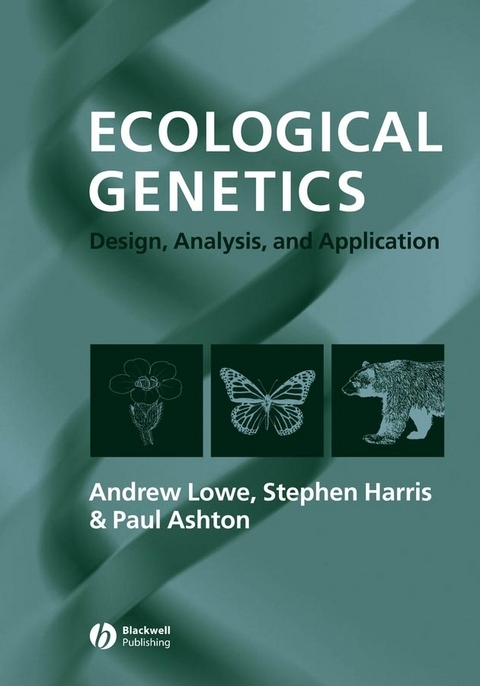
Ecological Genetics (eBook)
John Wiley & Sons (Verlag)
978-1-4443-1121-1 (ISBN)
Dr Andrew Lowe recently took up a position as Research Lecturer in Ecological Genetics at the University of Queensland, Australia, after serving as a Senior Scientific Research Officer at the Centre for Ecology and Hydrology, Edinburgh, UK. He manages a global network of highly regarded research projects on speciation and hybridization, range-wide phylogeography and fine-scale population gene dynamics, and has published more than 50 articles and papers on these subjects in scientific journals and books. Dr Stephen Harris is Druce Curator of the Oxford University Herbaria, UK. As a University Research Lecturer he teaches in plant conservation genetics, and his research interests are molecular systematics, conservation genetics, and the effects of human activities on plant genetic variation and speciation. He has published more than 50 articles and papers on these subjects in scientific journals and books. Dr Paul Ashton is a Senior Lecturer in Botany at Edge Hill College of Higher Education, UK. He was instrumental in implementing one of the UK's first degree programs in Conservation Biology. He is also an Associate Lecturer with the Open University and has recently developed a small research group to continue his long-held interests in plant speciation and introgression, while developing new interests in conservation genetics.
Preface vii
Abbreviations x
1 Ecological genetics 1
Summary 1
1.1 What is ecological genetics? 1
1.2 Why study ecological genetics? 3
References 4
2 Markers and sampling in ecological genetics 6
Summary 6
2.1 Introduction 6
2.2 Methods of data generation 7
2.3 Principles of sampling 15
2.4Practice 20
2.5 Within-population sampling 22
2.6 Among-population sampling 34
2.7 Power analysis 34
2.8 Further reading 35
Essential methods information 36
References 45
3 Genetic diversity and differentiation 52
Summary 52
3.1 Introduction 52
3.2 Factors influencing diversity and differentiation 53
3.3 The Hardy-Weinberg equilibrium 58
3.4Genetic diversity 62
3.5 Genetic differentiation 69
3.6 Genetic distance 81
3.7 Statistical approaches 86
3.8 Use of genetic diversity statistics 89
3.9 Concluding remarks 100
3.10 Further reading 100
References 100
4 Gene flow and mating system 106
Summary 106
4.1 Introduction 106
4.2 Factors governing gene flow 107
4.3 Considerations for measuring gene flow 115
4.4 Measuring gene flow - indirect estimates 122
4.5 Measuring gene flow - direct estimates 134
4.6 The importance of biological and environmental factors on gene flow 143
References 145
5 Intraspecific phylogenies and phylogeography 150
Summary 150
5.1 Introduction 150
5.2 Homology, gene trees, and species trees 157
5.3 Tree form and building 159
5.4Tree interpretation 170
5.5 Organelle versus nuclear intraspecific phylogenies 179
5.6 Further reading 180
Essential methods information 181
References 185
6 Speciation and hybridization 189
Summary 189
6.1 Introduction 189
6.2 Species 190
6.3 Speciation 194
6.4 Hybridization 204
6.5 Analysis of speciation and hybridization 206
6.6 Future developments 233
6.7 Further reading 233
References 233
7 Case studies in ecological genetics: Lycaenid butterflies, ragworts, bears, and oaks 243
Summary 243
7.1 Introduction 244
7.2 Lycaenid butterflies 244
7.3 European ragworts 257
7.4Brown bears 265
7.5 European oaks 274
References 292
Appendix A: Data analysis software 300
Appendix B: Which distance algorithm should be used and when? 306
Glossary 313
Index 320
| Erscheint lt. Verlag | 1.4.2009 |
|---|---|
| Sprache | englisch |
| Themenwelt | Naturwissenschaften ► Biologie ► Genetik / Molekularbiologie |
| Naturwissenschaften ► Biologie ► Ökologie / Naturschutz | |
| Technik | |
| Schlagworte | accessible • Biowissenschaften • clear • Data • Ecological • ecological genetics • Facing • fundamental • Genetics • Genetik • Last • Life Sciences • many • Markers • molecular markers • New • Problem • Professionals • Researchers • Specialist • suitable • upperlevel undergraduates • use • years |
| ISBN-10 | 1-4443-1121-2 / 1444311212 |
| ISBN-13 | 978-1-4443-1121-1 / 9781444311211 |
| Informationen gemäß Produktsicherheitsverordnung (GPSR) | |
| Haben Sie eine Frage zum Produkt? |
 PDF (Adobe DRM)
Kopierschutz: Adobe-DRM
Adobe-DRM ist ein Kopierschutz, der das eBook vor Mißbrauch schützen soll. Dabei wird das eBook bereits beim Download auf Ihre persönliche Adobe-ID autorisiert. Lesen können Sie das eBook dann nur auf den Geräten, welche ebenfalls auf Ihre Adobe-ID registriert sind.
Details zum Adobe-DRM
Dateiformat: PDF (Portable Document Format)
Mit einem festen Seitenlayout eignet sich die PDF besonders für Fachbücher mit Spalten, Tabellen und Abbildungen. Eine PDF kann auf fast allen Geräten angezeigt werden, ist aber für kleine Displays (Smartphone, eReader) nur eingeschränkt geeignet.
Systemvoraussetzungen:
PC/Mac: Mit einem PC oder Mac können Sie dieses eBook lesen. Sie benötigen eine
eReader: Dieses eBook kann mit (fast) allen eBook-Readern gelesen werden. Mit dem amazon-Kindle ist es aber nicht kompatibel.
Smartphone/Tablet: Egal ob Apple oder Android, dieses eBook können Sie lesen. Sie benötigen eine
Geräteliste und zusätzliche Hinweise
Buying eBooks from abroad
For tax law reasons we can sell eBooks just within Germany and Switzerland. Regrettably we cannot fulfill eBook-orders from other countries.
aus dem Bereich