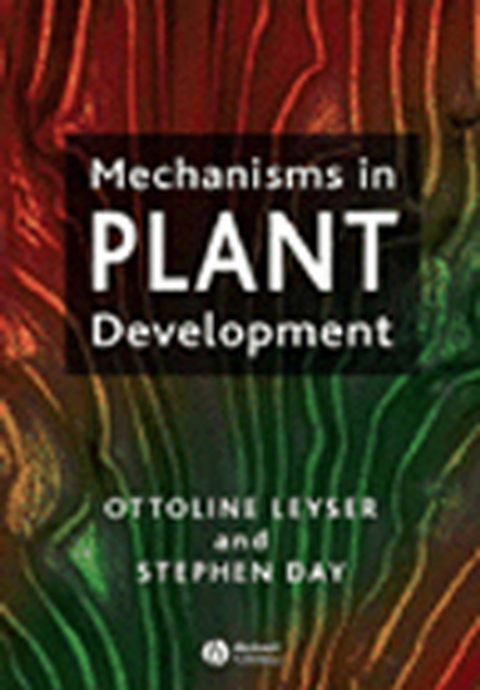
Mechanisms in Plant Development (eBook)
John Wiley & Sons (Verlag)
978-1-4443-1114-3 (ISBN)
Ottoline Leyser is a reader in plant developmental genetics at the University of York. Stephen Day is a science writer, also in York.
Preface, viii
Introduction, IX
Sources for Figures, xi
Chapter 1: An introduction to flowering plants, 1
Alternation of generations, 1
Gametophyte development, 1
Development of the sporophyte, 3
Further reading, 18
Chapter 2: Characteristics of plant development, 19
Plant cells, 19
Larger patterns, 24
Theoretical framework for the study of developmental mechanisms, 26
Conclusions, 27
Further reading, 27
Chapter 3: Cell-intrinsic information, 29
Lineage, 29
Case study 3.1: Laser ablation of cells in the Arabidopsis root tip, 34
Case study 3.2: Green-white-green periclinal chimeras, 36
Case study 3.3: Mutations affecting division patterns, 39
Relationship between age and position, 43
Case study 3.4: Mutations affecting the rate of leaf initiation in Arabidopsis, 44
Conclusions, 46
Further reading, 46
Chapter 4: Primary axis development, 48
Embryonic axes, 48
Case study 4.1: Longitudinal axis of the Fucus embryo, 49
Case study 4.2: Longitudinal axis of the Arabidopsis embryo, 54
Case study 4.3: Radial axis of the Arabidopsis embryo, 64
Conclusions, 71
Further reading, 71
Chapter 5: Axis development in the leaf and flower, 74
Leaves, 74
Case study 5.1: Adaxial-abaxial axis of the leaf, 75
Case study 5.2: Proximodistal axis of the leaf, 84
Case study 5.3: Determinate nature of leaf development, 87
Flowers, 91
Case study 5.4: Radial axis of the flower, 92
Case study 5.5: Adaxial-abaxial axis of the Antirrhinum flower, 100
Conclusions, 104
Further reading, 105
Chapter 6: Position relative to a particular cell, tissue or organ, 110
Case study 6.1: The pattern of trichomes on the Arabidopsis leaf, 111
Case study 6.2: The pattern of root hairs in Arabidopsis, 116
Case study 6.3: Phyllotaxy, 123
Case study 6.4: Coordination of leaf and vascular development, 131
Conclusions, 134
Further reading, 134
Chapter 7: Light, 138
Light perception, 138
Developmental responses to light, 143
Case study 7.1: Light-induced germination, 143
Case study 7.2: Seedling etiolation and photomorphogenesis, 146
Case study 7.3: Shade escape, 151
Case study 7.4: Phototropism, 154
Case study 7.5: Photoperiodic control of flowering, 156
Conclusions, 161
Further reading, 161
Chapter 8: Environmental information other than light, 165
Case study 8.1: Gravitropism, 165
Case study 8.2: Thigmomorphogenesis, 172
Case study 8.3: Effects of uneven nutrient supply on root development, 177
Case study 8.4: Vernalization, 180
Conclusions, 186
Further reading, 186
Chapter 9: The coordination of development, 190
Case study 9.1: Initiation and maintenance of the shoot apical meristem, 191
Case study 9.2: Transition from embryonic to post-embryonic development, 200
Case study 9.3: Phase transitions in post-germination development, 203
Case study 9.4: Shoot branching, 213
Conclusions, 219
Further reading, 220
Chapter 10: A comparison of plant and animal development, 224
Control of cell fate, 225
Development of pattern, 226
Consequences of autotrophy versus heterotrophy, 229
Conclusions, 230
Further reading, 230
Index, 233
| Erscheint lt. Verlag | 1.4.2009 |
|---|---|
| Sprache | englisch |
| Themenwelt | Naturwissenschaften ► Biologie ► Botanik |
| Naturwissenschaften ► Biologie ► Genetik / Molekularbiologie | |
| Technik | |
| Schlagworte | acquire • around • Biowissenschaften • Book • Botanik • CASE • Cells • continuous • Cycle • Different • Factors • forms • Framework • graduate courses • Life • Life Cycle • Life Sciences • many • mechanisms • Plant • plant science • Regulatory • similar • specific fates • Studies • undergraduate |
| ISBN-10 | 1-4443-1114-X / 144431114X |
| ISBN-13 | 978-1-4443-1114-3 / 9781444311143 |
| Informationen gemäß Produktsicherheitsverordnung (GPSR) | |
| Haben Sie eine Frage zum Produkt? |
 PDF (Adobe DRM)
Kopierschutz: Adobe-DRM
Adobe-DRM ist ein Kopierschutz, der das eBook vor Mißbrauch schützen soll. Dabei wird das eBook bereits beim Download auf Ihre persönliche Adobe-ID autorisiert. Lesen können Sie das eBook dann nur auf den Geräten, welche ebenfalls auf Ihre Adobe-ID registriert sind.
Details zum Adobe-DRM
Dateiformat: PDF (Portable Document Format)
Mit einem festen Seitenlayout eignet sich die PDF besonders für Fachbücher mit Spalten, Tabellen und Abbildungen. Eine PDF kann auf fast allen Geräten angezeigt werden, ist aber für kleine Displays (Smartphone, eReader) nur eingeschränkt geeignet.
Systemvoraussetzungen:
PC/Mac: Mit einem PC oder Mac können Sie dieses eBook lesen. Sie benötigen eine
eReader: Dieses eBook kann mit (fast) allen eBook-Readern gelesen werden. Mit dem amazon-Kindle ist es aber nicht kompatibel.
Smartphone/Tablet: Egal ob Apple oder Android, dieses eBook können Sie lesen. Sie benötigen eine
Geräteliste und zusätzliche Hinweise
Buying eBooks from abroad
For tax law reasons we can sell eBooks just within Germany and Switzerland. Regrettably we cannot fulfill eBook-orders from other countries.
aus dem Bereich