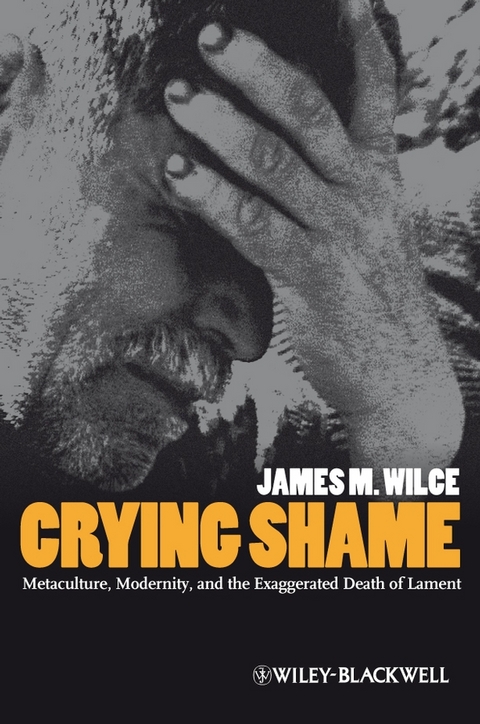
Crying Shame (eBook)
296 Seiten
John Wiley & Sons (Verlag)
978-1-4443-0625-5 (ISBN)
evidence, Crying Shame analyzes lament across thousands of
years and nearly every continent.
* Explores the enduring power of lament: expressing grief through
crying songs, often in a collective ritual context
* Draws on the author's extensive ethnographic fieldwork,
and unique long-term engagement and participation in the
phenomenon
* Offers a startling new perspective on the nature of modernity
and postmodernity
* An important addition to growing literature on cultural
globalization
James M. Wilce is Professor of Anthropology at Northern Arizona University. He has published a number of articles and is the author of Eloquence in Trouble: The Poetics and Politics of Complaint in Rural Bangladesh (1998) and Language and Emotion (forthcoming) and the editor of Social and Cultural Lives of Immune Systems (2003). Wilce serves on the editorial board of American Anthropologist and the Journal of Linguistic Anthropology. He is also the series editor for Blackwell Studies in Discourse and Culture.
Acknowledgments.
Preface.
1 Introduction.
PART I LOCATING LAMENT AS OBJECT.
Introduction.
2 For Crying Out Loud: What Is Lament Anyway?
3 Lament and Emotion.
4 Antiquity, Metaculture, and the Control of Lament.
PART II LOSING LAMENT: MODERNITY AS LOSS.
Introduction.
5 Cultural Amnesia and the Objectification of Lament in
Bangladesh.
6 Modern Transformations.
7 How Shame Spreads in Modernity.
8 Crying Backward: Primitivist Representations of Lament.
PART III REVIVING LAMENT: LAMENT AS KEY TROPE OF
MODERNITY.
Introduction.
9 Mourning Becomes the Electron's Age: Lamenting
Modernity(ies).
10 Lament's (Post)Modern Vertigo: Floating in a
Deterritorialized Media Sea.
11 Lament in a Postmodern World of "Revivals".
12 Conclusion.
Notes.
References.
Index.
"James Wilce's new book is a stunning attempt to present lament as
it currently exists cross-culturally." (Journal of Folklore
Research, 21 September 2011)
Wilce's book is fascinating for the range of cultures it
considers--from ancient Greece and pharaonic Egypt to rural
Bangladesh and Finland. Especially appealing are Wilce's dazzling
and creative conjunctions (such as Phil Spector's American
pop-cultural "wall of sound" as a way of appreciating polyphonic
funerary laments of the Amazonian rain forest). Wilce's personal
and scholarly engagement with the material successfully conveys the
nostalgia for emotional authenticity and the longing for
fully-lived life that haunt present-day globalized societies.
-David Pinault, author of Notes from the
Fortune-Telling Parrot: Islam and the Struggle for Religious
Pluralism in Pakistan
Crying Shame brings a broad range of scholarship to bear
on the subject of lament. Wilce not only offers a brilliant
synthesis of past and present scholarship, but argues persuasively
for the continuity of lament in new and surprising forms.
-Gail Holst-Warhaft, Cornell University
In this beautifully written work, alternately rueful and
ironically twinkling, Jim Wilce trains a laser-beam of attention on
a specific topic--the loss of lament--that turns out to
contain worlds. I can think of no recent book that offers so
insightful an overview of both traditional and postmodern aspects
of culture in the modern, globalized context. It is also an
exciting introduction to key theories and controversies in current
anthropology and cultural studies.
-Louis Sass, Professor of Clinical Psychology, Rutgers
University
In Crying Shame James Wilce writes eloquently of lament
practices as cultural performances that embody some of the deepest
cross-currents of modernity and postmodernity. ...a unique
combination of subtle analysis and global vision.
-Geoffrey White, University of Hawai'i, Manoa
| Erscheint lt. Verlag | 11.2.2009 |
|---|---|
| Sprache | englisch |
| Themenwelt | Geisteswissenschaften ► Archäologie |
| Geisteswissenschaften ► Sprach- / Literaturwissenschaft ► Sprachwissenschaft | |
| Sozialwissenschaften ► Ethnologie | |
| Sozialwissenschaften ► Soziologie | |
| Technik | |
| Schlagworte | Anthropologie • Anthropology • Linguistic Anthropology • Linguistische Anthropologie • Social & Cultural Anthropology • Soziale u. kulturelle Anthropologie |
| ISBN-10 | 1-4443-0625-1 / 1444306251 |
| ISBN-13 | 978-1-4443-0625-5 / 9781444306255 |
| Informationen gemäß Produktsicherheitsverordnung (GPSR) | |
| Haben Sie eine Frage zum Produkt? |
 PDF (Adobe DRM)
Kopierschutz: Adobe-DRM
Adobe-DRM ist ein Kopierschutz, der das eBook vor Mißbrauch schützen soll. Dabei wird das eBook bereits beim Download auf Ihre persönliche Adobe-ID autorisiert. Lesen können Sie das eBook dann nur auf den Geräten, welche ebenfalls auf Ihre Adobe-ID registriert sind.
Details zum Adobe-DRM
Dateiformat: PDF (Portable Document Format)
Mit einem festen Seitenlayout eignet sich die PDF besonders für Fachbücher mit Spalten, Tabellen und Abbildungen. Eine PDF kann auf fast allen Geräten angezeigt werden, ist aber für kleine Displays (Smartphone, eReader) nur eingeschränkt geeignet.
Systemvoraussetzungen:
PC/Mac: Mit einem PC oder Mac können Sie dieses eBook lesen. Sie benötigen eine
eReader: Dieses eBook kann mit (fast) allen eBook-Readern gelesen werden. Mit dem amazon-Kindle ist es aber nicht kompatibel.
Smartphone/Tablet: Egal ob Apple oder Android, dieses eBook können Sie lesen. Sie benötigen eine
Geräteliste und zusätzliche Hinweise
Buying eBooks from abroad
For tax law reasons we can sell eBooks just within Germany and Switzerland. Regrettably we cannot fulfill eBook-orders from other countries.
aus dem Bereich