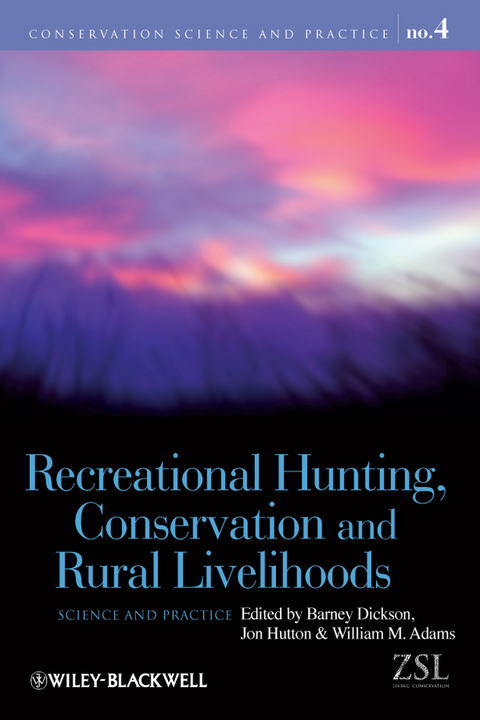
Recreational Hunting, Conservation and Rural Livelihoods (eBook)
384 Seiten
John Wiley & Sons (Verlag)
978-1-4443-0318-6 (ISBN)
For the first time, this book addresses many of the issues that are fundamental to an understanding of the real role of recreational hunting in conservation and rural development. It examines the key issues, asks the difficult questions, and seeks to present the answers to guide policy. Where the answers are not available, it highlights gaps in our knowledge and lays out the research agenda for the next decade.
Barney Dickson has recently taken up a post with UNEP World Conservation Monitoring Centre. Before that he was Head of International Policy at Fauna & Flora International where he worked on a range of international conservation policy issues, including conservation and poverty reduction, sustainable use and the trade in wild species. Jon Hutton is Director of the UNEP World Conservation Monitoring Centre based in Cambridge, UK. He is on the Steering Committee of IUCN's Species Survival Commission, Chair of its Sustainable Use Specialist Group and Honorary Professor of Sustainable Resource Use with the Durrell Institute of Conservation and Ecology. Bill Adams is Moran Professor of Conservation and Development. He is based in the Department of Geography at the University of Cambridge, where he has taught since 1984. His research focuses on the social dimensions of conservation in Africa and the UK. He is a Trustee of Fauna & Flora International.
Notes on contributors.
Acknowledgements.
Preface.
Part 1 Conservation and Hunting.
1. Conservation and hunting: friends or foes? N.
Leader-Williams.
2. An overview of recreational hunting in North America, Europe
and Australia Robin Sharp and Kai Wollscheid.
3. Recreational fisheries: socio-economic importance,
conservation issues and management challenges Robert Arlinghaus and
Steven J. Cooke.
4. The ethics of recreational hunting Barney Dickson.
Part 2 Science.
5. The science of sustainable hunting E.J.Milner-Gulland, Nils
Bunnefeld and Gil Proaktor.
6. Guns, sheep and genes: when and why trophy hunting may be a
selective pressure Marco Festa-Bianchet and Ray Lee.
7. Science and the recreational hunting of lions Andrew
Loveridge, Craig Packer and Adam Dutton.
Part 3 Livelihoods.
8. Sportsman's shot, poacher's pot: hunting, local
people and the history of conservation William M. Adams.
9. Exploitation prevents extinction: Case study of endangered
Himalayan sheep and goats Michael R. Frisina & Sardar Naseer A.
Tareen.
10. Community benefits from safari hunting and related
activities in southern Africa Brian T.B. Jones.
Part 4 Policy and Practice.
11. Conservation values from falconry Robert E. Kenward.
12. Gamebird science, agricultural policy and biodiversity
conservation in lowland UK Nicholas J. Aebischer.
13. The re-introduction of recreational hunting in Uganda
Richard H. Lamprey and Arthur Mugisha.
14. Does recreational hunting conflict with photo-tourism?
Richard Davies, Kas Hamman and Hector Magome.
Part 5 Governance.
15. When does hunting contribute to conservation & rural
development? Bill Wall and Brian Child.
16. Recreational hunting and sustainable wildlife use in North
America Shane Patrick Mahoney.
17. The development of a recreational hunting industry and its
relationship with conservation in southern Africa Vernon R. Booth
and David H.M. Cumming.
18. The influence of corruption on the conduct of recreational
hunting N. Leader-Williams, R.D. Baldus and R.J. Smith.
Part 6 Regulation and Certification.
19. Regulation and recreational hunting Alison M. Rosser.
20. The application of certification to hunting: a case for
simplicity Brian Child and Bill Wall.
Conclusion.
21. Conservation, Livelihoods and Recreational Hunting: Issues
and Strategies William M Adams, Barney Dickson, Holly Dublin and
Jon Hutton.
Index
| Erscheint lt. Verlag | 22.1.2009 |
|---|---|
| Reihe/Serie | Conservation Science and Practice | Conservation Science and Practice |
| Sprache | englisch |
| Themenwelt | Sachbuch/Ratgeber ► Sport |
| Naturwissenschaften ► Biologie ► Ökologie / Naturschutz | |
| Naturwissenschaften ► Geowissenschaften ► Geologie | |
| Sozialwissenschaften ► Soziologie | |
| Technik | |
| Schlagworte | Biowissenschaften • Conservation Science • Life Sciences • Naturschutzbiologie |
| ISBN-10 | 1-4443-0318-X / 144430318X |
| ISBN-13 | 978-1-4443-0318-6 / 9781444303186 |
| Informationen gemäß Produktsicherheitsverordnung (GPSR) | |
| Haben Sie eine Frage zum Produkt? |
 PDF (Adobe DRM)
Kopierschutz: Adobe-DRM
Adobe-DRM ist ein Kopierschutz, der das eBook vor Mißbrauch schützen soll. Dabei wird das eBook bereits beim Download auf Ihre persönliche Adobe-ID autorisiert. Lesen können Sie das eBook dann nur auf den Geräten, welche ebenfalls auf Ihre Adobe-ID registriert sind.
Details zum Adobe-DRM
Dateiformat: PDF (Portable Document Format)
Mit einem festen Seitenlayout eignet sich die PDF besonders für Fachbücher mit Spalten, Tabellen und Abbildungen. Eine PDF kann auf fast allen Geräten angezeigt werden, ist aber für kleine Displays (Smartphone, eReader) nur eingeschränkt geeignet.
Systemvoraussetzungen:
PC/Mac: Mit einem PC oder Mac können Sie dieses eBook lesen. Sie benötigen eine
eReader: Dieses eBook kann mit (fast) allen eBook-Readern gelesen werden. Mit dem amazon-Kindle ist es aber nicht kompatibel.
Smartphone/Tablet: Egal ob Apple oder Android, dieses eBook können Sie lesen. Sie benötigen eine
Geräteliste und zusätzliche Hinweise
Buying eBooks from abroad
For tax law reasons we can sell eBooks just within Germany and Switzerland. Regrettably we cannot fulfill eBook-orders from other countries.
aus dem Bereich