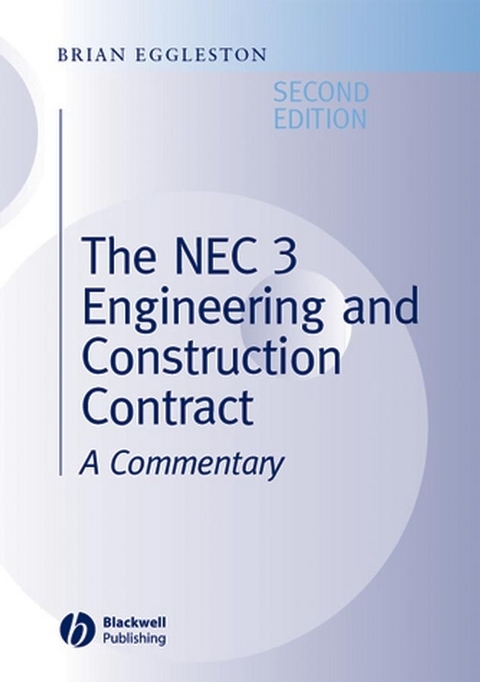
NEC 3 Engineering and Construction Contract (eBook)
392 Seiten
Wiley (Verlag)
978-1-4051-7282-0 (ISBN)
From its launch in 1991 the New Engineering Contract has rapidly overtaken traditional building and civil engineering contracts to become the UK's leading standard form for major construction projects. Additionally, under the generic title NEC 3, there is now a family of New Engineering Contract standard forms.
This book provides a detailed commentary on the latest edition of the main form - NEC 3 Engineering and Construction Contract. It explains how the contract is intended to operate and examines each clause to consider its application and legal interpretation. It draws upon the author's successful book on the second edition of the Engineering and Construction Contract, ECC 2, and it identifies and comments on the changes between ECC 2 and NEC 3.
Particular attention is given to the revised compensation event procedures in NEC3, with five chapters of the book devoted to this subject. In-depth analysis is also given to:
- The role of the project manager
- The obligations of the parties
- The liabilities of the parties
- The revised dispute resolution procedures
Brian Eggleston, CEng, FICE, FIStructE, FCIArb is a registered arbitrator.
Now Available in Paperback From its launch in 1991 the New Engineering Contract has rapidly overtaken traditional building and civil engineering contracts to become the UK's leading standard form for major construction projects. Additionally, under the generic title NEC 3, there is now a family of New Engineering Contract standard forms. This book provides a detailed commentary on the latest edition of the main form - NEC 3 Engineering and Construction Contract. It explains how the contract is intended to operate and examines each clause to consider its application and legal interpretation. It draws upon the author's successful book on the second edition of the Engineering and Construction Contract, ECC 2, and it identifies and comments on the changes between ECC 2 and NEC 3. Particular attention is given to the revised compensation event procedures in NEC3, with five chapters of the book devoted to this subject. In-depth analysis is also given to: The role of the project manager The obligations of the parties The liabilities of the parties The revised dispute resolution procedures
Brian Eggleston, CEng, FICE, FIStructE, FCIArb is a registered arbitrator.
Contents 7
Preface 13
Author’s note 15
1 Introduction 17
1.1 Development of NEC contracts 17
1.2 Characteristics of NEC contracts 18
1.3 Structure of the NEC 3 Engineering and Construction Contract 20
1.4 Feedback from ECC 2 21
1.5 Changes from ECC 2 22
1.6 Points of interest in NEC 3 23
2 Main options 27
2.1 Introduction 27
2.2 Contract strategy 28
2.3 Option A – priced contract with activity schedule 34
2.4 Option B – priced contract with bill of quantities 37
2.5 Target contracts generally 38
2.6 Options C and D – target contracts 41
2.7 Option E – cost reimbursable contract 42
2.8 Option F – management contract 43
2.9 Option W1 – dispute resolution 43
2.10 Option W2 – dispute resolution 44
3 Secondary option clauses 46
3.1 Introduction 46
3.2 Option X1 – price adjustment for in.ation 48
3.3 Option X2 – changes in the law 48
3.4 Option X3 – multiple currencies 49
3.5 Option X4 – parent company guarantee 50
3.6 Option X5 – sectional completion 51
3.7 Option X6 – bonus for early completion 52
3.8 Option X7 – delay damages 53
3.9 Option X12 – partnering 58
3.10 Option X13 – performance bond 60
3.11 Option X14 – advanced payment to the contractor 61
3.12 Option X15 – limitation of contractor’s liability for design 63
3.13 Option X16 – retention 64
3.14 Option X17 – low performance damages 66
3.15 Option X18 – limitation of liability 67
3.16 Option X20 – key performance indicators 70
3.17 Option Y(UK)2 – Housing Grants, Construction and Regeneration Act 1996 71
3.18 Option Y(UK)3 – Contracts (Rights of Third Parties) Act 1999 72
3.19 Option Z1 – additional conditions 72
4 Contract documents 74
4.1 Introduction 74
4.2 Entire agreements 75
4.3 Clause 12.4 of NEC 3 76
4.4 Construction of contracts generally 76
4.5 NEC 3 documentation 77
4.6 Essential contract documents 78
4.7 Identified and defined terms 80
4.8 The contract date 80
4.9 Works information 82
4.10 Site information 85
4.11 Contract data 87
4.12 Schedules of cost components 87
4.13 Ambiguities and inconsistencies in the contract documents 90
4.14 Schedule of clauses referring to the works information 91
5 Key players 95
5.1 Introduction 95
5.2 Others 97
5.3 Actions 98
5.4 The employer 101
5.5 Express obligations of the employer 102
5.6 The project manager 103
5.7 Express duties of the project manager 106
5.8 The supervisor 110
5.9 Express duties of the supervisor 111
5.10 Communications 111
5.11 The project manager and the supervisor 116
6 General core clauses 118
6.1 Introduction 118
6.2 Actions 119
6.3 Identified and defined terms 119
6.4 Interpretation and the law 129
6.5 Communications etc. 131
6.6 Instructions 131
6.7 Adding to the working areas 131
6.8 Early warning 132
6.9 Ambiguities and inconsistencies 135
6.10 Illegal and impossible requirements 136
6.11 Prevention 137
7 Obligations and responsibilities of the contractor 142
7.1 Introduction 142
7.2 Design obligations, responsibilities and liabilities 145
7.3 Providing the works 147
7.4 The contractor’s design 149
7.5 Using the contractor’s design 152
7.6 Design of equipment 152
7.7 People 153
7.8 Working with the employer and others 154
7.9 Subcontracting 156
7.10 Other responsibilities 159
7.11 Express obligations of the contractor 161
7.12 Express prohibitions on the contractor 165
8 Time (and related matters) 167
8.1 Introduction 167
8.2 Starting and completion 170
8.3 Programmes 172
8.4 Revision of programmes 175
8.5 Shortened programmes 177
8.6 Access to and use of the site 178
8.7 Instructions to stop or not to start work 179
8.8 Take-over 181
8.9 Acceleration 183
9 Testing and defects 186
9.1 Introduction 186
9.2 Definitions and certificates 189
9.3 Tests and inspections 193
9.4 Testing and inspection before delivery 195
9.5 Searching and notifying defects 196
9.6 Correcting defects 198
9.7 Accepting defects 200
9.8 Uncorrected defects 201
10 Payments 204
10.1 Introduction 204
10.2 Assessing the amount due 207
10.3 Payments 210
10.4 Defined cost 213
10.5 Payments – main option A 213
10.6 Payments – main option B 217
10.7 Payments – main option C 218
10.8 Payments – main option D 223
10.9 Payments – main option E 223
10.10 Payments – main option F 224
11 NEC 3 compensation event schemes 226
11.1 Introduction 226
11.2 Changes in NEC 3 (from ECC 2) 228
11.3 Outline of procedures 232
11.4 Defining a compensation event 233
11.5 Compensation events as exclusive remedies 233
11.6 Fairness of the compensation event procedures 234
11.7 Unusual features of the compensation event procedures 235
12 Listed compensation events 236
12.1 Introduction 236
12.2 Omissions from the listed events 237
12.3 Works information related events 237
12.4 Employer’s default events 240
12.5 Employer’s risk events 242
12.6 Project manager/supervisor related events 243
12.7 Physical conditions 247
12.8 Adverse weather 250
12.9 Prevention 251
12.10 Measurement related events 252
12.11 Secondary option clause events 238 254
13 Notifying compensation events 257
13.1 Introduction 257
13.2 Notifications by the project manager 258
13.3 Notifications by the contractor 260
13.4 Project manager’s response to notifications 264
13.5 Last date for notification of compensation events 267
14 Quotations for compensation events 269
14.1 Introduction 269
14.2 Instructions to submit quotations 272
14.3 Instructions for alternative quotations 275
14.4 Submission of quotations 276
14.5 Status of the contractor’s quotations 278
15 Assessment of compensation events 281
15.1 Introduction 281
15.2 Changes from ECC 2 282
15.3 General assessment rules 283
15.4 Particular assessment rules 290
15.5 The project manager’s assessments 294
15.6 Implementing compensation events 296
15.7 Other .nancial remedies 297
16 Title 299
16.1 Introduction 299
16.2 Employer’s title to equipment, plant and materials 300
16.3 Marking equipment, plant and materials 301
16.4 Removing equipment 301
16.5 Objects and materials within the site 302
17 Risks and insurances 304
17.1 Introduction 304
17.2 Employer’s risks 308
17.3 Contractor’s risks 311
17.4 Repairs 311
17.5 Indemnity 312
17.6 Insurance cover 312
17.7 Insurance policies 313
17.8 Contractor’s failure to insure 314
17.9 Insurance by the employer 314
18 Termination 316
18.1 Introduction 316
18.2 Summary of NEC 3 termination provisions 320
18.3 Termination for ‘any reason’ 321
18.4 Termination under section 9 322
18.5 Reasons for termination 324
18.6 Procedures on termination 328
18.7 Amounts due on termination 329
19 Dispute resolution 331
19.1 Introduction 331
19.2 Developments in dispute resolution 332
19.3 Meaning of dispute 333
19.4 Adjudication under Option W1 335
19.5 Adjudication under Option W2 345
19.6 Review by the tribunal 349
19.7 The Adjudicator’s Contract 352
20 NEC 3 Engineering and Construction Subcontract 353
20.1 Introduction 353
20.2 Core clauses – general 355
20.3 Core clauses – the subcontractor’s main responsibilities 356
20.4 Core clauses – time 356
20.5 Core clauses – testing and defects 357
20.6 Core clauses – payment 357
20.7 Core clauses – compensation events 358
20.8 Core clauses – title 359
20.9 Core clauses – risks and insurance 359
20.10 Core clauses – termination 359
20.11 Dispute resolution 360
21 NEC 3 family of contracts 361
21.1 The contracts 361
21.2 NEC 3 Short Contract and Short Subcontract 362
21.3 NEC 3 Term Service Contract 364
21.4 NEC 3 Framework Contract 368
21.5 NEC 3 Professional Services Contract 368
21.6 NEC 3 Adjudicator’s Contract 370
21.7 Concluding comment 370
Table of cases 371
Table of clause references 375
'Eggleston is the author of a number of highly successfulguides to engineering contracts [...] he writes with acertainty and facility that commends him to many practising lawyersand with an ease which makes him highly readable for otherconstruction professionals. Given its readability andperceptiveness, Eggleston can be thoroughly recommended to allconstruction professionals.' - Paul Newman,Construction Law
'A very useful and helpful guide.' - FionaHammond, Legal Advisor, BAA plc
'Brian Eggleston's books are always good. This oneis unique, as the only analysis on this contract that is bothdetailed and fair. The light it shines is startlinglyrevealing.' - Robert Fenwick Elliott, Fenwick Elliott,Solicitors
'Those who pride themselves on a comprehensive law library willbuy this book straightaway. Others would be well advised to buy itas soon as they are faced with the prospect of an NEC project.' -Construction Industry Law Letter
'everyone involved in projects using the NEC should have a copy'Building Magazine
| Erscheint lt. Verlag | 15.4.2008 |
|---|---|
| Sprache | englisch |
| Themenwelt | Recht / Steuern ► EU / Internationales Recht |
| Recht / Steuern ► Privatrecht / Bürgerliches Recht | |
| Technik ► Bauwesen | |
| Schlagworte | Bauingenieur- u. Bauwesen • Baurecht • Civil Engineering & Construction • construction law |
| ISBN-10 | 1-4051-7282-7 / 1405172827 |
| ISBN-13 | 978-1-4051-7282-0 / 9781405172820 |
| Informationen gemäß Produktsicherheitsverordnung (GPSR) | |
| Haben Sie eine Frage zum Produkt? |
 PDF (Adobe DRM)
Größe: 2,4 MB
Kopierschutz: Adobe-DRM
Adobe-DRM ist ein Kopierschutz, der das eBook vor Mißbrauch schützen soll. Dabei wird das eBook bereits beim Download auf Ihre persönliche Adobe-ID autorisiert. Lesen können Sie das eBook dann nur auf den Geräten, welche ebenfalls auf Ihre Adobe-ID registriert sind.
Details zum Adobe-DRM
Dateiformat: PDF (Portable Document Format)
Mit einem festen Seitenlayout eignet sich die PDF besonders für Fachbücher mit Spalten, Tabellen und Abbildungen. Eine PDF kann auf fast allen Geräten angezeigt werden, ist aber für kleine Displays (Smartphone, eReader) nur eingeschränkt geeignet.
Systemvoraussetzungen:
PC/Mac: Mit einem PC oder Mac können Sie dieses eBook lesen. Sie benötigen eine
eReader: Dieses eBook kann mit (fast) allen eBook-Readern gelesen werden. Mit dem amazon-Kindle ist es aber nicht kompatibel.
Smartphone/Tablet: Egal ob Apple oder Android, dieses eBook können Sie lesen. Sie benötigen eine
Geräteliste und zusätzliche Hinweise
Zusätzliches Feature: Online Lesen
Dieses eBook können Sie zusätzlich zum Download auch online im Webbrowser lesen.
Buying eBooks from abroad
For tax law reasons we can sell eBooks just within Germany and Switzerland. Regrettably we cannot fulfill eBook-orders from other countries.
aus dem Bereich