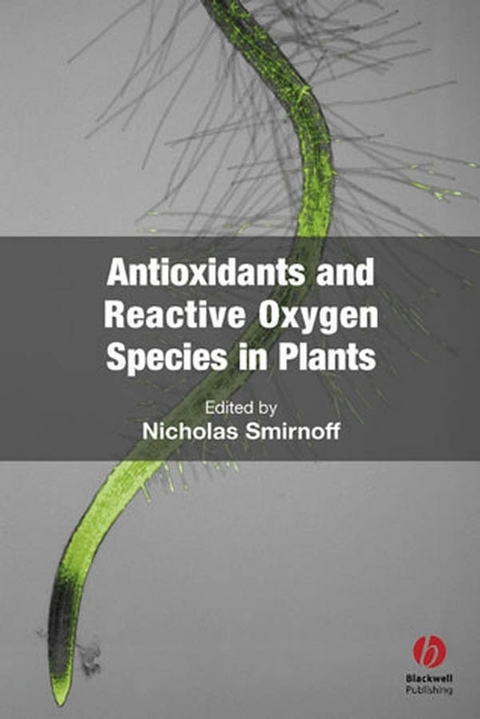
Antioxidants and Reactive Oxygen Species in Plants (eBook)
320 Seiten
John Wiley & Sons (Verlag)
978-1-4051-7146-5 (ISBN)
This book covers these new developments, generally focussing on molecular and biochemical details and providing a point of entry to the detailed literature. It is directed at researchers and professionals in plant molecular biology, biochemistry and cell biology, in both the academic and industrial sectors.
Dr Nicholas Smirnoff is at the School of Biological and Chemical Sciences, University of Exeter, UK
1. Glutathione.
Christine H. Foyer, Leonardo Gomez and Philippus D. R. van
Heerden, Rothamsted Research, Harpenden, UK.
2. Plant thiol enzymes and thiol homeostasis in relation to
thiol-dependent redox regulation and oxidative stress.
Karl-Josef Dietz, Lehrstuhl für Biochemie und Physiologie
der Pflanzen, Fakultät für Biologie, Universität
Bielefeld, Germany.
3. Ascorbate, tocopherol and carotenoids: metabolism, pathway
engineering and functions.
Nicholas Smirnoff, School of Biological and Chemical Sciences,
University of Exeter, UK.
4. Ascorbate peroxidase.
Ron Mittler, Department of Biochemistry, University of Nevada,
Reno, USA and Thomas L. Poulos, Department of Molecular Biology and
Biochemistry, University of California, Irvine, USA.
5. Catalases in plants: molecular and functional properties and
role in stress defence.
Jürgen Feierabend, Institute of Botany, J. W. Goethe
Universität, Frankfurt, Germany.
6. Phenolics as antioxidants.
Stepehen C. Grace, Biology Department, University of Arkansas at
Little Rock, Arkansas, USA.
7. Reactive oxygen species as signalling molecules.
Radhika Desikan, John Hancock and Steven Neill, Centre for
Research in Plant Science, University of the West of England,
Bristol, UK.
8. Reactive oxygen species in plant development and pathogen
defence.
Mark A. Jones and Nicholas Smirnoff, School of Biological and
Chemical Sciences, University of Exeter, UK.
9. Reactive oxygen species in cell walls.
Robert A. M. Vreeburg and Stephen C. Fry, School of Biological
Sciences, University of Edinburgh, UK.
10. Reactive oxygen species and photosynthesis.
Barry Logan, Biology Department, Bowdoin College, Brunswick,
Maine, USA.
11. Plant responses to ozone.
Pinja Jaspers, Hannes Kollist, Christian Langebartels, and
Jaakko Kangasjärvi, Department of Biological and Environmental
Sciences, University of Helsinki, Finland.
References.
Index
Antioxidants and Reactive Oxygen Species in Plants summarizes much
recent research in to the role of reactive oxygen species (ROS) in
plant metabolism, underling the important role of ROS as signalling
molecules in plant growth and development and in plant responses to
biotic and abiotic stress. It provides a solid background for
research workers involved in this field of investigation and
comprises eleven chapters written by twenty authors, all of whom
are recognized scientists with notable achievements in research
into antioxidants and oxygen stress.
The great value of the book is that it reflects recent marked
changes in our view of ROS.
The book will be very useful not only for researchers directly
involved in ROS and antioxidants investigations, but also to those
who are entering the field, since each chapter has a brief
introduction with definitions and an explanation of the problem. I
can certainly recommend Antioxidants and Reactive Oxygen Species in
Plants to graduate students with a background in plant molecular
biology, biochemistry and environmental biology and who have an
interest in the growing significance of ROS in so many aspects of
plant life.
Anna M. Rychter
| Erscheint lt. Verlag | 8.5.2008 |
|---|---|
| Reihe/Serie | Biological Sciences Series | Biological Sciences Series |
| Sprache | englisch |
| Themenwelt | Naturwissenschaften ► Biologie ► Botanik |
| Technik | |
| Schlagworte | Biowissenschaften • Botanik / Biochemie • Life Sciences • plant biochemistry |
| ISBN-10 | 1-4051-7146-4 / 1405171464 |
| ISBN-13 | 978-1-4051-7146-5 / 9781405171465 |
| Informationen gemäß Produktsicherheitsverordnung (GPSR) | |
| Haben Sie eine Frage zum Produkt? |
 PDF (Adobe DRM)
Kopierschutz: Adobe-DRM
Adobe-DRM ist ein Kopierschutz, der das eBook vor Mißbrauch schützen soll. Dabei wird das eBook bereits beim Download auf Ihre persönliche Adobe-ID autorisiert. Lesen können Sie das eBook dann nur auf den Geräten, welche ebenfalls auf Ihre Adobe-ID registriert sind.
Details zum Adobe-DRM
Dateiformat: PDF (Portable Document Format)
Mit einem festen Seitenlayout eignet sich die PDF besonders für Fachbücher mit Spalten, Tabellen und Abbildungen. Eine PDF kann auf fast allen Geräten angezeigt werden, ist aber für kleine Displays (Smartphone, eReader) nur eingeschränkt geeignet.
Systemvoraussetzungen:
PC/Mac: Mit einem PC oder Mac können Sie dieses eBook lesen. Sie benötigen eine
eReader: Dieses eBook kann mit (fast) allen eBook-Readern gelesen werden. Mit dem amazon-Kindle ist es aber nicht kompatibel.
Smartphone/Tablet: Egal ob Apple oder Android, dieses eBook können Sie lesen. Sie benötigen eine
Geräteliste und zusätzliche Hinweise
Buying eBooks from abroad
For tax law reasons we can sell eBooks just within Germany and Switzerland. Regrettably we cannot fulfill eBook-orders from other countries.
aus dem Bereich