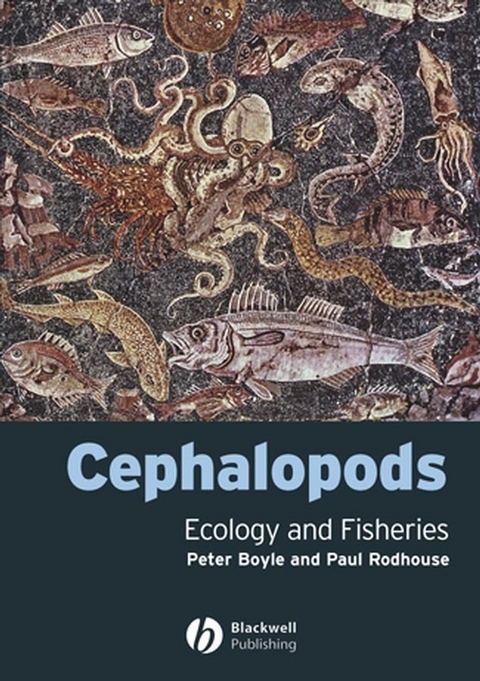
Cephalopods (eBook)
464 Seiten
John Wiley & Sons (Verlag)
978-1-4051-4543-5 (ISBN)

Cephalopods: ecology and fisheries is a thorough review of this most important animal group. The first introductory section of the book provides coverage of cephalopod form and function, origin and evolution, Nautilus, and biodiversity and zoogeography. The following section covers life cycles, growth, physiological ecology, reproductive strategies and early life histories. There follows a section on ecology, which provides details of slope and shelf species, oceanic and deep sea species, population ecology, trophic ecology and cephalopods as prey. The final section of the book deals with fisheries and ecological interactions, with chapters on fishing methods and scientific sampling, fisheries resources, fisheries oceanography and assessment and management methods.
This scientifically comprehensive and beautifully illustrated book is essential reading for marine biologists, zoologists, ecologists and fisheries managers. All libraries in universities and research establishments where biological sciences and fisheries are studied and taught should have multiple copies of this landmark publication on their shelves.
Peter Boyle is the author of Cephalopods: Ecology and Fisheries, published by Wiley. Paul Rodhouse is the author of Cephalopods: Ecology and Fisheries, published by Wiley.
Preface.
Acknowledgements.
Introduction.
Form and Function.
Origin and Evolution.
Nautilus: The Survivor.
Biodiversity and Zoogeography.
Life Cycle.
Growth.
Physiological Ecology.
Reproductive.
From Egg to Recruitment.
Coastal and Shelf Species.
Oceanic and Deep-Sea Species.
Cephalopods as Predators.
Cephalopods as Prey.
Fishing Methods and Scientific Sampling.
Fishery Resources.
Fisheries Oceanography.
Assessment and Management.
Conclusions.
Appendix A: Classification of Living Cephalopod Families.
Appendix B: Synopsis of Living Cephalopod Families.
References.
Index.
"This splendid book offers much more than what its title seems to
promise!
The wider biological background is explained in a sequence of
lucidly structured, superbly illustrated chapters.
The authors have perfectly succeeded in writing a book for
students and researchers as well as for lay readers interested in
marine zoology. This comprehensive treatment of the most exotic
group of marine molluscs is likely to become indispensible reading
for zoology classes at undergraduate and graduate levels. Above all
it is a very rich source of information, a true vademecum for
anyone interested in squid, cuttlefish and octopus."
Vie et Milieu, 2006
"This book provides a thorough review of this most important
animal group.
This comprehensive and well-illustrated book is essential
reading for marine biologists, zoologists, ecologists and fisheries
managers."
CAB Abstracts, 2006
"This is a fascinating book, providing for fish
biologists a readable and comprehensive review of a parallel and
rival universe of cephalopod adaptiveness, life-style and
significance in marine ecosystems. It is undoubtedly an essential
text and reference."
Journal of Fish Biology, 2006
"For many years to come, this book will surely be essential
reading not only for cephalopod biologists, but for anyone
interested in marine biology, ecology, and fisheries
science."
Quarterly Review of Biology, 2006
'This book is a good starting point for any student
interested in studying cephalopods. It also gives those that
specialise in a particular area of cephalopod research a broad
overview of other areas that they may know little or nothing
about'
Journal of Experimental Marine Biology and Ecology,
2007
'It is a well presented book that uses an abundance of graphs
and diagrams to illustrate the text, maps to show lifecycle
migration, colour photos to show composite satellite images of
fishing lights and to illustrate the use of camouflage. Key
morphological characters that can be used to identify
cephalopods'
Journal of Experimental Marine Biology and Ecology,
2007
'I recommend that everyone with an interest in cephalopods
reads this book from beginning to end because one will find
information of interest to them that they would not think to look
for'
Journal of Experimental Marine Biology and Ecology,
2007
| Erscheint lt. Verlag | 8.5.2008 |
|---|---|
| Sprache | englisch |
| Themenwelt | Naturwissenschaften ► Biologie ► Zoologie |
| Technik | |
| Weitere Fachgebiete ► Land- / Forstwirtschaft / Fischerei | |
| Schlagworte | Animal Science & Zoology • Aquaculture, Fisheries & Fish Science • Aquakultur, Fischereiwesen u. Fischforschung • Biowissenschaften • Crustaceans & Mollusks • Krusten- u. Weichtiere • Life Sciences • Zoologie |
| ISBN-10 | 1-4051-4543-9 / 1405145439 |
| ISBN-13 | 978-1-4051-4543-5 / 9781405145435 |
| Informationen gemäß Produktsicherheitsverordnung (GPSR) | |
| Haben Sie eine Frage zum Produkt? |
 PDF (Adobe DRM)
Kopierschutz: Adobe-DRM
Adobe-DRM ist ein Kopierschutz, der das eBook vor Mißbrauch schützen soll. Dabei wird das eBook bereits beim Download auf Ihre persönliche Adobe-ID autorisiert. Lesen können Sie das eBook dann nur auf den Geräten, welche ebenfalls auf Ihre Adobe-ID registriert sind.
Details zum Adobe-DRM
Dateiformat: PDF (Portable Document Format)
Mit einem festen Seitenlayout eignet sich die PDF besonders für Fachbücher mit Spalten, Tabellen und Abbildungen. Eine PDF kann auf fast allen Geräten angezeigt werden, ist aber für kleine Displays (Smartphone, eReader) nur eingeschränkt geeignet.
Systemvoraussetzungen:
PC/Mac: Mit einem PC oder Mac können Sie dieses eBook lesen. Sie benötigen eine
eReader: Dieses eBook kann mit (fast) allen eBook-Readern gelesen werden. Mit dem amazon-Kindle ist es aber nicht kompatibel.
Smartphone/Tablet: Egal ob Apple oder Android, dieses eBook können Sie lesen. Sie benötigen eine
Geräteliste und zusätzliche Hinweise
Buying eBooks from abroad
For tax law reasons we can sell eBooks just within Germany and Switzerland. Regrettably we cannot fulfill eBook-orders from other countries.
aus dem Bereich