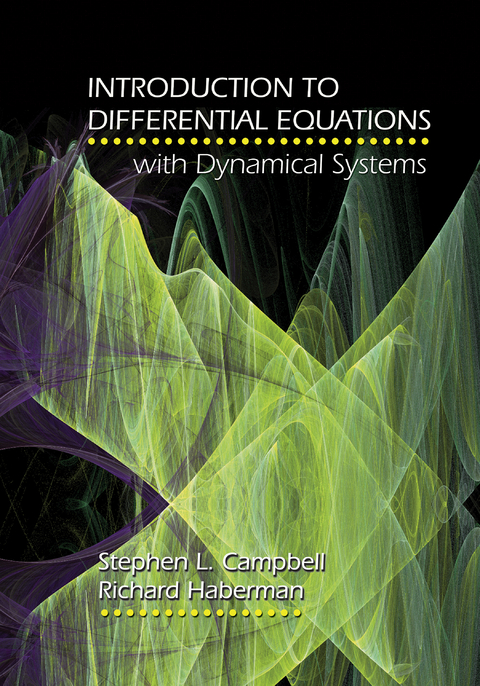
Introduction to Differential Equations with Dynamical Systems (eBook)
Princeton University Press (Verlag)
978-1-4008-4132-5 (ISBN)
Stephen L. Campbell is professor of mathematics and director of the graduate program in mathematics at North Carolina State University. Richard Haberman is professor of mathematics at Southern Methodist University. Campbell and Haberman are prolific researchers in applied mathematics and the authors of a number of textbooks.
| Erscheint lt. Verlag | 14.10.2011 |
|---|---|
| Zusatzinfo | 150 line illus. |
| Verlagsort | Princeton |
| Sprache | englisch |
| Themenwelt | Mathematik / Informatik ► Mathematik ► Analysis |
| Technik | |
| Schlagworte | Addition • algebraic equation • Amplitude • Approximation • Asymptote • Calculation • capacitor • Cartesian coordinate system • chain rule • Change of variables • Characteristic equation • Characteristic Polynomial • clockwise • coefficient • complex number • continuous function • Convolution Theorem • coordinate system • Damping • Derivative • Determinant • Diagram (category theory) • differential equation • Differential (infinitesimal) • Dimension • Dirac delta function • Division by zero • Dynamical system • Eigenvalues and Eigenvectors • Electrical Engineering • Equation • Equilibrium Point • Euler equations (fluid dynamics) • Euler's formula • exponential growth • Forcing function (differential equations) • Function (mathematics) • Green's Function • Heaviside step function • Homogeneous differential equation • Hooke's law • Initial Condition • Initial Value Problem • Integrating factor • inverse Laplace transform • Laplace transform • Linear combination • linear differential equation • linear equation • Linearization • linear stability • logistic function • logistic map • Lyapunov stability • Mathematical problem • Mathematics • Matrix (mathematics) • matrix multiplication • Matrix theory (physics) • Maxima and minima • Method of undetermined coefficients • Newton's laws of motion • nonlinear system • Notation • Numerical analysis • Numerical Integration • Numerical methods for ordinary differential equations • ordinary differential equation • Oscillation • Parameter • partial derivative • Partial fraction decomposition • Periodic function • Phase line (mathematics) • phase plane • polynomial • Proportionality (mathematics) • Quadratic • quadratic function • Quantity • Reduction of order • resistor • Saddle point • scientific notation • separation of variables • Special case • step function • Summation • system of linear equations • Taylor series • Theorem • Trigonometric Functions • uniqueness theorem • Upper half-plane • Variable (mathematics) • Vector field • voltage drop • Voltage source • Wronskian • Zero of a function |
| ISBN-10 | 1-4008-4132-1 / 1400841321 |
| ISBN-13 | 978-1-4008-4132-5 / 9781400841325 |
| Informationen gemäß Produktsicherheitsverordnung (GPSR) | |
| Haben Sie eine Frage zum Produkt? |
 EPUB (Adobe DRM)
Kopierschutz: Adobe-DRM
Adobe-DRM ist ein Kopierschutz, der das eBook vor Mißbrauch schützen soll. Dabei wird das eBook bereits beim Download auf Ihre persönliche Adobe-ID autorisiert. Lesen können Sie das eBook dann nur auf den Geräten, welche ebenfalls auf Ihre Adobe-ID registriert sind.
Details zum Adobe-DRM
Dateiformat: EPUB (Electronic Publication)
EPUB ist ein offener Standard für eBooks und eignet sich besonders zur Darstellung von Belletristik und Sachbüchern. Der Fließtext wird dynamisch an die Display- und Schriftgröße angepasst. Auch für mobile Lesegeräte ist EPUB daher gut geeignet.
Systemvoraussetzungen:
PC/Mac: Mit einem PC oder Mac können Sie dieses eBook lesen. Sie benötigen eine
eReader: Dieses eBook kann mit (fast) allen eBook-Readern gelesen werden. Mit dem amazon-Kindle ist es aber nicht kompatibel.
Smartphone/Tablet: Egal ob Apple oder Android, dieses eBook können Sie lesen. Sie benötigen eine
Geräteliste und zusätzliche Hinweise
Buying eBooks from abroad
For tax law reasons we can sell eBooks just within Germany and Switzerland. Regrettably we cannot fulfill eBook-orders from other countries.
aus dem Bereich