Hope M. Harrison is Director of the Institute for European, Russian, and Eurasian Studies in the Elliott School of International Affairs at The George Washington University. She is also Associate Professor of History and International Affairs at the Elliott School. She served as Director for European and Eurasian Affairs at the National Security Council from 2000 to 2001.
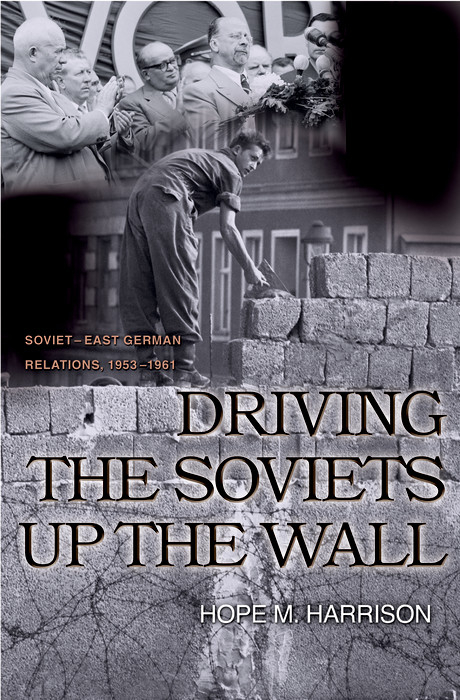
The Berlin Wall was the symbol of the Cold War. For the first time, this path-breaking book tells the behind-the-scenes story of the communists' decision to build the Wall in 1961. Hope Harrison's use of archival sources from the former East German and Soviet regimes is unrivalled, and from these sources she builds a highly original and provocative argument: the East Germans pushed the reluctant Soviets into building the Berlin Wall. This fascinating work portrays the different approaches favored by the East Germans and the Soviets to stop the exodus of refugees to West Germany. In the wake of Stalin's death in 1953, the Soviets refused the East German request to close their border to West Berlin. The Kremlin rulers told the hard-line East German leaders to solve their refugee problem not by closing the border, but by alleviating their domestic and foreign problems. The book describes how, over the next seven years, the East German regime managed to resist Soviet pressures for liberalization and instead pressured the Soviets into allowing them to build the Berlin Wall. Driving the Soviets Up the Wall forces us to view this critical juncture in the Cold War in a different light. Harrison's work makes us rethink the nature of relations between countries of the Soviet bloc even at the height of the Cold War, while also contributing to ongoing debates over the capacity of weaker states to influence their stronger allies.
Hope M. Harrison is Director of the Institute for European, Russian, and Eurasian Studies in the Elliott School of International Affairs at The George Washington University. She is also Associate Professor of History and International Affairs at the Elliott School. She served as Director for European and Eurasian Affairs at the National Security Council from 2000 to 2001.
| Erscheint lt. Verlag | 27.6.2011 |
|---|---|
| Reihe/Serie | Princeton Studies in International History and Politics | Princeton Studies in International History and Politics |
| Zusatzinfo | 3 maps. |
| Verlagsort | Princeton |
| Sprache | englisch |
| Themenwelt | Geschichte ► Allgemeine Geschichte ► Neuzeit (bis 1918) |
| Geschichte ► Allgemeine Geschichte ► Zeitgeschichte | |
| Geisteswissenschaften ► Geschichte ► Regional- / Ländergeschichte | |
| Sozialwissenschaften ► Politik / Verwaltung ► Europäische / Internationale Politik | |
| Sozialwissenschaften ► Politik / Verwaltung ► Politische Systeme | |
| Sozialwissenschaften ► Politik / Verwaltung ► Politische Theorie | |
| Technik ► Bauwesen | |
| Schlagworte | Adolf Hitler • Allied-occupied Germany • Andrei Gromyko • Annexation • Anti-Party Group • Berlin Crisis of 1961 • Berlin Wall • Bundestag • Bundeswehr • Central Committee • Checkpoint Charlie • Cold War • Communist Party of Germany • communist state • cuban missile crisis • czechoslovakia • de-Stalinization • Disarmament • domestic policy • Dwight D. Eisenhower • East Berlin • Eastern Bloc • Eastern Europe • East Germany • Erich Honecker • Erich Mielke • Foreign Minister • foreign policy • Georgy Malenkov • German Reunification • Germans • Group of Soviet Forces in Germany • Hungarian Revolution of 1956 • imperialism • International Relations • John F. Kennedy • John Lewis Gaddis • Konrad Adenauer • Lavrentiy Beria • Lazar Kaganovich • Leonid Brezhnev • Marc Trachtenberg • Marxism–Leninism • Mikhail Gorbachev • military alliance • Molotov–Ribbentrop Pact • NATO • Nazi Germany • Nazi Party • Nazism • Neues Deutschland • New Course • Nikita Khrushchev • Nikolai Bulganin • north vietnam • Nuclear warfare • nuclear weapon • Otto Grotewohl • Peaceful coexistence • Peace treaty • politburo • Politics • Potsdamer Platz • Presidium • Prisoner of War • Red Army • Refugee • Revanchism • Revolution • Russians in Germany • Russian State Archive of Contemporary History • Second World • security dilemma • Sino-Soviet split • socialist state • Soviet occupation zone • Soviet people • Soviet Union • Soviet Union–United States relations • Stalinism • Stalin's cult of personality • Stasi • Treaty • unrest • Uprising of 1953 in East Germany • Vladislav Zubok • Vyacheslav Molotov • Walter Ulbricht • war • Warsaw Pact • W. Averell Harriman • West Berlin • Western World • West Germany • Wismut (mining company) • Wolfgang Leonhard • World War • World War I • World War II • Yuri Andropov |
| ISBN-13 | 9781400840724 / 9781400840724 |
| Informationen gemäß Produktsicherheitsverordnung (GPSR) | |
| Haben Sie eine Frage zum Produkt? |
 PDF (Wasserzeichen)
Größe: 1,3 MB
DRM: Digitales Wasserzeichen
Dieses eBook enthält ein digitales Wasserzeichen und ist damit für Sie personalisiert. Bei einer missbräuchlichen Weitergabe des eBooks an Dritte ist eine Rückverfolgung an die Quelle möglich.
Dateiformat: PDF (Portable Document Format)
Mit einem festen Seitenlayout eignet sich die PDF besonders für Fachbücher mit Spalten, Tabellen und Abbildungen. Eine PDF kann auf fast allen Geräten angezeigt werden, ist aber für kleine Displays (Smartphone, eReader) nur eingeschränkt geeignet.
Systemvoraussetzungen:
PC/Mac: Mit einem PC oder Mac können Sie dieses eBook lesen. Sie benötigen dafür einen PDF-Viewer - z.B. den Adobe Reader oder Adobe Digital Editions.
eReader: Dieses eBook kann mit (fast) allen eBook-Readern gelesen werden. Mit dem amazon-Kindle ist es aber nicht kompatibel.
Smartphone/Tablet: Egal ob Apple oder Android, dieses eBook können Sie lesen. Sie benötigen dafür einen PDF-Viewer - z.B. die kostenlose Adobe Digital Editions-App.
Buying eBooks from abroad
For tax law reasons we can sell eBooks just within Germany and Switzerland. Regrettably we cannot fulfill eBook-orders from other countries.
 EPUB (Adobe DRM)
Kopierschutz: Adobe-DRM
Adobe-DRM ist ein Kopierschutz, der das eBook vor Mißbrauch schützen soll. Dabei wird das eBook bereits beim Download auf Ihre persönliche Adobe-ID autorisiert. Lesen können Sie das eBook dann nur auf den Geräten, welche ebenfalls auf Ihre Adobe-ID registriert sind.
Details zum Adobe-DRM
Dateiformat: EPUB (Electronic Publication)
EPUB ist ein offener Standard für eBooks und eignet sich besonders zur Darstellung von Belletristik und Sachbüchern. Der Fließtext wird dynamisch an die Display- und Schriftgröße angepasst. Auch für mobile Lesegeräte ist EPUB daher gut geeignet.
Systemvoraussetzungen:
PC/Mac: Mit einem PC oder Mac können Sie dieses eBook lesen. Sie benötigen eine
eReader: Dieses eBook kann mit (fast) allen eBook-Readern gelesen werden. Mit dem amazon-Kindle ist es aber nicht kompatibel.
Smartphone/Tablet: Egal ob Apple oder Android, dieses eBook können Sie lesen. Sie benötigen eine
Geräteliste und zusätzliche Hinweise
Buying eBooks from abroad
For tax law reasons we can sell eBooks just within Germany and Switzerland. Regrettably we cannot fulfill eBook-orders from other countries.
aus dem Bereich