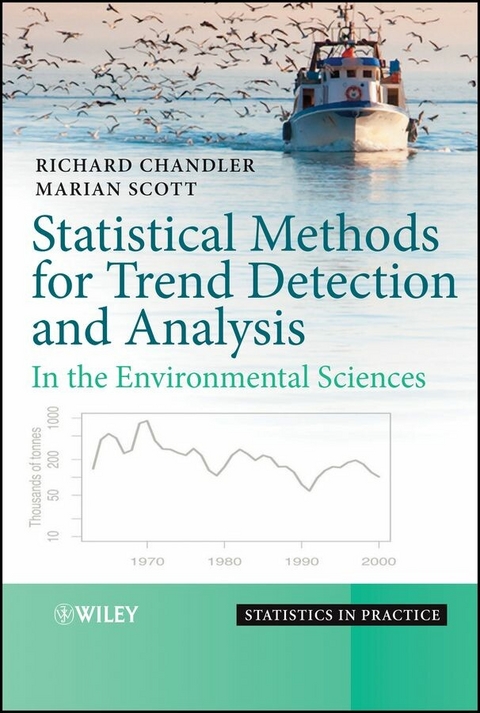
Statistical Methods for Trend Detection and Analysis in the Environmental Sciences (eBook)
John Wiley & Sons (Verlag)
978-1-119-99196-0 (ISBN)
Practitioners studying environmental change will be familiar with many classical statistical procedures for the detection and estimation of trends. However, the ever increasing capacity to collect and process vast amounts of environmental information has led to growing awareness that such procedures are limited in the insights that they can deliver. At the same time, significant developments in statistical methodology have often been widely dispersed in the statistical literature and have therefore received limited exposure in the environmental science community. This book aims to provide a thorough but accessible review of these developments. It is split into two parts: the first provides an introduction to this area and the second part presents a collection of case studies illustrating the practical application of modern statistical approaches to the analysis of trends in real studies.
Key Features:
- Presents a thorough introduction to the practical application and methodology of trend analysis in environmental science.
- Explores non-parametric estimation and testing as well as parametric techniques.
- Methods are illustrated using case studies from a variety of environmental application areas.
- Looks at trends in all aspects of a process including mean, percentiles and extremes.
- Supported by an accompanying website featuring datasets and R code.
The book is designed to be accessible to readers with some basic statistical training, but also contains sufficient detail to serve as a reference for practising statisticians. It will therefore be of use to postgraduate students and researchers both in the environmental sciences and in statistics.
Richard E Chandler, Lecturer in Statistical Science, Department of Statistical Science, University College London
Researcher in the area of stochastic processes and time series, with specific applications in hydrology and climate modeling. Work previously published by Wiley in the Encyclopaedia of Biostatistics.
E. Marian Scott, Professor of Environmental Statistics, Department of Statistics, University of Glasgow
Marian Scott is the editor of the Earth & Environmental Sciences section of Statistics in Practice for Wiley. She has 49 published articles. Her reputation within the community is evidenced by her associate editorship for 2 external journals (Radiocarbon and the Journal of Environmental Radioactivity); she is also honorary secretary for the Royal Statistical Society's Environmental Statistics Study Group.
The need to understand and quantify change is fundamental throughout the environmental sciences. This might involve describing past variation, understanding the mechanisms underlying observed changes, making projections of possible future change, or monitoring the effect of intervening in some environmental system. This book provides an overview of modern statistical techniques that may be relevant in problems of this nature. Practitioners studying environmental change will be familiar with many classical statistical procedures for the detection and estimation of trends. However, the ever increasing capacity to collect and process vast amounts of environmental information has led to growing awareness that such procedures are limited in the insights that they can deliver. At the same time, significant developments in statistical methodology have often been widely dispersed in the statistical literature and have therefore received limited exposure in the environmental science community. This book aims to provide a thorough but accessible review of these developments. It is split into two parts: the first provides an introduction to this area and the second part presents a collection of case studies illustrating the practical application of modern statistical approaches to the analysis of trends in real studies. Key Features: Presents a thorough introduction to the practical application and methodology of trend analysis in environmental science. Explores non-parametric estimation and testing as well as parametric techniques. Methods are illustrated using case studies from a variety of environmental application areas. Looks at trends in all aspects of a process including mean, percentiles and extremes. Supported by an accompanying website featuring datasets and R code. The book is designed to be accessible to readers with some basic statistical training, but also contains sufficient detail to serve as a reference for practising statisticians. It will therefore be of use to postgraduate students and researchers both in the environmental sciences and in statistics.
Richard E Chandler, Lecturer in Statistical Science, Department of Statistical Science, University College London Researcher in the area of stochastic processes and time series, with specific applications in hydrology and climate modeling. Work previously published by Wiley in the Encyclopaedia of Biostatistics. E. Marian Scott, Professor of Environmental Statistics, Department of Statistics, University of Glasgow Marian Scott is the editor of the Earth & Environmental Sciences section of Statistics in Practice for Wiley. She has 49 published articles. Her reputation within the community is evidenced by her associate editorship for 2 external journals (Radiocarbon and the Journal of Environmental Radioactivity); she is also honorary secretary for the Royal Statistical Society's Environmental Statistics Study Group.
Preface.
Contributing authors.
Part I METHODOLOGY.
1 Introduction.
1.1 What is a trend?
1.2 Why analyse trends?
1.3 Some simple examples.
1.4 Considerations and Difficulties.
1.5 Scope of the book.
1.6 Further reading.
References.
2 Exploratory analysis.
2.1 Data visualisation.
2.2 Simple smoothing.
2.3 Linear filters.
2.4 Classical test procedures.
2.5 Concluding comments.
References.
3 Parametric modelling - deterministic trends.
3.1 The Linear trend.
3.2 Multiple regression techniques.
3.3 Violations of assumptions.
3.4 Nonlinear trends.
3.5 Generalized linear models.
3.6 Inference with small samples.
References.
4 Nonparametric trend estimation.
4.1 An introduction to nonparametric regression.
4.2 Multiple covariates.
4.3 Other nonparametric estimation techniques.
4.4 Parametric or nonparametric?
References.
5 Stochastic trends.
5.1 Stationary time series models and their properties.
5.2 Trend removal via differencing.
5.3 Long memory models.
5.4 Models for irregularly spaced series.
5.5 State space and structural models.
5.6 Nonlinear models.
References.
6 Other issues.
6.1 Multisite data.
6.2 Multivariate series.
6.3 Point process data.
6.4 Trends in extremes.
6.5 Censored data.
References.
Part II CASE STUDIES.
7 Additive models for sulphur dioxide pollution in Europe
(Marco Giannitrapani, Adrian Bowman, E. Marian Scott and Ron
Smith)
7.1 Introduction.
7.2 Additive models with correlated errors.
7.3 Models for the SO2 data.
7.4 Conclusions.
References.
8 Rainfall trends in southwest Western Australia
(Richard E. Chandler, Bryson C. Bates and Stephen P.
Charles).
8.1 Motivation.
8.2 The study region.
8.3 Data used in the study.
8.4 Modelling methodology.
8.5 Results.
8.6 Summary and conclusions.
References.
9 Estimation of Common tends for tropical index series
(Alain F. Zuur, Elena N. Ieno, Christina Mazziotti, Giuseppe
Montanari, Attilio Rinaldi and Carla Rita Ferrari).
9.1 Introduction.
9.2 Data exploration.
9.3 Common trends and additive modelling.
9.4 Dynamic factor analysis to estimate common trends.
9.5 Discussion.
Acknowledgement.
References.
10 A Space-time study on forest health (Thomas Kneib
and Ludwig Fahrmeir).
10.1 Forest health: survey and data.
10.2 Regression models for longitudinal data with ordinal
responses.
10.3 Spatiotemporal models.
10.4 Spatiotemporal modelling and analysis of forest health
data.
Acknowledgements.
References.
Index.
"The book is well written and I strongly recommend the book to the users. I have no doubt that many applied statisticians will benefit by the wide coverage of topics in the book." (Journal of Time Series Analysis, 9 May 2011)
| Erscheint lt. Verlag | 25.3.2011 |
|---|---|
| Sprache | englisch |
| Themenwelt | Mathematik / Informatik ► Mathematik ► Statistik |
| Mathematik / Informatik ► Mathematik ► Wahrscheinlichkeit / Kombinatorik | |
| Naturwissenschaften ► Biologie ► Ökologie / Naturschutz | |
| Technik ► Umwelttechnik / Biotechnologie | |
| Schlagworte | biometrics • Biometrie • Book • Change • changes • effect • environmental system • fundamental • Future • intervening • involve • mechanisms • Modern • Nature • Overview • possible • Problems • projections • quantify • relevant • Sciences • Statistical • Statistics • Statistik • techniques • throughout • Variation |
| ISBN-10 | 1-119-99196-X / 111999196X |
| ISBN-13 | 978-1-119-99196-0 / 9781119991960 |
| Informationen gemäß Produktsicherheitsverordnung (GPSR) | |
| Haben Sie eine Frage zum Produkt? |
 EPUB (Adobe DRM)
Kopierschutz: Adobe-DRM
Adobe-DRM ist ein Kopierschutz, der das eBook vor Mißbrauch schützen soll. Dabei wird das eBook bereits beim Download auf Ihre persönliche Adobe-ID autorisiert. Lesen können Sie das eBook dann nur auf den Geräten, welche ebenfalls auf Ihre Adobe-ID registriert sind.
Details zum Adobe-DRM
Dateiformat: EPUB (Electronic Publication)
EPUB ist ein offener Standard für eBooks und eignet sich besonders zur Darstellung von Belletristik und Sachbüchern. Der Fließtext wird dynamisch an die Display- und Schriftgröße angepasst. Auch für mobile Lesegeräte ist EPUB daher gut geeignet.
Systemvoraussetzungen:
PC/Mac: Mit einem PC oder Mac können Sie dieses eBook lesen. Sie benötigen eine
eReader: Dieses eBook kann mit (fast) allen eBook-Readern gelesen werden. Mit dem amazon-Kindle ist es aber nicht kompatibel.
Smartphone/Tablet: Egal ob Apple oder Android, dieses eBook können Sie lesen. Sie benötigen eine
Geräteliste und zusätzliche Hinweise
Buying eBooks from abroad
For tax law reasons we can sell eBooks just within Germany and Switzerland. Regrettably we cannot fulfill eBook-orders from other countries.
aus dem Bereich