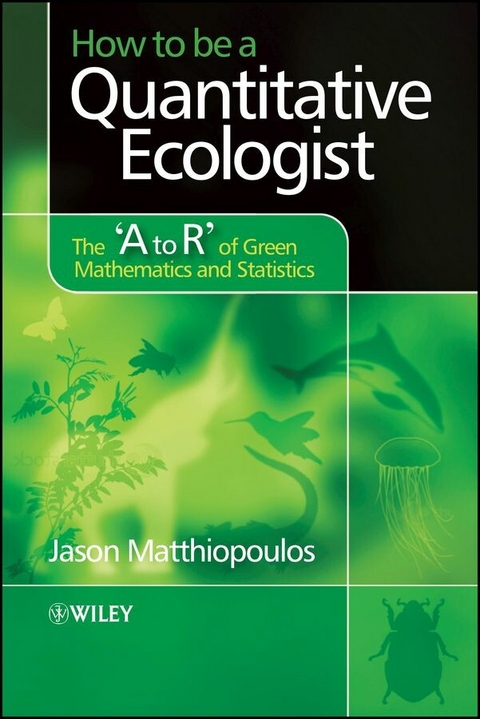
How to be a Quantitative Ecologist (eBook)
John Wiley & Sons (Verlag)
978-1-119-99172-4 (ISBN)
The text is addressed to readers who haven't used mathematics since school, who were perhaps more confused than enlightened by their undergraduate lectures in statistics and who have never used a computer for much more than word processing and data entry. From this starting point, it slowly but surely instils an understanding of mathematics, statistics and programming, sufficient for initiating research in ecology. The book's practical value is enhanced by extensive use of biological examples and the computer language R for graphics, programming and data analysis.
Key Features:
- Provides a complete introduction to mathematics statistics and computing for ecologists.
- Presents a wealth of ecological examples demonstrating the applied relevance of abstract mathematical concepts, showing how a little technique can go a long way in answering interesting ecological questions.
- Covers elementary topics, including the rules of algebra, logarithms, geometry, calculus, descriptive statistics, probability, hypothesis testing and linear regression.
- Explores more advanced topics including fractals, non-linear dynamical systems, likelihood and Bayesian estimation, generalised linear, mixed and additive models, and multivariate statistics.
- R boxes provide step-by-step recipes for implementing the graphical and numerical techniques outlined in each section.
How to be a Quantitative Ecologist provides a comprehensive introduction to mathematics, statistics and computing and is the ideal textbook for late undergraduate and postgraduate courses in environmental biology.
'With a book like this, there is no excuse for people to be afraid of maths, and to be ignorant of what it can do.'
-Professor Tim Benton, Faculty of Biological Sciences, University of Leeds, UK
Jason Matthiopoulos, Lecturer in biology (University of St Andrews). He is a senior researcher in the Sea Mammal Research Unit and member of the Centre for Ecological and Environmental Modelling.
How to be a Quantitative Ecologist: The 'A to R' of Green Mathematics and Statistics Ecological research is becoming increasingly quantitative, yet students often opt out of courses in mathematics and statistics, unwittingly limiting their ability to carry out research in the future. This textbook provides a practical introduction to quantitative ecology for students and practitioners who have realised that they need this opportunity. The text is addressed to readers who haven't used mathematics since school, who were perhaps more confused than enlightened by their undergraduate lectures in statistics and who have never used a computer for much more than word processing and data entry. From this starting point, it slowly but surely instils an understanding of mathematics, statistics and programming, sufficient for initiating research in ecology. The book's practical value is enhanced by extensive use of biological examples and the computer language R for graphics, programming and data analysis. Key Features: Provides a complete introduction to mathematics statistics and computing for ecologists. Presents a wealth of ecological examples demonstrating the applied relevance of abstract mathematical concepts, showing how a little technique can go a long way in answering interesting ecological questions. Covers elementary topics, including the rules of algebra, logarithms, geometry, calculus, descriptive statistics, probability, hypothesis testing and linear regression. Explores more advanced topics including fractals, non-linear dynamical systems, likelihood and Bayesian estimation, generalised linear, mixed and additive models, and multivariate statistics. R boxes provide step-by-step recipes for implementing the graphical and numerical techniques outlined in each section. How to be a Quantitative Ecologist provides a comprehensive introduction to mathematics, statistics and computing and is the ideal textbook for late undergraduate and postgraduate courses in environmental biology. "e;With a book like this, there is no excuse for people to be afraid of maths, and to be ignorant of what it can do."e; Professor Tim Benton, Faculty of Biological Sciences, University of Leeds, UK
Jason Matthiopoulos, Lecturer in biology (University of St Andrews). He is a senior researcher in the Sea Mammal Research Unit and member of the Centre for Ecological and Environmental Modelling.
"For those looking through R books for something a bit
more technical, this book will be an essential accomplice to
mastering R." (British Ecological Society, 1
April 2013)
"The book is written in a style that is easy to read and
for which one quickly forgets that the examples are essentially
mathematical in nature. If you are an ecologist who has shied away
from quantitative ecology in the past then this may be the text to
convince you that there is much to be learnt from quantitative
ecology. I thoroughly recommend this book and trust that you enjoy
reading it as much as I did." (International
Statistical Review, 2012)
"After a course of one or two semesters using this textbook, he
says, students should have the absolute minimum of knowledge about
quantitative research that ecologists need, but can provide a
foundation for students who want to move further in that
direction." (Book News, 1 August 2011)
| Erscheint lt. Verlag | 12.4.2011 |
|---|---|
| Sprache | englisch |
| Themenwelt | Mathematik / Informatik ► Mathematik ► Angewandte Mathematik |
| Mathematik / Informatik ► Mathematik ► Statistik | |
| Naturwissenschaften ► Biologie ► Ökologie / Naturschutz | |
| Naturwissenschaften ► Geowissenschaften ► Geologie | |
| Technik | |
| Schlagworte | Ability • Ãkologie / Methoden, Statistik • Biowissenschaften • Confused • Courses • earth sciences • ecological research • Ecology • Enlightened • Environmental Geoscience • Environmental Statistics & Environmetrics • Future • Geowissenschaften • Increasingly • Introduction • Life Sciences • Mathematics • Mathematik • Methods & Statistics in Ecology • Ökologie / Methoden, Statistik • Practical • Practitioners • Quantitative • Readers • Research • school • Statistics • Statistik • students • Umweltgeowissenschaften • Umweltstatistik u. Environmetrics • undergraduate lectures |
| ISBN-10 | 1-119-99172-2 / 1119991722 |
| ISBN-13 | 978-1-119-99172-4 / 9781119991724 |
| Informationen gemäß Produktsicherheitsverordnung (GPSR) | |
| Haben Sie eine Frage zum Produkt? |
 EPUB (Adobe DRM)
Kopierschutz: Adobe-DRM
Adobe-DRM ist ein Kopierschutz, der das eBook vor Mißbrauch schützen soll. Dabei wird das eBook bereits beim Download auf Ihre persönliche Adobe-ID autorisiert. Lesen können Sie das eBook dann nur auf den Geräten, welche ebenfalls auf Ihre Adobe-ID registriert sind.
Details zum Adobe-DRM
Dateiformat: EPUB (Electronic Publication)
EPUB ist ein offener Standard für eBooks und eignet sich besonders zur Darstellung von Belletristik und Sachbüchern. Der Fließtext wird dynamisch an die Display- und Schriftgröße angepasst. Auch für mobile Lesegeräte ist EPUB daher gut geeignet.
Systemvoraussetzungen:
PC/Mac: Mit einem PC oder Mac können Sie dieses eBook lesen. Sie benötigen eine
eReader: Dieses eBook kann mit (fast) allen eBook-Readern gelesen werden. Mit dem amazon-Kindle ist es aber nicht kompatibel.
Smartphone/Tablet: Egal ob Apple oder Android, dieses eBook können Sie lesen. Sie benötigen eine
Geräteliste und zusätzliche Hinweise
Buying eBooks from abroad
For tax law reasons we can sell eBooks just within Germany and Switzerland. Regrettably we cannot fulfill eBook-orders from other countries.
aus dem Bereich