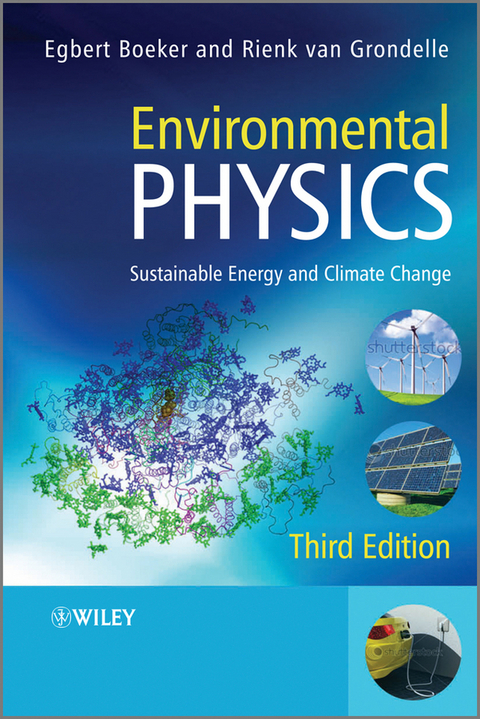
Environmental Physics (eBook)
John Wiley & Sons (Verlag)
978-1-119-97418-5 (ISBN)
Instructor support material is available at http://booksupport.wiley.com
Egbert Boekeris a retired Professor from the Free University of Amsterdam with a career in which he taught virtually all of the undergraduate courses in physics.
Rienk van Grondelle is a Professor in the Department of Biophysics and Physics of Complex Systems at the Free University of Amsterdam. He is performing research in biophysics and teaching not only to physics students but also to biology students. He is a member of the Royal Netherlands Academy of Sciences.
This thoroughly revised and updated third edition focuses on the utilization of sustainable energy and mitigating climate change, serving as an introduction to physics in the context of societal problems. A distinguishing feature of the text is the discussion of spectroscopy and spectroscopic methods as a crucial means to quantitatively analyze and monitor the condition of the environment, the factors determining climate change, and all aspects of energy conversion. This textbook will be invaluable to students in physics and related subjects, and supplementary materials are available on a companion website: http://www.nat.vu.nl/environmentalphysicsInstructor support material is available at: http://booksupport.wiley.com
Egbert Boekeris a retired Professor from the Free University of Amsterdam with a career in which he taught virtually all of the undergraduate courses in physics. Rienk van Grondelle is a Professor in the Department of Biophysics and Physics of Complex Systems at the Free University of Amsterdam. He is performing research in biophysics and teaching not only to physics students but also to biology students. He is a member of the Royal Netherlands Academy of Sciences.
Environmental Physics 3
Contents 7
Preface 15
Acknowledgements 17
1 Introduction 19
1.1 A Sustainable Energy Supply 19
1.2 The Greenhouse Effect and Climate Change 21
1.3 Light Absorption in Nature as a Source of Energy 22
1.4 The Contribution of Science: Understanding, Modelling and Monitoring 23
Exercises 24
References 24
2 Light and Matter 25
2.1 The Solar Spectrum 25
2.1.1 Radiation from a Black Body 25
2.1.2 Emission Spectrum of the Sun 27
2.2 Interaction of Light with Matter 30
2.2.1 Electric Dipole Moments of Transitions 30
2.2.2 Einstein Coefficients 32
2.2.3 Absorption of a Beam of Light: Lambert-Beer’s Law 34
2.3 Ultraviolet Light and Biomolecules 37
2.3.1 Spectroscopy of Biomolecules 38
2.3.2 Damage to Life from Solar UV 39
2.3.3 The Ozone Filter as Protection 40
Exercises 46
References 46
3 Climate and Climate Change 49
3.1 The Vertical Structure of the Atmosphere 50
3.2 The Radiation Balance and the Greenhouse Effect 54
3.2.1 Simple Changes in the Radiation Balance 57
3.2.2 Radiation Transfer 59
3.2.3 A Simple Analytical Model 62
3.2.4 Radiative Forcing and Global Warming 63
3.2.5 The Greenhouse Gases 66
3.3 Dynamics in the Climate System 69
3.3.1 Horizontal Motion of Air 71
3.3.2 Vertical Motion of Ocean Waters 76
3.3.3 Horizontal Motion of Ocean Waters 77
3.4 Natural Climate Variability 77
3.5 Modelling Human-Induced Climate Change 80
3.5.1 The Carbon Cycle 81
3.5.2 Structure of Climate Modelling 84
3.5.3 Modelling the Atmosphere 85
3.5.4 A Hierarchy of Models 88
3.6 Analyses of IPCC, the Intergovernmental Panel on Climate Change 88
3.7 Forecasts of Climate Change 88
Exercises 92
References 94
4 Heat Engines 95
4.1 Heat Transfer and Storage 96
4.1.1 Conduction 97
4.1.2 Convection 100
4.1.3 Radiation 100
4.1.4 Phase Change 101
4.1.5 The Solar Collector 102
4.1.6 The Heat Diffusion Equation 105
4.1.7 Heat Storage 108
4.2 Principles of Thermodynamics 109
4.2.1 First and Second Laws 109
4.2.2 Heat and Work Carnot Efficiency
4.2.3 Efficiency of a ‘Real’ Heat Engine 115
4.2.4 Second Law Efficiency 116
4.2.5 Loss of Exergy in Combustion 119
4.3 Idealized Cycles 121
4.3.1 Carnot Cycle 121
4.3.2 Stirling Engine 122
4.3.3 Steam Engine 123
4.3.4 Internal Combustion 125
4.3.5 Refrigeration 128
4.4 Electricity as Energy Carrier 131
4.4.1 Varying Grid Load 132
4.4.2 Co-Generation of Heat and Electricity 133
4.4.3 Storage of Electric Energy 135
4.4.4 Transmission of Electric Power 141
4.5 Pollution from Heat Engines 143
4.5.1 Nitrogen Oxides NOx 143
4.5.2 SO2 144
4.5.3 CO and CO2 144
4.5.4 Aerosols 145
4.5.5 Volatile Organic Compounds VOC 146
4.5.6 Thermal Pollution 147
4.5.7 Regulations 147
4.6 The Private Car 147
4.6.1 Power Needs 148
4.6.2 Automobile Fuels 149
4.6.3 Three-Way Catalytic Converter 150
4.6.4 Electric Car 151
4.6.5 Hybrid Car 152
4.7 Economics of Energy Conversion 152
4.7.1 Capital Costs 152
4.7.2 Learning Curve 156
Exercises 156
References 160
5 Renewable Energy 163
5.1 Electricity from the Sun 164
5.1.1 Varying Solar Input 164
5.1.2 Electricity from Solar Heat: Concentrating Solar Power CSP 168
5.1.3 Direct Conversion of Light into Electricity: Photovoltaics PV 170
5.2 Energy from the Wind 177
5.2.1 Betz Limit 178
5.2.2 Aerodynamics 180
5.2.3 Wind Farms 183
5.2.4 Vertical Wind Profile 183
5.2.5 Wind Statistics 185
5.2.6 State of the Art and Outlook 186
5.3 Energy from the Water 187
5.3.1 Power from Dams 187
5.3.2 Power from Flowing Rivers 188
5.3.3 Power from Waves 188
5.3.4 Power from the Tides 192
5.4 Bio Energy 193
5.4.1 Thermodynamics of Bio Energy 193
5.4.2 Stability 198
5.4.3 Solar Efficiency 198
5.4.4 Energy from Biomass 200
5.5 Physics of Photosynthesis 201
5.5.1 Basics of Photosynthesis 202
5.5.2 Light-Harvesting Antennas 203
5.5.3 Energy Transfer Mechanism 205
5.5.4 Charge Separation 208
5.5.5 Flexibility and Disorder 211
5.5.6 Photoprotection 211
5.5.7 Research Directions 213
5.6 Organic Photocells: the Gr¨atzel Cell 214
5.6.1 The Principle 214
5.6.2 Efficiency 217
5.6.3 New Developments and the Future 220
5.6.4 Applications 221
5.7 Bio Solar Energy 221
5.7.1 Comparison of Biology and Technology 222
5.7.2 Legacy Biochemistry 225
5.7.3 Artificial Photosynthesis 227
5.7.4 Solar Fuels with Photosynthetic Microorganisms: Two Research Questions 231
5.7.5 Conclusion 231
Exercises 233
References 235
6 Nuclear Power 239
6.1 Nuclear Fission 240
6.1.1 Principles 240
6.1.2 Four Factor Formula 244
6.1.3 Reactor Equations 247
6.1.4 Stationary Reactor 249
6.1.5 Time Dependence of a Reactor 251
6.1.6 Reactor Safety 252
6.1.7 Nuclear Explosives 255
6.2 Nuclear Fusion 256
6.3 Radiation and Health 262
6.3.1 Definitions 262
6.3.2 Norms on Exposure to Radiation 263
6.3.3 Normal Use of Nuclear Power 265
6.3.4 Radiation from Nuclear Accidents 265
6.3.5 Health Aspects of Fusion 265
6.4 Managing the Fuel Cycle 266
6.4.1 Uranium Mines 267
6.4.2 Enrichment 267
6.4.3 Fuel Burnup 270
6.4.4 Reprocessing 270
6.4.5 Waste Management 271
6.4.6 Nonproliferation 274
6.5 Fourth Generation Nuclear Reactors 275
Exercises 276
References 277
7 Dispersion of Pollutants 279
7.1 Diffusion 280
7.1.1 Diffusion Equation 280
7.1.2 Point Source in Three Dimensions in Uniform Wind 285
7.1.3 Effect of Boundaries 287
7.2 Dispersion in Rivers 288
7.2.1 One-Dimensional Approximation 289
7.2.2 Influence of Turbulence 293
7.2.3 Example: A Calamity Model for the Rhine River 295
7.2.4 Continuous Point Emission 296
7.2.5 Two Numerical Examples 298
7.2.6 Improvements 299
7.2.7 Conclusion 300
7.3 Dispersion in Groundwater 300
7.3.1 Basic Definitions 301
7.3.2 Darcy’s Equations 304
7.3.3 Stationary Applications 308
7.3.4 Dupuit Approximation 313
7.3.5 Simple Flow in a Confined Aquifer 316
7.3.6 Time Dependence in a Confined Aquifer 319
7.3.7 Adsorption and Desorption of Pollutants 320
7.4 Mathematics of Fluid Dynamics 322
7.4.1 Stress Tensor 322
7.4.2 Equations of Motion 326
7.4.3 Newtonian Fluids 327
7.4.4 Navier-Stokes Equation 328
7.4.5 Reynolds Number 329
7.4.6 Turbulence 331
7.5 Gaussian Plumes in the Air 335
7.5.1 Statistical Analysis 337
7.5.2 Continuous Point Source 339
7.5.3 Gaussian Plume from a High Chimney 340
7.5.4 Empirical Determination of the Dispersion Coefficients 341
7.5.5 Semi-Empirical Determination of the Dispersion Parameters 342
7.5.6 Building a Chimney 343
7.6 Turbulent Jets and Plumes 344
7.6.1 Dimensional Analysis 346
7.6.2 Simple Jet 347
7.6.3 Simple Plume 349
Exercises 351
References 352
8 Monitoring with Light 355
8.1 Overview of Spectroscopy 355
8.1.1 Population of Energy Levels and Intensity of Absorption Lines 359
8.1.2 Transition Dipole Moment: Selection Rules 359
8.1.3 Linewidths 360
8.2 Atomic Spectra 363
8.2.1 One-Electron Atoms 363
8.2.2 Many-Electron Atoms 364
8.3 Molecular Spectra 365
8.3.1 Rotational Transitions 365
8.3.2 Vibrational Transitions 367
8.3.3 Electronic Transitions 371
8.4 Scattering 377
8.4.1 Raman Scattering 377
8.4.2 Resonance Raman Scattering 378
8.4.3 Rayleigh Scattering 379
8.4.4 Mie Scattering 380
8.4.5 Scattering in the Atmosphere 380
8.5 Remote Sensing by Satellites 380
8.5.1 ENVISAT Satellite 380
8.5.2 SCIAMACHY’s Operation 380
8.5.3 Analysis 382
8.5.4 Ozone Results 386
8.6 Remote Sensing by Lidar 386
8.6.1 Lidar Equation and DIAL 387
8.6.2 Range-Resolved Cloud and Aerosol Optical Properties 389
Exercises 394
References 395
9 The Context of Society 397
9.1 Using Energy Resources 398
9.1.1 Energy Consumption 398
9.1.2 Energy Consumption and Resources 400
9.1.3 Energy Efficiency 401
9.1.4 Comparing Energy Resources 402
9.1.5 Energy Options 405
9.1.6 Conclusion 406
9.2 Fresh Water 407
9.3 Risks 407
9.3.1 Small Concentrations of Harmful Chemicals 408
9.3.2 Acceptable Risks 410
9.3.3 Small Probability for a Large Harm 411
9.3.4 Dealing with Uncertainties 412
9.4 International Efforts 414
9.4.1 Protection of the Ozone Layer 414
9.4.2 Protection of Climate 414
9.5 Global Environmental Management 416
9.5.1 Self-Organized Criticality 416
9.5.2 Conclusion 419
9.6 Science and Society 419
9.6.1 Nature of Science 419
9.6.2 Control of Science 420
9.6.3 Aims of Science 420
9.6.4 A New Social Contract between Science and Society 422
Exercises and social questions 423
Social questions 423
References 424
Appendix A: Physical and Numerical Constants 427
Appendix B: Vector Algebra 429
Appendix C: Gauss, Delta and Error Functions 437
Appendix D: Experiments in a Student’s Lab 441
Appendix E: Web Sites 443
Appendix F: Omitted Parts of the Second Edition 445
Index 447
Color Plate 459
| Erscheint lt. Verlag | 5.7.2011 |
|---|---|
| Sprache | englisch |
| Themenwelt | Naturwissenschaften ► Biologie ► Ökologie / Naturschutz |
| Naturwissenschaften ► Geowissenschaften ► Geologie | |
| Naturwissenschaften ► Physik / Astronomie ► Allgemeines / Lexika | |
| Technik | |
| Schlagworte | attention • Climate • climate change • Concepts • ConText • Due • efficiently • Energy • Environmental change • environmental physics • Environmental Studies • Field • Fossil • fuels • importance • Introduction • mitigate • photosynthesis • Physics • Physik • Problems • Produce • resources • societal • Supply • Text • Third • Umwelt • Umweltforschung • Umweltphysik • Umweltveränderungen • Umweltveränderungen • Ways |
| ISBN-10 | 1-119-97418-6 / 1119974186 |
| ISBN-13 | 978-1-119-97418-5 / 9781119974185 |
| Informationen gemäß Produktsicherheitsverordnung (GPSR) | |
| Haben Sie eine Frage zum Produkt? |
 PDF (Adobe DRM)
Kopierschutz: Adobe-DRM
Adobe-DRM ist ein Kopierschutz, der das eBook vor Mißbrauch schützen soll. Dabei wird das eBook bereits beim Download auf Ihre persönliche Adobe-ID autorisiert. Lesen können Sie das eBook dann nur auf den Geräten, welche ebenfalls auf Ihre Adobe-ID registriert sind.
Details zum Adobe-DRM
Dateiformat: PDF (Portable Document Format)
Mit einem festen Seitenlayout eignet sich die PDF besonders für Fachbücher mit Spalten, Tabellen und Abbildungen. Eine PDF kann auf fast allen Geräten angezeigt werden, ist aber für kleine Displays (Smartphone, eReader) nur eingeschränkt geeignet.
Systemvoraussetzungen:
PC/Mac: Mit einem PC oder Mac können Sie dieses eBook lesen. Sie benötigen eine
eReader: Dieses eBook kann mit (fast) allen eBook-Readern gelesen werden. Mit dem amazon-Kindle ist es aber nicht kompatibel.
Smartphone/Tablet: Egal ob Apple oder Android, dieses eBook können Sie lesen. Sie benötigen eine
Geräteliste und zusätzliche Hinweise
Buying eBooks from abroad
For tax law reasons we can sell eBooks just within Germany and Switzerland. Regrettably we cannot fulfill eBook-orders from other countries.
aus dem Bereich