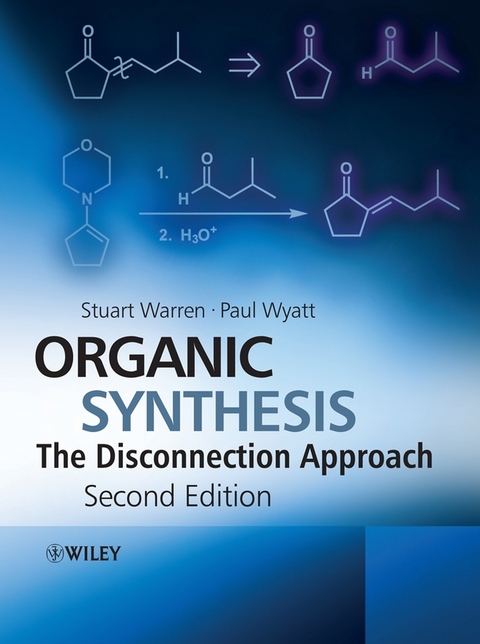
Organic Synthesis (eBook)
John Wiley & Sons (Verlag)
978-1-119-96553-4 (ISBN)
Organic Synthesis: The Disconnection Approach, 2nd Edition introduces this important technique, to help students to design their own organic syntheses. There are forty chapters: those on the synthesis of given types of molecules alternate with strategy chapters in which the methods just learnt are placed in a wider context. The synthesis chapters cover many ways of making each type of molecule starting with simple aromatic and aliphatic compounds with one functional group and progressing to molecules with many functional groups. The strategy chapters cover questions of selectivity, protection, stereochemistry, and develop more advanced thinking via reagents specifically designed for difficult problems.
Examples are drawn from pharmaceuticals, agrochemicals, natural products, pheromones, perfumery and flavouring compounds, dyestuffs, monomers, and intermediates used in more advanced synthetic work. Reasons for wishing to synthesise each compound are given.
This second edition has been fully revised and updated with a modern look. Recent examples and techniques are included and illustrated additional material has been added to take the student to the level required by the sequel, 'Organic Synthesis: Strategy and Control'.
Several chapters contain extensive new material based on courses that the authors give to chemists in the pharmaceutical industry.
Organic Synthesis: The Disconnection Approach, 2nd edition provides a full course in retrosynthetic analysis for chemistry and biochemistry students and a refresher for organic chemists working in industry and academia.
Dr Stuart Warren, Department of Chemistry, University of Cambridge, UK
Dr Warren is the author of the bestselling textbooks Organic Synthesis: The Disconnection Approach (Wiley), Organic Synthesis: Strategy and Control (Wiley) and Organic Chemistry (OUP).
Dr Paul Wyatt, School of Chemistry, University of Bristol, UK
Dr Wyatt is Director of Undergraduate Studies for the School of Chemistry at Bristol University and also Director of BRISTOL ChemLabS - a HEFCE Centre for Excellence in Teaching & Learning. He is co-author, with Warren, of Organic Synthesis: Strategy and Control.
One approach to organic synthesis is retrosynthetic analysis. With this approach a chemist will start with the structure of their target molecule and progressively cut bonds to create simpler molecules. Reversing this process gives a synthetic route to the target molecule from simpler starting materials. This disconnection approach to synthesis is now a fundamental part of every organic synthesis course. Organic Synthesis: The Disconnection Approach, 2nd Edition introduces this important technique, to help students to design their own organic syntheses. There are forty chapters: those on the synthesis of given types of molecules alternate with strategy chapters in which the methods just learnt are placed in a wider context. The synthesis chapters cover many ways of making each type of molecule starting with simple aromatic and aliphatic compounds with one functional group and progressing to molecules with many functional groups. The strategy chapters cover questions of selectivity, protection, stereochemistry, and develop more advanced thinking via reagents specifically designed for difficult problems. Examples are drawn from pharmaceuticals, agrochemicals, natural products, pheromones, perfumery and flavouring compounds, dyestuffs, monomers, and intermediates used in more advanced synthetic work. Reasons for wishing to synthesise each compound are given. This second edition has been fully revised and updated with a modern look. Recent examples and techniques are included and illustrated additional material has been added to take the student to the level required by the sequel, Organic Synthesis: Strategy and Control . Several chapters contain extensive new material based on courses that the authors give to chemists in the pharmaceutical industry. Organic Synthesis: The Disconnection Approach, 2nd edition provides a full course in retrosynthetic analysis for chemistry and biochemistry students and a refresher for organic chemists working in industry and academia.
Dr Stuart Warren, Department of Chemistry, University of Cambridge, UK Dr Warren is the author of the bestselling textbooks Organic Synthesis: The Disconnection Approach (Wiley), Organic Synthesis: Strategy and Control (Wiley) and Organic Chemistry (OUP). Dr Paul Wyatt, School of Chemistry, University of Bristol, UK Dr Wyatt is Director of Undergraduate Studies for the School of Chemistry at Bristol University and also Director of BRISTOL ChemLabS - a HEFCE Centre for Excellence in Teaching & Learning. He is co-author, with Warren, of Organic Synthesis: Strategy and Control.
Preface ix
General References xi
1. The Disconnection Approach 1
2. Basic Principles: Synthons and Reagents Synthesis of Aromatic Compounds 7
3. Strategy I: The Order of Events 17
4. One-Group C-X Disconnections 23
5. Strategy II: Chemoselectivity 29
6. Two-Group C-X Disconnections 35
7. Strategy III: Reversal of Polarity, Cyclisations, Summary of Strategy 45
8. Amine Synthesis 53
9. Strategy IV: Protecting Groups 61
10. One Group C-C Disconnections I: Alcohols 69
11. General Strategy A: Choosing a Disconnection 77
12. Strategy V: Stereoselectivity A 83
13. One Group C-C Disconnections II: Carbonyl Compounds 93
14. Strategy VI: Regioselectivity 101
15. Alkene Synthesis 107
16. Strategy VII: Use of Acetylenes (Alkynes) 115
17. Two-Group C-C Disconnections I: Diels-Alder Reactions 121
18. Strategy VIII: Introduction to Carbonyl Condensations 129
19. Two-Group C-C Disconnections II: 1,3-Difunctionalised Compounds 133
20. Strategy IX: Control in Carbonyl Condensations 139
21. Two-Group C-C Disconnections III: 1,5-Difunctionalised Compounds Conjugate (Michael) Addition and Robinson Annelation 151
22. Strategy X: Aliphatic Nitro Compounds in Synthesis 161
23. Two-Group Disconnections IV: 1,2-Difunctionalised Compounds 167
24. Strategy XI: Radical Reactions in Synthesis 177
25. Two-Group Disconnections V: 1,4-Difunctionalised Compounds 185
26. Strategy XII: Reconnection 193
27. Two-Group C-C Disconnections VI: 1,6-diCarbonyl Compounds 199
28. General Strategy B: Strategy of Carbonyl Disconnections 207
29. Strategy XIII: Introduction to Ring Synthesis: Saturated Heterocycles 217
30. Three-Membered Rings 229
31. Strategy XIV: Rearrangements in Synthesis 237
32. Four-Membered Rings: Photochemistry in Synthesis 245
33. Strategy XV: The Use of Ketenes in Synthesis 251
34. Five-Membered Rings 255
35. Strategy XVI: Pericyclic Reactions in Synthesis: Special Methods for Five-Membered Rings 261
36. Six-Membered Rings 269
37. General Strategy C: Strategy of Ring Synthesis 279
38. Strategy XVII: Stereoselectivity B 289
39. Aromatic Heterocycles 301
40. General Strategy D: Advanced Strategy 313
Index 325
?The authors have succeeded admirably in the updating of a classic
in the pedagogy of organic chemistry.? ( Journal of Medicinal
Chemistry , August 2009)
?This book is suitable for advanced undergraduate students,
researchers and professional chemists. Both the writing and the
diagrams are simple and clear.? ( Reviews, May 2009)
| Erscheint lt. Verlag | 24.8.2011 |
|---|---|
| Sprache | englisch |
| Themenwelt | Naturwissenschaften ► Chemie ► Organische Chemie |
| Technik | |
| Schlagworte | Approach • Bonds • Chemie • Chemistry • Course • Disconnection Approach • every • fundamental • Methods - Synthesis & Techniques • Molecule • Molecules • One • organic • Organic Chemistry • Organische Chemie • Organische Chemie / Methoden, Synthesen, Verfahren • Organische Synthese • Part • Process • progressively • retrosynthetic • Route • simpler • Structure • synthesis • Synthetic • target |
| ISBN-10 | 1-119-96553-5 / 1119965535 |
| ISBN-13 | 978-1-119-96553-4 / 9781119965534 |
| Informationen gemäß Produktsicherheitsverordnung (GPSR) | |
| Haben Sie eine Frage zum Produkt? |
 EPUB (Adobe DRM)
Kopierschutz: Adobe-DRM
Adobe-DRM ist ein Kopierschutz, der das eBook vor Mißbrauch schützen soll. Dabei wird das eBook bereits beim Download auf Ihre persönliche Adobe-ID autorisiert. Lesen können Sie das eBook dann nur auf den Geräten, welche ebenfalls auf Ihre Adobe-ID registriert sind.
Details zum Adobe-DRM
Dateiformat: EPUB (Electronic Publication)
EPUB ist ein offener Standard für eBooks und eignet sich besonders zur Darstellung von Belletristik und Sachbüchern. Der Fließtext wird dynamisch an die Display- und Schriftgröße angepasst. Auch für mobile Lesegeräte ist EPUB daher gut geeignet.
Systemvoraussetzungen:
PC/Mac: Mit einem PC oder Mac können Sie dieses eBook lesen. Sie benötigen eine
eReader: Dieses eBook kann mit (fast) allen eBook-Readern gelesen werden. Mit dem amazon-Kindle ist es aber nicht kompatibel.
Smartphone/Tablet: Egal ob Apple oder Android, dieses eBook können Sie lesen. Sie benötigen eine
Geräteliste und zusätzliche Hinweise
Buying eBooks from abroad
For tax law reasons we can sell eBooks just within Germany and Switzerland. Regrettably we cannot fulfill eBook-orders from other countries.
aus dem Bereich