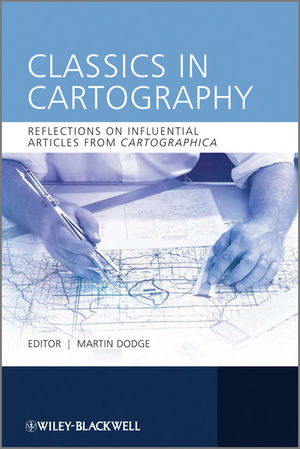
Classics in Cartography (eBook)
430 Seiten
John Wiley & Sons (Verlag)
978-1-119-95737-9 (ISBN)
reinterpretation of a selection of ten touchstone articles in the
development of mapping scholarship over the last four decades. The
'classics' are drawn exclusively from the international
peer-review journal Cartographica and are reprinted in full
here. They are accompanied by newly commissioned reflective essays
by the original article authors, and other eminent scholars, to
provide fresh interpretation of the meaning of the ideas presented
and their wider, lasting impact on cartographic research.
The book provides an equal balance of influential articles from
the past and current commentaries which highlight their impact and
current context. Read in combination the original
'classic' articles and these new reflective essays
demonstrate how cartography works as a powerful representational
form and explores how various different aspects of mapping practice
have been conceptualized by an influential set of academic
researchers.
* Collates 'classic' articles from four decades of
the journal Cartographica
* Brings key articles up-to-date with contemporary interpretative
essays by the leading scholars in mapping research
* Themes covered are the epistemological of mapping practice, the
ontological underpinnings of cartographic representation, and the
contested societal implications of maps
* Evaluates the progression of the field of cartographic research
and demonstrates how new theoretical ideas originate, develop and
circulate
* Provides a signpost for students and new researchers on the key
articles in cartography to read and reflect upon
Martin Dodge, Lecturer in Human Geography, University of Manchester, Department of Geography, School of Environment and Development, Manchester, UK.
Contributor's Biographies.
Foreword.
Acknowledgements.
1. What are the 'classic' articles in cartography?
(Martin Dodge).
Section One: Epistemological Practice.
2. Algorithms for the Reduction of the Number of Points Required
to Represent a Digitized Line or its Caricature (1973) (David H.
Douglas and Thomas K. Peucker).
3. Reflection Essay: Algorithms for the Reduction of the Number
of Points Required to Represent a Digitized Line or its Caricature
(Tom Poiker and David Douglas).
4. The Nature of Boundaries on 'Area-Class' Maps
(1989) (David M. Mark and Ferenc Csillag).
5. Reflection Essay: The Nature of Boundaries on
'Area-Class' Maps (David M. Mark).
6. Strategies for the Visualization of Geographic Time-Series
Data (1990) (Mark Monmonier).
7. Reflection Essay: Strategies for the Visualization of
Geographic Time-Series Data (Mark Monmonier).
8. PPGIS in Community Development Planning: Framing the
Organizational Context (2001) (Sarah Elwood and Rina
Ghose).
9. Reflection Essay: PPGIS in Community Development
Planning (Sarah Elwood and Rina Ghose).
Section Two: Ontological Understanding.
10. Cartographic Communication and Geographic Understanding
(1976) (Leonard Guelke).
11. Reflection Essay:Cartographic Communication and Geographic
Understanding (Mordechai (Muki) Haklay and Catherine Emma
(Kate) Jones).
12. A Conceptual Framework and Comparison of Spatial Data Models
(1984) (Donna J. Peuquet).
13. Reflection Essay: A Conceptual Framework and Comparison of
Spatial Data Models (Jeremy Mennis).
14. Designs on Signs: Myth and Meaning in Maps (1986) (Denis
Wood and John Fels).
15. Reflection Essay: Designs on Signs/Myth and Meaning in Maps
(Denis Wood and John Fels).
Section Three: Politics and Society.
16. Deconstructing the Map (1989) (J.B. Harley).
17. Reflection Essay: Deconstructing the Map (Jeremy W.
Crampton).
18. Cartography Without 'Progress': Reinterpreting
the Nature and Historical Development of Mapmaking (1993)
(Matthew H. Edney).
19. Reflection Essay: Progress and the Nature of
'Cartography'(Jeremy W. Crampton). (Matthew H.
Edney).
20. Between Demythologizing and Deconstructing the Map:
Shawnadithit's New-Found-Land and the Alienation of Canada
(1995) (Matthew Sparke).
21. The Look of Surveillance Returns: Reflection Essay: Between
Demythologizing and Deconstructing the Map (Matt
Sparke).
Index
| Erscheint lt. Verlag | 15.6.2011 |
|---|---|
| Sprache | englisch |
| Themenwelt | Naturwissenschaften ► Geowissenschaften ► Geografie / Kartografie |
| Naturwissenschaften ► Geowissenschaften ► Geologie | |
| Technik | |
| Schlagworte | earth sciences • Geowissenschaften • GIS & Remote Sensing • GIS u. Fernerkundung |
| ISBN-10 | 1-119-95737-0 / 1119957370 |
| ISBN-13 | 978-1-119-95737-9 / 9781119957379 |
| Informationen gemäß Produktsicherheitsverordnung (GPSR) | |
| Haben Sie eine Frage zum Produkt? |
 EPUB (Adobe DRM)
Kopierschutz: Adobe-DRM
Adobe-DRM ist ein Kopierschutz, der das eBook vor Mißbrauch schützen soll. Dabei wird das eBook bereits beim Download auf Ihre persönliche Adobe-ID autorisiert. Lesen können Sie das eBook dann nur auf den Geräten, welche ebenfalls auf Ihre Adobe-ID registriert sind.
Details zum Adobe-DRM
Dateiformat: EPUB (Electronic Publication)
EPUB ist ein offener Standard für eBooks und eignet sich besonders zur Darstellung von Belletristik und Sachbüchern. Der Fließtext wird dynamisch an die Display- und Schriftgröße angepasst. Auch für mobile Lesegeräte ist EPUB daher gut geeignet.
Systemvoraussetzungen:
PC/Mac: Mit einem PC oder Mac können Sie dieses eBook lesen. Sie benötigen eine
eReader: Dieses eBook kann mit (fast) allen eBook-Readern gelesen werden. Mit dem amazon-Kindle ist es aber nicht kompatibel.
Smartphone/Tablet: Egal ob Apple oder Android, dieses eBook können Sie lesen. Sie benötigen eine
Geräteliste und zusätzliche Hinweise
Buying eBooks from abroad
For tax law reasons we can sell eBooks just within Germany and Switzerland. Regrettably we cannot fulfill eBook-orders from other countries.
aus dem Bereich