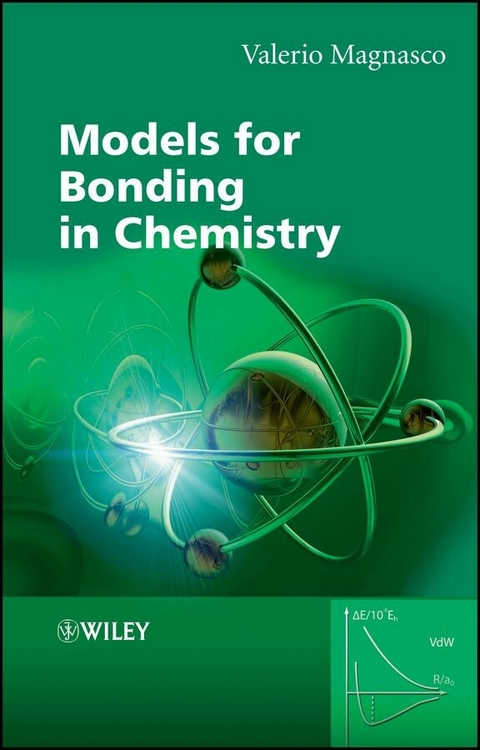
Models for Bonding in Chemistry (eBook)
John Wiley & Sons (Verlag)
978-1-119-95734-8 (ISBN)

Dr Valerio Magnasco, MRSC, is full Professor of Theoretical Chemistry at the University of Genoa, Italy, presently at the Department of Chemistry and Industrial Chemistry (DCCI) of the Faculty of Mathematical, Physical and Natural Sciences of the University. He is Member of the Royal Society of Chemistry (UK, RSC), the American Institute of Physics (US, AIP), the Physical Chemistry Division of the Italian Chemical Society (Italy, SCI), the Class of Sciences of Accademia Ligure di Scienze e Lettere (Italy, Genova). He is supervising a research group working on the theoretical study of atomic and molecular interactions, and is author or co-author of over 170 scientific papers mostly published on international journals, and of one book on Molecular Quantum Mechanics.
Dr Valerio Magnasco, MRSC, is full Professor of Theoretical Chemistry at the University of Genoa, Italy, presently at the Department of Chemistry and Industrial Chemistry (DCCI) of the Faculty of Mathematical, Physical and Natural Sciences of the University. He is Member of the Royal Society of Chemistry (UK, RSC), the American Institute of Physics (US, AIP), the Physical Chemistry Division of the Italian Chemical Society (Italy, SCI), the Class of Sciences of Accademia Ligure di Scienze e Lettere (Italy, Genova). He is supervising a research group working on the theoretical study of atomic and molecular interactions, and is author or co-author of over 170 scientific papers mostly published on international journals, and of one book on Molecular Quantum Mechanics.
Preface xi
1 Mathematical Foundations 1
1.1 Matrices and Systems of Linear Equations 1
1.2 Properties of Eigenvalues and Eigenvectors 6
1.3 Variational Approximations 10
1.4 Atomic Units 15
1.5 The Electron Distribution in Molecules 17
1.6 Exchange-overlap Densities and the Chemical Bond 19
Part 1: Short-range Interactions 27
2 The Chemical Bond 29
2.1 An Elementary Molecular Orbital Model 30
2.2 Bond Energies and Pauli Repulsions in Homonuclear Diatomics 34
2.2.1 The Hydrogen Molecular Ion H2¯+ (N=1) 35
2.2.2 The Hydrogen Molecule H2(N=2) 35
2.2.3 The Helium Molecular Ion He2¯+ (N=3) 35
2.2.4 The Helium Molecule He2 (N=4) 36
2.3 Multiple Bonds 37
2.3.1 sigma²pi² Description of the Double Bond 38
2.3.2 B1²B2² Bent (or Banana) Description of the Double Bond 40
2.3.3 Hybridization Effects 42
2.3.4 Triple Bonds 46
2.4 The Three-centre Double Bond in Diborane 47
2.5 The Heteropolar Bond 49
2.6 Stereochemistry of Polyatomic Molecules 55
2.6.1 The Molecular Orbital Model of Directed Valency 55
2.6.2 Analysis of the MO Bond Energy 58
2.7 sp-Hybridization Effects in First-row Hydrides 60
2.7.1 The Methane Molecule 61
2.7.2 The Hydrogen Fluoride Molecule 64
2.7.3 The Water Molecule 75
2.7.4 The Ammonia Molecule 87
2.8 Delocalized Bonds 96
2.8.1 The Ethylene Molecule 98
2.8.2 The Allyl Radical 98
2.8.3 The Butadiene Molecule 100
2.8.4 The Cyclobutadiene Molecule 102
2.8.5 The Benzene Molecule 104
2.9 Appendices 108
2.9.1 The Second Derivative of the Hückel Energy 108
2.9.2 The Set of Three Coulson Orthogonal Hybrids 109
2.9.3 Calculation of Coefficients of Real MOs for Benzene 110
3 An Introduction to Bonding in Solids 119
3.1 The Linear Polyene Chain 120
3.1.1 Butadiene N = 4 122
3.2 The Closed Polyene Chain 123
3.2.1 Benzene N = 6 126
3.3 A Model for the One-dimensional Crystal 131
3.4 Electronic Bands in Crystals 133
3.5 Insulators, Conductors, Semiconductors and Superconductors 138
3.6 Appendix: The Trigonometric Identity 143
Part 2: Long-Range Interactions 145
4 The van der Waals Bond 147
4.1 Introduction 147
4.2 Elements of Rayleigh-Schrödinger (RS) Perturbation Theory 149
4.3 Molecular Interactions 151
4.3.1 Non-expanded Energy Corrections up to Second Order 152
4.3.2 Expanded Energy Corrections up to Second Order 153
4.4 The Two-state Model of Long-range Interactions 157
4.5 The van der Waals Interactions 159
4.5.1 Atom-Atom Dispersion 161
4.5.2 Atom-Linear Molecule Dispersion 162
4.5.3 Atom-Linear Dipolar Molecule¯10 Induction 163
4.6 The C6 Dispersion Coefficient for the H-H Interaction 165
4.7 The van der Waals Bond 167
4.8 The Keesom Interaction 169
5 The Hydrogen Bond 177
5.1 A Molecular Orbital Model of the Hydrogen Bond 178
5.2 Electrostatic Interactions and the Hydrogen Bond 179
5.2.1 The Hydrogen Fluoride Dimer (HF)2 182
5.2.2 The Water Dimer (H2O)2 185
5.3 The Electrostatic Model of the Hydrogen Bond 186
5.4 The Rg-HF Heterodimers 197
References 201
Author Index 209
Subject Index 213
"In summary, although this book has one foot in the past and the other as well, it serves as a useful
collection of case studies in standard models of short and long range interactions." (Chemistry World, 18 February 2011)
| Erscheint lt. Verlag | 22.7.2011 |
|---|---|
| Sprache | englisch |
| Themenwelt | Naturwissenschaften ► Chemie ► Physikalische Chemie |
| Technik | |
| Schlagworte | Anorganische Chemie • atomic and molecular physics • Atom- u. Molekülphysik • Atom- u. Molekülphysik • Chemie • Chemistry • Inorganic Chemistry • Physical Chemistry • Physics • Physik • Physikalische Chemie • valerio magnasco, models for bonding in chemistry, atomic units, molecular quantum mechanics, quantum chemistry |
| ISBN-10 | 1-119-95734-6 / 1119957346 |
| ISBN-13 | 978-1-119-95734-8 / 9781119957348 |
| Informationen gemäß Produktsicherheitsverordnung (GPSR) | |
| Haben Sie eine Frage zum Produkt? |
 EPUB (Adobe DRM)
Kopierschutz: Adobe-DRM
Adobe-DRM ist ein Kopierschutz, der das eBook vor Mißbrauch schützen soll. Dabei wird das eBook bereits beim Download auf Ihre persönliche Adobe-ID autorisiert. Lesen können Sie das eBook dann nur auf den Geräten, welche ebenfalls auf Ihre Adobe-ID registriert sind.
Details zum Adobe-DRM
Dateiformat: EPUB (Electronic Publication)
EPUB ist ein offener Standard für eBooks und eignet sich besonders zur Darstellung von Belletristik und Sachbüchern. Der Fließtext wird dynamisch an die Display- und Schriftgröße angepasst. Auch für mobile Lesegeräte ist EPUB daher gut geeignet.
Systemvoraussetzungen:
PC/Mac: Mit einem PC oder Mac können Sie dieses eBook lesen. Sie benötigen eine
eReader: Dieses eBook kann mit (fast) allen eBook-Readern gelesen werden. Mit dem amazon-Kindle ist es aber nicht kompatibel.
Smartphone/Tablet: Egal ob Apple oder Android, dieses eBook können Sie lesen. Sie benötigen eine
Geräteliste und zusätzliche Hinweise
Buying eBooks from abroad
For tax law reasons we can sell eBooks just within Germany and Switzerland. Regrettably we cannot fulfill eBook-orders from other countries.
aus dem Bereich