Human Bioarchaeology of the Transition to Agriculture (eBook)
500 Seiten
John Wiley & Sons (Verlag)
978-1-119-95668-6 (ISBN)
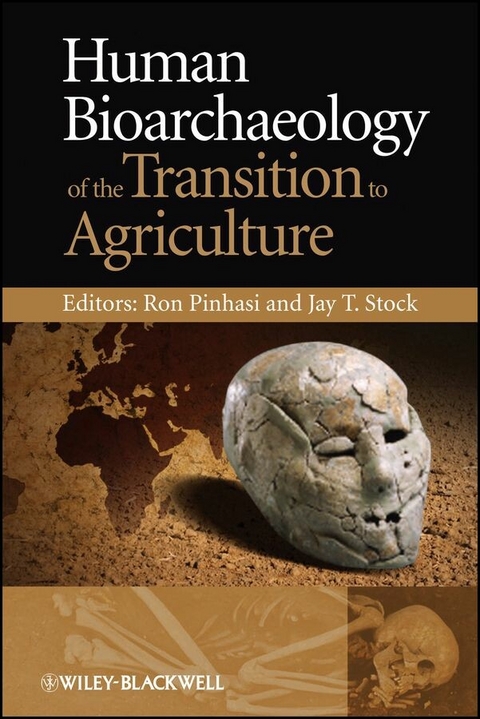
This book is of major interest to the relevant audience since it offers for the first time a global perspective on the bioarchaeology of the transition to agriculture. It includes contributions from world-class researchers, with a particular emphasis on advances in methods (e.g. ancient DNA of pathogens, stable isotope analysis, etc.).
The book specifically addresses the following aspects associated with the transition to agriculture in various world regions:
* Changes in adult and subadult stature and subadult growth profiles
* Diachronic trends in the analysis of functional morphological structures (craniofacial, vault, lower limbs, etc.) and whether these are associated with change in overall sex-specific morphological variability
* Changes in mobility
* Changes in behaviour which can be reconstructed from the study of the skeletal record. These include changes in activity patterns, sexual dimorphism, evidence of inter-personal trauma, and the like.
* Population dynamics and microevolution by examining intra and inter population variations in dental and cranial metric traits, as well as archaeogenetic studies of ancient DNA (e.g. mtDNA markers).
Dr Ron Pinhasi, Lecturer in Prehistoric Archaeology, Department of Archaeology, University College Cork, Cork. Jay T. Stock, University Lecturer in Human Evolution and Development, Fellow of Downing College, Director of Studies in Archaeology & Anthropology, Assistant Director of the Duckworth Laboratory.
Foreword (Clark Spencer Larsen).
List of Contributors.
1. Introduction: Changing Paradigms in Our Understanding of the
Transition to Agriculture: Human Bioarchaeology, Behaviour and
Adaption (Jay T. Stock and Ron Pinhasi).
Section A: Subsistence Transitions.
2. Mesolithic-Neolithic Transitions: An Isotopic Tour through
Europe (Rick Schulting).
3. The Mesolithic-Neolithic Transition in Eastern Europe:
Integrating Stable Isotope Studies of Diet with Palaeopathology to
Identify Subsistence Strategies and Economy (Malcolm Lillie and
Chelsea Budd).
4. Climatic Conditions, Hunting Activities and Husbandry
Practices in the Course of the Neolithic Transition: The Story Told
by Stable Isotope Analyses of Human and Animal Skeletal Remains
(Gisela Grupe and Joris Peters).
5. Health, Diet and Social Implications in Neolithic Greece from
the Study of Human Osteological Material (Anastasia
Papathanasiou).
6. Using a Bioarchaeological Approach to Explore Subsistence
Transitions in the Eastern Cape, South Africa during the Mid- to
Late Holocene (Jaime K. Ginter).
Section B: Growth and Body Size Variation.
7. Long Bone Length, Stature and Time in the European Late
Pleistocene and Early Holocene (Christopher Mieklejohn and Jeff
Babb).
8. Variability in Long Bone Growth Patterns and Limb Proportions
Within and Amongst Mesolithic and Neolithic Populations from
Southeast Europe (Ron Pinhasi, S. Stefanovic, Anastasia
Papathanasiou and Jay T. Stock).
9. Reaching Great Heights: Changes in Indigenous Stature, Body
Size and Body Shape with Agricultural Intensification in North
America (Benjamin M. Auerbach).
10. Evolution of Postcranial Morphology during the Agricultural
Transition in Prehistoric Japan (Daniel H. Temple).
Section C: Biomechanics and Indicators of Habitual
Activity.
11. The Bioarchaeology of Habitual Activity and Dietary Change
in the Siberian Middle Holocene (A.R. Lieverse, Jay T. Stock,
M.A. Katzenberg and C.M. Haverkort).
12. 'An External Agency of Considerable Importance': The
Stresses of Agriculture in the Foraging-to-Farming Transition in
Eastern North America (Clark Spencer Larsen and Christopher
Ruff).
13. Mobility and Lower Limb Robusticity of a Pastoralist
Neolithic Population from North-Western Italy (Damiano Marchi,
Vitale Sparacello and Colin Shaw).
14. Body Size, Skeletal Biomechanics, Mobility and Habitual
Activity from the Late Palaeolithic to the Mid-Dynastic Nile Valley
(Jay T. Stock, Matthew C. O'Neill, Christopher B. Ruff, Melissa
Zabecki, Laura Shackelford and Jerome C. Rose).
Section D: Archaeogenetics, Palaeodemography, Cranial and
Dental Morphology.
15. The Palaeopopulationgenetics of Humans, Cattle and Dairying
in Neolithic Europe (Joachim Burger and Mark G. Thomas).
16. The Genetics of the Neolithic Transition: New Light on
Differences Between Hunter-Gatherers and Farmers in Southern Sweden
(Anna Linderholm).
17. Palaeodemography of Southern Levantine Pre-Pottery Neolithic
Populations: Regional and Temporal Perspectives (Vered Eshed and
Ehud Galili).
18. Skeletal Differentiation at the Southernmost Frontier of
Andean Agriculture (Marina L. Sardi and Marien
Beguelin).
19. Dental Reduction and the Transition to Agriculture in Europe
(Ron Pinhasi and Christopher Meiklejohn).
Index.
"The book comprises numerous excellent case studies
incorporating traditional osteometric methods with newer approaches
such as stable isotopes, biomechanics, and paleogenetics, casting a
much broader net than Cohen and Armelagos' volume, which
focused explicitly on paleopathological indicators of
health." (American Journal of Physical
Anthropology, 5 October 2012)
| Erscheint lt. Verlag | 24.6.2011 |
|---|---|
| Sprache | englisch |
| Themenwelt | Geisteswissenschaften ► Archäologie |
| Geschichte ► Allgemeine Geschichte ► Vor- und Frühgeschichte | |
| Naturwissenschaften ► Biologie ► Evolution | |
| Technik | |
| Schlagworte | Archäologie • archaeology • Archäologie • Biowissenschaften • Evolution des Menschen • Human Evolution • Life Sciences |
| ISBN-10 | 1-119-95668-4 / 1119956684 |
| ISBN-13 | 978-1-119-95668-6 / 9781119956686 |
| Informationen gemäß Produktsicherheitsverordnung (GPSR) | |
| Haben Sie eine Frage zum Produkt? |
 EPUB (Adobe DRM)
Kopierschutz: Adobe-DRM
Adobe-DRM ist ein Kopierschutz, der das eBook vor Mißbrauch schützen soll. Dabei wird das eBook bereits beim Download auf Ihre persönliche Adobe-ID autorisiert. Lesen können Sie das eBook dann nur auf den Geräten, welche ebenfalls auf Ihre Adobe-ID registriert sind.
Details zum Adobe-DRM
Dateiformat: EPUB (Electronic Publication)
EPUB ist ein offener Standard für eBooks und eignet sich besonders zur Darstellung von Belletristik und Sachbüchern. Der Fließtext wird dynamisch an die Display- und Schriftgröße angepasst. Auch für mobile Lesegeräte ist EPUB daher gut geeignet.
Systemvoraussetzungen:
PC/Mac: Mit einem PC oder Mac können Sie dieses eBook lesen. Sie benötigen eine
eReader: Dieses eBook kann mit (fast) allen eBook-Readern gelesen werden. Mit dem amazon-Kindle ist es aber nicht kompatibel.
Smartphone/Tablet: Egal ob Apple oder Android, dieses eBook können Sie lesen. Sie benötigen eine
Geräteliste und zusätzliche Hinweise
Buying eBooks from abroad
For tax law reasons we can sell eBooks just within Germany and Switzerland. Regrettably we cannot fulfill eBook-orders from other countries.
aus dem Bereich