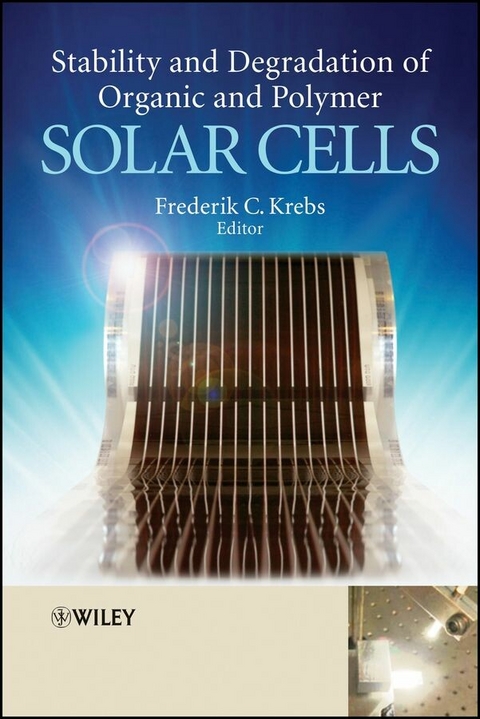
Stability and Degradation of Organic and Polymer Solar Cells (eBook)
368 Seiten
John Wiley & Sons (Verlag)
978-1-119-94242-9 (ISBN)
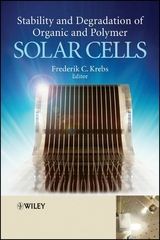
Covering both small molecule and polymer solar cells, Stability and Degradation of Organic and Polymer Solar Cells summarizes the state of the art understanding of stability and provides a detailed analysis of the mechanisms by which degradation occurs. Following an introductory chapter which compares different photovoltaic technologies, the book focuses on OPV degradation, discussing the origin and characterization of the instability and describing measures for extending the duration of operation.
Topics covered include:
* Chemical and physical probes for studying degradation
* Imaging techniques
* Photochemical stability of OPV materials
* Degradation mechanisms
* Testing methods
* Barrier technology and applications
Stability and Degradation of Organic and Polymer Solar Cells is an essential reference source for researchers in academia and industry, engineers and manufacturers working on OPV design, development and implementation.
Professor Frederik Krebs is based at the Riso National Laboratory for Sustainable Energy in Denmark where he is part of the Solar Energy Program. The aim of the program is to synthesize new materials for light harvesting and to optimize the structure of the solar cell with regards to energy conversion, stability and cost. Professor Krebs has been working in the field of polymer solar cells for over 10 years, focusing his efforts on the materials, manufacture and stability of solar cells. His research group are international pioneers, leading the way in their work on organic and polymeric solar cells. He has authored more than 200 publications, has written 2 books on organic photovoltaics (OPVs) and has hosted a conference on the stability of polymer solar cells (ISOS-3 International Summit on OPV Stabilty). He has also edited many journal special issues on organic photovoltaics, including one dedicated to their stability. In 2009, Professor Krebs received the Carlsberg Energy Research Prize in recognition of his work in polymer solar cells.
| Erscheint lt. Verlag | 2.4.2012 |
|---|---|
| Sprache | englisch |
| Themenwelt | Naturwissenschaften ► Chemie ► Physikalische Chemie |
| Technik ► Elektrotechnik / Energietechnik | |
| Technik ► Maschinenbau | |
| Schlagworte | Chemie • Chemistry • Electrical & Electronics Engineering • Electronic materials • Elektronische Materialien • Elektrotechnik u. Elektronik • Festkörperchemie • Festkörperchemie • Materialien f. Energiesysteme • Materials for Energy Systems • Materials Science • Materialwissenschaften • Organischer Halbleiter • Solarzelle • solid state chemistry |
| ISBN-10 | 1-119-94242-X / 111994242X |
| ISBN-13 | 978-1-119-94242-9 / 9781119942429 |
| Informationen gemäß Produktsicherheitsverordnung (GPSR) | |
| Haben Sie eine Frage zum Produkt? |
 PDF (Adobe DRM)
Kopierschutz: Adobe-DRM
Adobe-DRM ist ein Kopierschutz, der das eBook vor Mißbrauch schützen soll. Dabei wird das eBook bereits beim Download auf Ihre persönliche Adobe-ID autorisiert. Lesen können Sie das eBook dann nur auf den Geräten, welche ebenfalls auf Ihre Adobe-ID registriert sind.
Details zum Adobe-DRM
Dateiformat: PDF (Portable Document Format)
Mit einem festen Seitenlayout eignet sich die PDF besonders für Fachbücher mit Spalten, Tabellen und Abbildungen. Eine PDF kann auf fast allen Geräten angezeigt werden, ist aber für kleine Displays (Smartphone, eReader) nur eingeschränkt geeignet.
Systemvoraussetzungen:
PC/Mac: Mit einem PC oder Mac können Sie dieses eBook lesen. Sie benötigen eine
eReader: Dieses eBook kann mit (fast) allen eBook-Readern gelesen werden. Mit dem amazon-Kindle ist es aber nicht kompatibel.
Smartphone/Tablet: Egal ob Apple oder Android, dieses eBook können Sie lesen. Sie benötigen eine
Geräteliste und zusätzliche Hinweise
Buying eBooks from abroad
For tax law reasons we can sell eBooks just within Germany and Switzerland. Regrettably we cannot fulfill eBook-orders from other countries.
aus dem Bereich