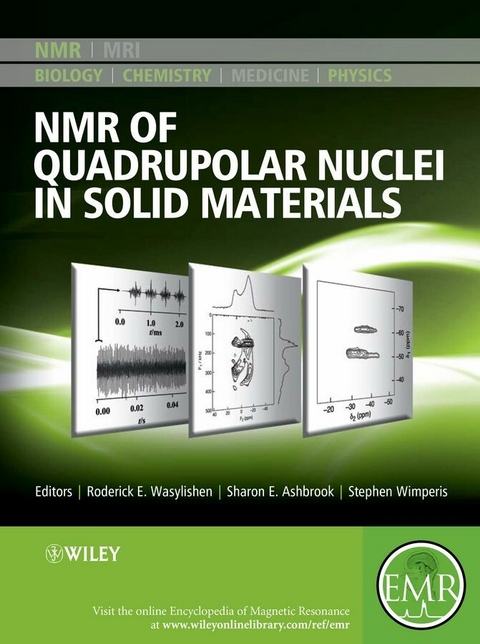
NMR of Quadrupolar Nuclei in Solid Materials (eBook)
John Wiley & Sons (Verlag)
978-1-118-58884-0 (ISBN)
The content of this volume has been added to eMagRes (formerly Encyclopedia of Magnetic Resonance) - the ultimate online resource for NMR and MRI.
Over the past 20 years technical developments in superconducting magnet technology and instrumentation have increased the potential of NMR spectroscopy so that it is now possible to study a wide range of solid materials. In addition, one can probe the nuclear environments of many other additional atoms that possess the property of spin. In particular, it is possible to carry out NMR experiments on isotopes that have nuclear spin greater that ½ (i.e. quadrupolar nuclei). Since more that two-thirds of all NMR active isotopes are quadrupolar nuclei, applications of NMR spectroscopy with quadrupolar nuclei are increasing rapidly.
The purpose of this handbook is to provide under a single cover the fundamental principles, techniques and applications of quadrupolar NMR as it pertains to solid materials. Each chapter has been prepared by an expert who has made significant contributions to out understanding and appreciation of the importance of NMR studies of quadrupolar nuclei in solids. The text is divided into three sections: The first provides the reader with the background necessary to appreciate the challenges in acquiring and interpreting NMR spectra of quadrupolar neclei in solids. The second presents cutting-edge techniques and methodology for employing these techniques to investigate quadrupolar nuclei in solids. The final section explores applications of solid-state NMR studies of solids ranging from investigations of dynamics, characterizations of biological samples, organic and inorganic materials, porous materials, glasses, catalysts, semiconductors and high-temperature superconductors.
About EMR Handbooks / eMagRes Handbooks
The Encyclopedia of Magnetic Resonance (up to 2012) and eMagRes (from 2013 onward) publish a wide range of online articles on all aspects of magnetic resonance in physics, chemistry, biology and medicine. The existence of this large number of articles, written by experts in various fields, is enabling the publication of a series of EMR Handbooks / eMagRes Handbooks on specific areas of NMR and MRI. The chapters of each of these handbooks will comprise a carefully chosen selection of articles from eMagRes. In consultation with the eMagRes Editorial Board, the EMR Handbooks / eMagRes Handbooks are coherently planned in advance by specially-selected Editors, and new articles are written (together with updates of some already existing articles) to give appropriate complete coverage. The handbooks are intended to be of value and interest to research students, postdoctoral fellows and other researchers learning about the scientific area in question and undertaking relevant experiments, whether in academia or industry.
Have the content of this Handbook and the complete content of eMagRes at your fingertips!
Visit: www.wileyonlinelibrary.com/ref/eMagRes
View other eMagRes publications here
NMR OF QUADRUPOLAR NUCLEI IN SOLID MATERIALS Over the past 20 years technical developments in superconducting magnet technology and instrumentation have increased the potential of NMR spectroscopy so that it is now possible to study a wide range of solid materials. In addition, one can probe the nuclear environments of many other additional atoms that possess the property of spin. In particular, it is possible to carry out NMR experiments on isotopes that have nuclear spin greater that (i.e. quadrupolar nuclei). Since more that two-thirds of all NMR active isotopes are quadrupolar nuclei, applications of NMR spectroscopy with quadrupolar nuclei are increasing rapidly. The purpose of this handbook is to provide under a single cover the fundamental principles, techniques and applications of quadrupolar NMR as it pertains to solid materials. Each chapter has been prepared by an expert who has made significant contributions to out understanding and appreciation of the importance of NMR studies of quadrupolar nuclei in solids. The text is divided into three sections: The first provides the reader with the background necessary to appreciate the challenges in acquiring and interpreting NMR spectra of quadrupolar neclei in solids. The second presents cutting-edge techniques and methodology for employing these techniques to investigate quadrupolar nuclei in solids. The final section explores applications of solid-state NMR studies of solids ranging from investigations of dynamics, characterizations of biological samples, organic and inorganic materials, porous materials, glasses, catalysts, semiconductors and high-temperature superconductors. About EMR Handbooks The Encyclopedia of Magnetic Resonance (EMR) publishes a wide range of online articles on all aspects of magnetic resonance in physics, chemistry, biology and medicine. The existence-of this large number of articles, written by experts in various fields, is enabling the publication of a series of EMR Handbooks on specific areas of NMR and MRI. The chapters of each of these handbooks will comprise a carefully chosen selection of Encyclopedia articles. In consultation with the EMR Editorial Board, the EMR Handbooks are coherently planned in advance by specially-selected Editors, and new articles, are written (together with updates of some already existing articles) to give appropriate complete coverage. The handbooks are intended to be of value and interest to research students, postdoctoral fellows and other researchers learning about the scientific area in question and undertaking relevant experiments, whether in academia or industry. Have the content of this handbook and the complete content of the Encyclopedia of Magnetic Resonance at your fingertips! Visit: www.wileyonlinelibrary.com/ref/emr
Roderick E. Wasylishen, Canada Research Chair in Physical Chemistry, Department of -Chemistry, Edmonton, Alberta, Canada. Sharon E. Ashbrook, Reader, School of Chemistry, University of St Andrews, UK. Stephen Wimperis, Professor, Department of Chemistry, Faculty of Physical Sciences, -University of Glasgow, UK.
Contributors ix
Series Preface xiii
Volume Preface xv
Part A: Basic Principles 1
1 Quadrupolar Interactions
Pascal P. Man 3
2 Quadrupolar Nuclei in Solids
Alexander J. Vega 17
3 Quadrupolar Coupling: An Introduction and Crystallographic Aspects
Sharon E. Ashbrook, Stephen Wimperis 45
4 Quadrupolar Nuclei in Solids: Influence of Different Interactions on Spectra
David L. Bryce, Roderick E. Wasylishen 63
Part B: Advanced Techniques 75
5 Acquisition of Wideline Solid-State NMR Spectra of Quadrupolar Nuclei
Robert W. Schurko 77
6 Sensitivity and Resolution Enhancement of Half-Integer Quadrupolar Nuclei in Solid-State NMR
Thomas T. Nakashima, Roderick E. Wasylishen 95
7 Quadrupolar Nutation Spectroscopy
Arno P.M. Kentgens 107
8 Dynamic Angle Spinning
Philip J. Grandinetti 121
9 Double Rotation (DOR) NMR
Ray Dupree 133
10 MQMAS NMR: Experimental Strategies
Jean-Paul Amoureux, Marek Pruski 143
11 STMAS NMR: Experimental Advances
Sharon E. Ashbrook, Stephen Wimperis 163
12 Correlation Experiments Involving Half-Integer Quadrupolar Nuclei
Michael Deschamps, Dominique Massiot 179
13 Computing Electric Field Gradient Tensors
Josef W. Zwanziger 199
Part C: Applications 211
14 Quadrupolar NMR to Investigate Dynamics in Solid Materials
Luke A. O'Dell, Christopher I. Ratcliffe 213
15 Alkali Metal NMR of Biological Molecules
Gang Wu 233
16 Nitrogen-14 NMR Studies of Biological Systems
Luminita Duma 255
17 Oxygen-17 NMR Studies of Organic and Biological Molecules
Gang Wu 273
18 Oxygen-17 NMR of Inorganic Materials
Sharon E. Ashbrook, Mark E. Smith 291
19 Chlorine, Bromine, and Iodine Solid-State NMR
David L. Bryce, Cory M. Widdifield, Rebecca P. Chapman, Robert J. Attrell 321
20 Quadrupolar NMR of Ionic Conductors, Batteries, and other Energy-Related Materials
Frédéric Blanc, Leigh Spencer, Gillian R. Goward 349
21 Quadrupolar NMR of Nanoporous Materials
Mohamed Haouas, Charlotte Martineau, Francis Taulelle 371
22 Quadrupolar NMR in the Earth Sciences
Jonathan F. Stebbins 387
23 Quadrupolar NMR of Superconductors
Nicholas J. Curro 401
24 Quadrupolar NMR of Semiconductors
James P. Yesinowski 417
25 Quadrupolar NMR of Metal Nuclides in Biological Materials
Tatyana Polenova, Andrew S. Lipton, Paul D. Ellis 439
26 Nuclear Waste Glasses: Insights from Solid-State NMR
Scott Kroeker 453
27 Quadrupolar Metal NMR of Oxide Materials Including Catalysts
Olga B. Lapina, Victor V. Terskikh 467
28 Quadrupolar NMR of Intermetallic Compounds
Frank Haarmann 495
Index 511
Contributors
| Jean-Paul Amoureux | Université de Lille, Villeneuve d’Ascq 59650, France Chapter 10: MQMAS NMR: Experimental Strategies |
| Sharon E. Ashbrook | School of Chemistry and EaStCHEM, University of St Andrews, St Andrews KY16 9ST, UK Chapter 3: Quadrupolar Coupling: An Introduction and Crystallographic Aspects Chapter 11: STMAS NMR: Experimental Advances Chapter 18: Oxygen-17 NMR of Inorganic Materials |
| Robert J. Attrell | Department of Chemistry and Centre for Catalysis Research and Innovation, University of Ottawa, 10 Marie Curie Private, Ottawa, ON K1N 6N5, Canada Chapter 19: Chlorine, Bromine, and Iodine Solid-State NMR |
| Frédéric Blanc | Department of Chemistry, University of Cambridge, Lensfield Road, Cambridge CB2 1EW, UK Chapter 20: Quadrupolar NMR of Ionic Conductors, Batteries, and other Energy-Related Materials |
| David L. Bryce | Department of Chemistry and Centre for Catalysis Research and Innovation, University of Ottawa, 10 Marie Curie Private, Ottawa, ON K1N 6N5, Canada Chapter 4: Quadrupolar Nuclei in Solids: Influence of Different Interactions on Spectra Chapter 19: Chlorine, Bromine, and Iodine Solid-State NMR |
| Rebecca P. Chapman | Department of Chemistry and Centre for Catalysis Research and Innovation, University of Ottawa, 10 Marie Curie Private, Ottawa, ON K1N 6N5, Canada Chapter 19: Chlorine, Bromine, and Iodine Solid-State NMR |
| Nicholas J. Curro | Department of Physics, University of California, Davis, CA 95616, USA Chapter 23: Quadrupolar NMR of Superconductors |
| Michael Deschamps | Département de Chimie, Université d’Orléans, BP 6759, 1 Rue de Chartres, 45067 Orléans cedex 2, France Chapter 12: Correlation Experiments Involving Half-Integer Quadrupolar Nuclei |
| Luminita Duma | Ecole Normale Supérieure, Départment de Chimie, Laboratoire des BioMolécules, UMR 7203 CNRS-ENS-UPMC, 24 rue Lhomond, 75005 Paris, France Université Pierre et Marie Curie Paris 6, 4 Place Jussieu, 75005 Paris, France Chapter 16: Nitrogen-14 NMR Studies of Biological Systems |
| Ray Dupree | Department of Physics, University of Warwick, Coventry CV4 7AL, UK Chapter 9: Double Rotation (DOR) NMR |
| Paul D. Ellis | Biological Sciences Division, K8-98, Pacific Northwest National Laboratory, Richland, WA 99352, USA Chapter 25: Quadrupolar NMR of Metal Nuclides in Biological Materials |
| Gillian R. Goward | Department of Chemistry and Brockhouse Institute for Materials Research, McMaster University, Hamilton, ON L8S 4M1, Canada Chapter 20: Quadrupolar NMR of Ionic Conductors, Batteries, and other Energy-Related Materials |
| Philip J. Grandinetti | Department of Chemistry, The Ohio State University, Columbus, OH 43210-1185, USA Chapter 8: Dynamic Angle Spinning |
| Frank Haarmann | Institute of Inorganic Chemistry, RWTH Aachen University, Aachen D-52074, Germany Chapter 28: Quadrupolar NMR of Intermetallic Compounds |
| Mohamed Haouas | Tectospin, Institut Lavoisier de Versailles, Université de Versailles-St. Quentin en Yvelines, 78035 Versailles, France Chapter 21: Quadrupolar NMR of Nanoporous Materials |
| Arno P.M. Kentgens | Radboud University Nijmegen, Institute for Molecules and Materials, Heyendaalseweg 135, 6525 AJ Nijmegen, The Netherlands Chapter 7: Quadrupolar Nutation Spectroscopy |
| Scott Kroeker | Department of Chemistry, University of Manitoba, Winnipeg, MB R3T 2N2, Canada Chapter 26: Nuclear Waste Glasses: Insights from Solid-State NMR |
| Olga B. Lapina | Boreskov Institute of Catalysis, Russian Academy of Sciences, Prospect Lavrent’eva 5, Novosibirsk 630090, Russia Chapter 27: Quadrupolar Metal NMR of Oxide Materials Including Catalysts |
| Andrew S. Lipton | Biological Sciences Division, K8-98, Pacific Northwest National Laboratory, Richland, WA 99352, USA Chapter 25: Quadrupolar NMR of Metal Nuclides in Biological Materials |
| Pascal P. Man | Université Pierre et Marie Curie, Paris 94200, France Chapter 1: Quadrupolar Interactions |
| Charlotte Martineau | Tectospin, Institut Lavoisier de Versailles, Université de Versailles-St. Quentin en Yvelines, 78035 Versailles, France Chapter 21: Quadrupolar NMR of Nanoporous Materials |
| Dominique Massiot | CNRS-CEMHTI, Site Hautes Températures, 1D Avenue de la Recherche Scientifique, 45071 Orléans cedex 2, France Chapter 12: Correlation Experiments Involving Half-Integer Quadrupolar Nuclei |
| Thomas T. Nakashima | Department of Chemistry, University of Alberta, Edmonton, AB T6G 2G2, Canada Chapter 6: Sensitivity and Resolution Enhancement of Half-Integer Quadrupolar Nuclei in Solid-State NMR |
| Luke A. O’Dell | Steacie Institute for Molecular Sciences, National Research Council of Canada, 100 Sussex Drive, Ottawa, ON K1A 0R6, Canada Chapter 14: Quadrupolar NMR to Investigate Dynamics in Solid Materials |
| Tatyana Polenova | Department of Chemistry and Biochemistry, 036 Brown Laboratories, University of Delaware, Newark, DE 19716, USA Chapter 25: Quadrupolar NMR of Metal Nuclides in Biological Materials |
| Marek Pruski | Department of Chemistry, Ames Laboratory, Iowa State University, Ames, IA 50011, USA Chapter 10: MQMAS NMR: Experimental Strategies |
| Christopher I. Ratcliffe | Steacie Institute for Molecular Sciences, National Research Council of Canada, 100 Sussex Drive, Ottawa, ON K1A 0R6, Canada Chapter 14: Quadrupolar NMR to Investigate Dynamics in Solid Materials |
| Robert W. Schurko | University of Windsor, Department of Chemistry and Biochemistry, Windsor, ON N9B 3P4, Canada Chapter 5: Acquisition of Wideline Solid-State NMR Spectra of Quadrupolar Nuclei |
| Mark E. Smith | Department of Physics, University of Warwick, Coventry CV4 7AL, UK Chapter 18: Oxygen-17 NMR of Inorganic Materials |
| Leigh Spencer | Department of Chemistry and Brockhouse Institute for Materials Research, McMaster University, Hamilton, ON L8S 4M1, Canada Chapter 20: Quadrupolar NMR of Ionic Conductors, Batteries, and other Energy-Related Materials |
| Jonathan F. Stebbins | Department of Geological and Environmental Sciences, Stanford University, Stanford, CA 94305, USA Chapter 22: Quadrupolar NMR in the Earth Sciences |
| Francis Taulelle | Tectospin, Institut Lavoisier de Versailles, Université de Versailles-St. Quentin en Yvelines, 78035 Versailles, France Chapter 21: Quadrupolar NMR of Nanoporous... |
| Erscheint lt. Verlag | 19.12.2012 |
|---|---|
| Reihe/Serie | eMagRes Books |
| EMR Books | EMR Books |
| Sprache | englisch |
| Themenwelt | Naturwissenschaften ► Chemie ► Analytische Chemie |
| Naturwissenschaften ► Physik / Astronomie | |
| Technik ► Maschinenbau | |
| Schlagworte | Addition • Additional • atoms • Chemie • Chemistry • Developments • Environments • experiments • Festkörperchemie • Festkörperchemie • greater • isotopes • many • materials characterization • Materials Science • Materialwissenschaften • NMR • NMR Spectroscopy / MRI / Imaging • NMR-Spektroskopie • NMR-Spektroskopie / MRT / Bildgebende Verfahren • Nuclear • One • PAST • possible • Potential • property • solid state chemistry • spectroscopy • Spin • superconducting • technical • Technology • twothirds • Werkstoffprüfung • Werkstoffprüfung • years |
| ISBN-10 | 1-118-58884-3 / 1118588843 |
| ISBN-13 | 978-1-118-58884-0 / 9781118588840 |
| Informationen gemäß Produktsicherheitsverordnung (GPSR) | |
| Haben Sie eine Frage zum Produkt? |
 EPUB (Adobe DRM)
Kopierschutz: Adobe-DRM
Adobe-DRM ist ein Kopierschutz, der das eBook vor Mißbrauch schützen soll. Dabei wird das eBook bereits beim Download auf Ihre persönliche Adobe-ID autorisiert. Lesen können Sie das eBook dann nur auf den Geräten, welche ebenfalls auf Ihre Adobe-ID registriert sind.
Details zum Adobe-DRM
Dateiformat: EPUB (Electronic Publication)
EPUB ist ein offener Standard für eBooks und eignet sich besonders zur Darstellung von Belletristik und Sachbüchern. Der Fließtext wird dynamisch an die Display- und Schriftgröße angepasst. Auch für mobile Lesegeräte ist EPUB daher gut geeignet.
Systemvoraussetzungen:
PC/Mac: Mit einem PC oder Mac können Sie dieses eBook lesen. Sie benötigen eine
eReader: Dieses eBook kann mit (fast) allen eBook-Readern gelesen werden. Mit dem amazon-Kindle ist es aber nicht kompatibel.
Smartphone/Tablet: Egal ob Apple oder Android, dieses eBook können Sie lesen. Sie benötigen eine
Geräteliste und zusätzliche Hinweise
Buying eBooks from abroad
For tax law reasons we can sell eBooks just within Germany and Switzerland. Regrettably we cannot fulfill eBook-orders from other countries.
aus dem Bereich