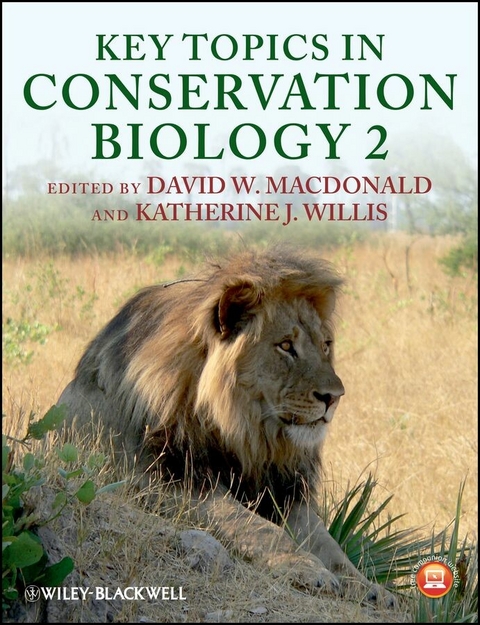
Key Topics in Conservation Biology 2 (eBook)
John Wiley & Sons (Verlag)
978-1-118-52020-8 (ISBN)
Following the much acclaimed success of the first volume of Key Topics in Conservation Biology, this entirely new second volume addresses an innovative array of key topics in contemporary conservation biology. Written by an internationally renowned team of authors, Key Topics in Conservation Biology 2 adds to the still topical foundations laid in the first volume (published in 2007) by exploring a further 25 cutting-edge issues in modern biodiversity conservation, including controversial subjects such as setting conservation priorities, balancing the focus on species and ecosystems, and financial mechanisms to value biodiversity and pay for its conservation. Other chapters, setting the framework for conservation, address the sociology and philosophy of peoples' relation with Nature and its impact on health, and such challenging practical issues as wildlife trade and conflict between people and carnivores. As a new development, this second volume of Key Topics includes chapters on major ecosystems, such as forests, islands and both fresh and marine waters, along with case studies of the conservation of major taxa: plants, butterflies, birds and mammals. A further selection of topics consider how to safeguard the future through monitoring, reserve planning, corridors and connectivity, together with approaches to reintroduction and re-wilding, along with managing wildlife disease. A final chapter, by the editors, synthesises thinking on the relationship between biodiversity conservation and human development.
Each topic is explored by a team of top international experts, assembled to bring their own cross-cutting knowledge to a penetrating synthesis of the issues from both theoretical and practical perspectives.
The interdisciplinary nature of biodiversity conservation is reflected throughout the book. Each essay examines the fundamental principles of the topic, the methodologies involved and, crucially, the human dimension. In this way, Key Topics in Conservation Biology 2, like its sister volume, Key Topics in Conservation Biology, embraces issues from cutting-edge ecological science to policy, environmental economics, governance, ethics, and the practical issues of implementation.
Key Topics in Conservation Biology 2 will, like its sister volume, be a valuable resource in universities and colleges, government departments, and conservation agencies. It is aimed particularly at senior undergraduate and graduate students in conservation biology and wildlife management and wider ecological and environmental subjects, and those taking Masters degrees in any field relevant to conservation and the environment. Conservation practitioners, policy-makers, and the wider general public eager to understand more about important environmental issues will also find this book invaluable.
David W. Macdonald CBE FRSE is Professor of Wildlife Conservation at the University of Oxford. Founder and Director of Oxford's Wildlife Conservation Research Unit (WildCRU), and a Fellow of Lady Margaret Hall, Oxford. In addition to his conservation research, he is heavily involved in the practice and policy of conservation, and is also known through his films and books on wildlife.
Katherine J. Willis is the Tasso Leventis Professor of Biodiversity at the University of Oxford, Director of the Oxford Martin School Biodiversity Institute (BIO) in the Department of Zoology, and a Fellow of Merton College, Oxford. She is also an adjunct Professor in Biology at the University of Bergen, Norway. Her work within the Biodiversity Institute falls under three key research areas: biodiversity beyond protected areas; ecological and evolutionary processes responsible for biodiversity; and biodiversity technologies. She is also heavily involved in the development of smartphone and web-based decision support tools to facilitate the transfer of knowledge on biodiversity science and ecosystem services into conservation, management and policy.
Following the much acclaimed success of the first volume of Key Topics in Conservation Biology, this entirely new second volume addresses an innovative array of key topics in contemporary conservation biology. Written by an internationally renowned team of authors, Key Topics in Conservation Biology 2 adds to the still topical foundations laid in the first volume (published in 2007) by exploring a further 25 cutting-edge issues in modern biodiversity conservation, including controversial subjects such as setting conservation priorities, balancing the focus on species and ecosystems, and financial mechanisms to value biodiversity and pay for its conservation. Other chapters, setting the framework for conservation, address the sociology and philosophy of peoples relation with Nature and its impact on health, and such challenging practical issues as wildlife trade and conflict between people and carnivores. As a new development, this second volume of Key Topics includes chapters on major ecosystems, such as forests, islands and both fresh and marine waters, along with case studies of the conservation of major taxa: plants, butterflies, birds and mammals. A further selection of topics consider how to safeguard the future through monitoring, reserve planning, corridors and connectivity, together with approaches to reintroduction and re-wilding, along with managing wildlife disease. A final chapter, by the editors, synthesises thinking on the relationship between biodiversity conservation and human development. Each topic is explored by a team of top international experts, assembled to bring their own cross-cutting knowledge to a penetrating synthesis of the issues from both theoretical and practical perspectives. The interdisciplinary nature of biodiversity conservation is reflected throughout the book. Each essay examines the fundamental principles of the topic, the methodologies involved and, crucially, the human dimension. In this way, Key Topics in Conservation Biology 2, like its sister volume, Key Topics in Conservation Biology, embraces issues from cutting-edge ecological science to policy, environmental economics, governance, ethics, and the practical issues of implementation. Key Topics in Conservation Biology 2 will, like its sister volume, be a valuable resource in universities and colleges, government departments, and conservation agencies. It is aimed particularly at senior undergraduate and graduate students in conservation biology and wildlife management and wider ecological and environmental subjects, and those taking Masters degrees in any field relevant to conservation and the environment. Conservation practitioners, policy-makers, and the wider general public eager to understand more about important environmental issues will also find this book invaluable.
David W. Macdonald CBE FRSE is Professor of Wildlife Conservation at the University of Oxford. Founder and Director of Oxford's Wildlife Conservation Research Unit (WildCRU), and a Fellow of Lady Margaret Hall, Oxford. In addition to his conservation research, he is heavily involved in the practice and policy of conservation, and is also known through his films and books on wildlife. Katherine J. Willis is the Tasso Leventis Professor of Biodiversity at the University of Oxford, Director of the Oxford Martin School Biodiversity Institute (BIO) in the Department of Zoology, and a Fellow of Merton College, Oxford. She is also an adjunct Professor in Biology at the University of Bergen, Norway. Her work within the Biodiversity Institute falls under three key research areas: biodiversity beyond protected areas; ecological and evolutionary processes responsible for biodiversity; and biodiversity technologies. She is also heavily involved in the development of smartphone and web-based decision support tools to facilitate the transfer of knowledge on biodiversity science and ecosystem services into conservation, management and policy.
Contributors
Preface
Part 1: The Framework
1. Conservation priorities: Identifying need, taking action and evaluating success
Andrew Pullin, Bill Sutherland, Toby Gardner, Val Kapos and John Fa
2. Levels of Approach: on the appropriate scales for conservation interventions and planning
Jonathan Baillie, David Raffaelli and Claudio Sillero-Zubiri
3. Five Paradigms of Collective Action Underlying the Human Dimension of Conservation
Laurent Mermet, Katherine Homewood, Andrew Dobson and Raphaël Billé
4. Economic instruments for nature conservation
Christopher Barrett, Erwin Bulte, Paul Ferraro and Sven Wunder
5. Tackling unsustainable wildlife trade
Adam Dutton, Brian Gratwicke, Cameron Hepburn, Emilio Herrera and David Macdonald
6. Leadership and Listening: Inspiration for Conservation Mission and Advocacy
Andrew Gosler, Shonil Bhagwat, Stuart Harrop, Mark Bonta and Sonia Tidemann
7. The importance of the human dimension in addressing conflict with large carnivores
Amy Dickman, Silvio Marchini andMichael Manfredo
8. Citizen Science and nature conservation
Jonathan Silvertown, Christina Buesching, Susan Jacobson and Tony Rebelo
9. Nature as a source of health and well-being: is this an ecosystem service that could pay for conserving biodiversity?
Joelene Hughes, Jules Pretty and David Macdonald
Part 2: Habitat Case Studies
10. Ocean conservation: current challenges and future opportunities
Alex Rogers,Dan Laffoley, Nick Polunin and Derek Tittensor
11. Lost in muddy waters: freshwater biodiversity
Nic Pacini, David Harper, Peter Henderson, and Tom Le Quesne
12. Habitat case studies: Islands
Kim King, Mark Lomolino, Gary Roemer and Brendan Godley
13. Conservation of tropical forests: maintaining ecological integrity and resilience
Owen Lewis, Robert Ewers, Margaret Loman and Yadvinder Malhi
Part 3. Taxonomic Case Studies
14. A Global Perspective on Conserving Butterflies and Moths and their Habitats
Thomas Merckx, Blanca Huertas, Yves Basset and Jeremy Thomas
15. Bird Conservation in Tropical Ecosystems: Challenges and Opportunities
Joseph Tobias, Çadan Dekerciodlu and Hernan Vargas
16. Conserving Large Mammals: are they a special case?
David Macdonald, Luigi Boitani, Eric Dinerstein, Herve Fritz and Richard Wrangham
17. Plant conservation: the seeds of success
Tim Walker, Stephen Harris and Kingsley Dixon
Part 4. Safeguarding the Future
18. The 'why', 'what' and 'how' of monitoring for conservation
Julia Jones, Greg Asner, Stu Butchart and Ullas Karanth
19. Effective conservation depends upon understanding human behaviour
Freya St. John, Aidan Keane and E.J. Milner-Gulland
20. Designing effective solutions to conservation planning problems
Andrew T. Knight, Ana. S.L. Rodrigues, Niels Strange, Tom Tew and Kerrie A. Wilson
21. Biological Corridors and Connectivity
Samuel Cushman, Brad McRae, Frank Adriaensen, Paul Beier, Mark Shirley and Kathy Zeller
22. Righting past wrongs and ensuring the future: challenges and opportunities for effective reintroductions amidst a biodiversity crisis
Axel Moehrenschlager, Debra Shier, Tom Moorhouse, Mark Stanley Price
23. Re-wilding
Chris Sandom, Josh Donlan, Jens-Christian Svenning and Dennis Hansen
24. Disease Control
Peter D. Walsh
Part 5: A Synthesis
25. Key Topics -Elephants in the room: tough choices for a maturing discipline
David W. Macdonald and Kathy Willis
Index
"The synthesis chapter is one of the highlights of this valuable multidisciplinary contribution to the field of conservation biology and should be mandatory reading material for both students of conservation biology and policymakers." (Quarterly Review Biology, 1 March 2015)
"The editors deserve credit for having assembled and coordinated such a rich and diverse group of authors and for having produced such an innovative and very useful work." (Biological Conservation, 1 January 2015)
"This excellent documentation will help readers see the connection between several subdisciplines of biology. Summing Up: Highly recommended. Upper-division undergraduates and above." (Choice, 1 December 2013)
| Erscheint lt. Verlag | 6.2.2013 |
|---|---|
| Sprache | englisch |
| Themenwelt | Naturwissenschaften ► Biologie ► Ökologie / Naturschutz |
| Naturwissenschaften ► Geowissenschaften ► Geologie | |
| Technik | |
| Schlagworte | acclaimed • adds • Angewandte Ãkologie • Angewandte Ökologie • Applied Ecology • Array • Biology • Biowissenschaften • conservation • Conservation Science • Contemporary • Exploring • First • Foundations • Innovative • internationally • Key • Life Sciences • Naturschutzbiologie • New • Second • Still • Team • Topical • Topics • Volume |
| ISBN-10 | 1-118-52020-3 / 1118520203 |
| ISBN-13 | 978-1-118-52020-8 / 9781118520208 |
| Informationen gemäß Produktsicherheitsverordnung (GPSR) | |
| Haben Sie eine Frage zum Produkt? |
 EPUB (Adobe DRM)
Kopierschutz: Adobe-DRM
Adobe-DRM ist ein Kopierschutz, der das eBook vor Mißbrauch schützen soll. Dabei wird das eBook bereits beim Download auf Ihre persönliche Adobe-ID autorisiert. Lesen können Sie das eBook dann nur auf den Geräten, welche ebenfalls auf Ihre Adobe-ID registriert sind.
Details zum Adobe-DRM
Dateiformat: EPUB (Electronic Publication)
EPUB ist ein offener Standard für eBooks und eignet sich besonders zur Darstellung von Belletristik und Sachbüchern. Der Fließtext wird dynamisch an die Display- und Schriftgröße angepasst. Auch für mobile Lesegeräte ist EPUB daher gut geeignet.
Systemvoraussetzungen:
PC/Mac: Mit einem PC oder Mac können Sie dieses eBook lesen. Sie benötigen eine
eReader: Dieses eBook kann mit (fast) allen eBook-Readern gelesen werden. Mit dem amazon-Kindle ist es aber nicht kompatibel.
Smartphone/Tablet: Egal ob Apple oder Android, dieses eBook können Sie lesen. Sie benötigen eine
Geräteliste und zusätzliche Hinweise
Buying eBooks from abroad
For tax law reasons we can sell eBooks just within Germany and Switzerland. Regrettably we cannot fulfill eBook-orders from other countries.
aus dem Bereich