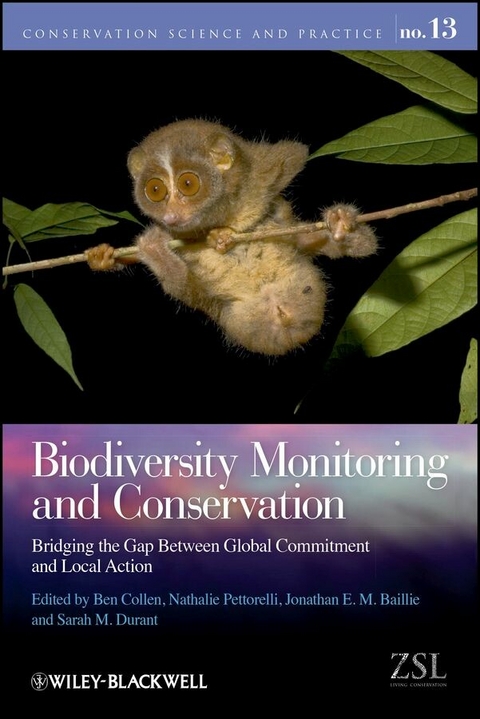
Biodiversity Monitoring and Conservation (eBook)
John Wiley & Sons (Verlag)
978-1-118-49076-1 (ISBN)
As the impacts of anthropogenic activities increase in both magnitude and extent, biodiversity is coming under increasing pressure. Scientists and policy makers are frequently hampered by a lack of information on biological systems, particularly information relating to long-term trends. Such information is crucial to developing an understanding as to how biodiversity may respond to global environmental change. Knowledge gaps make it very difficult to develop effective policies and legislation to reduce and reverse biodiversity loss.
This book explores the gap between global commitments to biodiversity conservation, and local action to track biodiversity change and implement conservation action. High profile international political commitments to improve biodiversity conservation, such as the targets set by the Convention on Biological Diversity, require innovative and rapid responses from both science and policy. This multi-disciplinary perspective highlights barriers to conservation and offers novel solutions to evaluating trends in biodiversity at multiple scales.
Ben Collen is head of the Indicators & Assessments Unit at the Zoological Society of London. His research is focussed on developing indicators to monitor change in biodiversity and help guide policy responses to conservation problems. He conducts local scale monitoring on tropical forest fauna in Liberia, and penguins in the Antarctic.
Nathalie Pettorelli is a population ecologist, whose research is centred on predicting the impacts of global environmental change on biodiversity. Her work was among the first to explore the usefulness of satellite data (in particular, the Normalised Difference Vegetation Index) in the context of population ecology and dynamics.
Jonathan Baillie is Director of Conservation at the Zoological Society of London. He is responsible for conservation projects focusing on threatened species and habitats in over 50 countries around the world. His research focus lies in defining the status and trends of the world's species and ecosystems.
Sarah Durant is head of the Tanzania Carnivore Centre in Arusha, and the Range Wide Conservation Initiative for Cheetah and Wild Dog. She has been working for over 20 years in carnivore conservation in Africa, focussing on developing effective and sustainable approaches to conserve threatened species.
As the impacts of anthropogenic activities increase in both magnitude and extent, biodiversity is coming under increasing pressure. Scientists and policy makers are frequently hampered by a lack of information on biological systems, particularly information relating to long-term trends. Such information is crucial to developing an understanding as to how biodiversity may respond to global environmental change. Knowledge gaps make it very difficult to develop effective policies and legislation to reduce and reverse biodiversity loss. This book explores the gap between global commitments to biodiversity conservation, and local action to track biodiversity change and implement conservation action. High profile international political commitments to improve biodiversity conservation, such as the targets set by the Convention on Biological Diversity, require innovative and rapid responses from both science and policy. This multi-disciplinary perspective highlights barriers to conservation and offers novel solutions to evaluating trends in biodiversity at multiple scales.
Ben Collen is head of the Indicators & Assessments Unit at the Zoological Society of London. His research is focussed on developing indicators to monitor change in biodiversity and help guide policy responses to conservation problems. He conducts local scale monitoring on tropical forest fauna in Liberia, and penguins in the Antarctic. Nathalie Pettorelli is a population ecologist, whose research is centred on predicting the impacts of global environmental change on biodiversity. Her work was among the first to explore the usefulness of satellite data (in particular, the Normalised Difference Vegetation Index) in the context of population ecology and dynamics. Jonathan Baillie is Director of Conservation at the Zoological Society of London. He is responsible for conservation projects focusing on threatened species and habitats in over 50 countries around the world. His research focus lies in defining the status and trends of the world's species and ecosystems. Sarah Durant is head of the Tanzania Carnivore Centre in Arusha, and the Range Wide Conservation Initiative for Cheetah and Wild Dog. She has been working for over 20 years in carnivore conservation in Africa, focussing on developing effective and sustainable approaches to conserve threatened species.
Contributors xi
Acknowledgements xv
1. Biodiversity Monitoring and Conservation: Bridging the Gaps Between Global Commitment and Local Action 1
Ben Collen, Nathalie Pettorelli, Jonathan E.M. Baillie and SarahM. Durant
Part I Species-Based Indicators of Biodiversity Change 17
2. Tracking Change in National-Level Conservation Status: National Red Lists 19
Ben Collen, Janine Griffiths, Yolan Friedmann, Jon Paul Rodriguez, Franklin Rojas-Suarez and Jonathan E.M. Baillie
3. TheWildlife Picture Index: A Biodiversity Indicator for Top Trophic Levels 45
Timothy G. O'Brien and Margaret F. Kinnaird
4. Tracking Change in Abundance: The Living Planet Index 71
Ben Collen, Louise McRae, Jonathan Loh, Stefanie Deinet, Adriana De Palma, Robyn Manley and Jonathan E.M. Baillie
Part II Indicators of the Pressures on Biodiversity 95
5. Satellite Data-Based Indices to Monitor Land Use and Habitat Changes 97
Nathalie Pettorelli
6. Indicators of Climate Change Impacts on Biodiversity 120
Wendy B. Foden, Georgina M. Mace and Stuart H.M. Butchart
7. Monitoring Trends in Biological Invasion, its Impact andPolicyResponses 138
Piero Genovesi, Stuart H.M. Butchart, Melodie A. McGeoch and David B. Roy
8. Exploitation Indices: Developing Global and National Metrics of Wildlife Use and Trade 159
Rosamunde E.A. Almond, Stuart H.M. Butchart, Thomasina E.E. Oldfield, Louise McRae and Steven de Bie
9. Personalized Measures of Consumption and Development in the Context of Biodiversity Conservation: Connecting the Ecological Footprint Calculation with the Human Footprint Map 189
Eric W. Sanderson
Part III The Next Generation of Biodiversity Indicators 211
10. Indicator Bats Program: A System for the Global Acoustic Monitoring of Bats 213
Kate E. Jones, Jon A. Russ, Andriy-Taras Bashta, Zoltan Bilhari, Colin Catto, Istvan Csosz, Alexander Gorbachev, Peter Gyorfi, Alice Hughes, Igor Ivashkiv, Natalia Koryagina, Aniko Kurali, Steve Langton, Alanna Collen, Georgiana Margiean, Ivan Pandourski, Stuart Parsons, Igor Prokofev, Abigel Szodoray-Paradi, Farkas Szodoray-Paradi, Elena Tilova, Charlotte L. Walters, Aidan Weatherill and Oleg Zavarzin
11. Occupancy Methods for Conservation Management 248
Darryl I. MacKenzie and James T. Reardon
12. Monitoring and Evaluating the Socioeconomic Impacts of Conservation Projects on Local Communities 265
Katherine Homewood
13. Science to Policy Linkages for the Post-2010 Biodiversity Targets 291
Georgina M. Mace, Charles Perrings, Philippe Le Prestre, Wolfgang Cramer, Sandra Diaz, Anne Larigauderie, Robert J. Scholes and Harold A. Mooney
Part IV Biodiversity Monitoring in Practice 311
14. Building Sustainable National Monitoring Networks 313
Sarah M. Durant
15. Monitoring in the Real World 335
Julia P.G. Jones
16. Monitoring in UNDP-GEF Biodiversity Projects: Balancing Conservation Priorities, Financial Realities, and Scientific Rigour 348
Sultana Bashir
17. Scaling Up or Down? LinkingGlobal and National Biodiversity Indicators and Reporting 402
Philip Bubb
18. Conserving Biodiversity in a Target-Driven World 421
Simon N. Stuart and Ben Collen
Index 439
"If you are a teacher, conservation scientist, or biodiversity manager and want to choose one book integrating biodiversity monitoring and indicators, this is the volume to get." (The Quarterly Review of Biology, 1 October 2015)
"This does nothing to take away from the editors' primary accomplishment, however, which is to have produced the most authoritative volume currently available on biodiversity monitoring." (Biological Conservation,1 October 2014)
"Summing Up: Recommended. Upper-division undergraduates and above." (Choice, 1 March 2014)
| Erscheint lt. Verlag | 13.2.2013 |
|---|---|
| Reihe/Serie | Conservation Science and Practice | Conservation Science and Practice |
| Sprache | englisch |
| Themenwelt | Naturwissenschaften ► Biologie ► Ökologie / Naturschutz |
| Naturwissenschaften ► Geowissenschaften ► Geologie | |
| Technik | |
| Schlagworte | Ben Collen, Nathalie Pettorelli, Jonathan Baillie, Sarah Durant, biodiversity monitoring and conservation, conservation science and practice, biodiversity conservation, conservation biology, biodiversity change • Biodiversität • Biodiversität • biodiversity • Biowissenschaften • Conservation Science • Life Sciences • Naturschutzbiologie |
| ISBN-10 | 1-118-49076-2 / 1118490762 |
| ISBN-13 | 978-1-118-49076-1 / 9781118490761 |
| Informationen gemäß Produktsicherheitsverordnung (GPSR) | |
| Haben Sie eine Frage zum Produkt? |
 PDF (Adobe DRM)
Kopierschutz: Adobe-DRM
Adobe-DRM ist ein Kopierschutz, der das eBook vor Mißbrauch schützen soll. Dabei wird das eBook bereits beim Download auf Ihre persönliche Adobe-ID autorisiert. Lesen können Sie das eBook dann nur auf den Geräten, welche ebenfalls auf Ihre Adobe-ID registriert sind.
Details zum Adobe-DRM
Dateiformat: PDF (Portable Document Format)
Mit einem festen Seitenlayout eignet sich die PDF besonders für Fachbücher mit Spalten, Tabellen und Abbildungen. Eine PDF kann auf fast allen Geräten angezeigt werden, ist aber für kleine Displays (Smartphone, eReader) nur eingeschränkt geeignet.
Systemvoraussetzungen:
PC/Mac: Mit einem PC oder Mac können Sie dieses eBook lesen. Sie benötigen eine
eReader: Dieses eBook kann mit (fast) allen eBook-Readern gelesen werden. Mit dem amazon-Kindle ist es aber nicht kompatibel.
Smartphone/Tablet: Egal ob Apple oder Android, dieses eBook können Sie lesen. Sie benötigen eine
Geräteliste und zusätzliche Hinweise
Buying eBooks from abroad
For tax law reasons we can sell eBooks just within Germany and Switzerland. Regrettably we cannot fulfill eBook-orders from other countries.
aus dem Bereich