Bioremediation and Sustainability (eBook)
438 Seiten
John Wiley & Sons (Verlag)
978-1-118-37126-8 (ISBN)
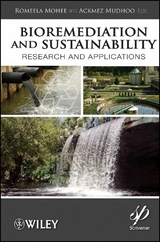
Sustainable development requires the development and promotion of environmental management and a constant search for green technologies to treat a wide range of aquatic and terrestrial habitats contaminated by increasing anthropogenic activities with the main sources of contaminants being the chemical industries. Bioremediation is a technique that uses living organisms in order to degrade or transform contaminants into their less toxic forms. It is based on the existence of microorganisms with the capacity to attack the compounds on the enzymatic level.
Bioremediation is an increasingly popular low-cost alternative to conventional methods for treating wastes and contaminated media with the possibility to degrade these contaminants using natural microbial activity mediated by different consortia of microbes. Over the last few years, the scientific literature has revealed the progressive emergence of various bioremediation techniques. Bioremediation and Sustainability presents an up-to-date and comprehensive collection of chapters prepared in bioremediation technology research and applications.
The strategies covered in this volume can be applied in situ or ex situ, depending on the site in which they will be applied. In situ is the treatment done in the site of the contamination, and ex situ involves the removal of soil or water to subsequent treatment. There is a wide variety of techniques that have been developed in the past and are covered in this volume, such as natural attenuation, bioaugmentation, biostimulation, biosorption, composting, phytoremediation, rhizoremediation, and bioleaching.
Romeela Mohee, PhD, is Professor of Environmental Engineering in the Department of Chemical and Environmental Engineering at the University of Mauritius. She obtained her PhD at the University of Mauritius in 1998, and her primary research interests are in waste containment, solid waste management and treatment by anaerobic digestion and composting, beneficial reuse of waste materials, and heat and mass transfer modeling. An eminent international consultant in environmental science and energy issues, Dr. Mohee has authored or contributed to over 70 international publications on waste biotreatment, including four books and numerous conference papers and consultancy reports. Ackmez Mudhoo, MPhil, is Lecturer in the Department of Chemical and Environmental Engineering at the University of Mauritius. His main research interests encompass the design of composting systems, analysis of composting processes, and the biological treatment of solid wastes and wastewater. He has dozens of international journal publications and conference papers to his credit. He is also a peer reviewer on numerous journals, and is the editor-in-chief for two international research journals.
Dedications
Preface
Acknowledgements
Editor
List of Contributors
Chapter 1. Elements of Sustainability and Bioremediation
Ackmez Mudhoo and Romeela Mohee
Chapter 2. Natural Attenuation
R. Ryan Dupont
Chapter 3. Anaerobic Digestion Processes
Steven I. Safferman, Dana M. Kirk Louis L. Faivor, Wei
Wu-Haan
Chapter 4. Biosurfactants: Synthesis, Properties and
Applications in Environmental Bioremediation
Ramkrishna Sen, Ackmez Mudhoo and Gunaseelan, D.
Chapter 5. Phytoremediation: An Efficient Approach for
Bioremediation of Organic and Metallic Ions Pollutants
Divya Gupta, Lalit Kumar Singh, Ashish Deep Gupta and Vikash
Babu
Chapter 6. Bioleaching
Leo G. Leduc and Garry D. Ferroni
Chapter 7. Biosorption of Heavy Metals - New
Perspectives
Teresa Taveres and Hugo Figueiredo
Chapter 8. Biofiltration: Essentials, Research and
Applications
Smita Raghuvanshi, Subhajit Majumder and Suresh Gupta
Chapter 9. Modeling and Implementation of Sustainable
Remediation Based on Bioventing
Hillel Rubin, Eran Rubin, and Holger Schüttrumpf
Chapter 10. Bioremediation of Xenobiotics
Kamal Saxena, Gajendra Kumar Aseri, Ashish Deep Gupta and Vikash
Babu
Index
| Erscheint lt. Verlag | 3.4.2012 |
|---|---|
| Sprache | englisch |
| Themenwelt | Naturwissenschaften ► Biologie ► Ökologie / Naturschutz |
| Naturwissenschaften ► Geowissenschaften | |
| Technik ► Umwelttechnik / Biotechnologie | |
| Schlagworte | Chemie • Chemistry • Environmental Science • Environmental Studies • Petrochemie • Petrochemie / Brennstoffindustrie • Petrochemistry / Fuel • Umweltforschung • Umweltwissenschaften |
| ISBN-10 | 1-118-37126-7 / 1118371267 |
| ISBN-13 | 978-1-118-37126-8 / 9781118371268 |
| Informationen gemäß Produktsicherheitsverordnung (GPSR) | |
| Haben Sie eine Frage zum Produkt? |
 PDF (Adobe DRM)
Kopierschutz: Adobe-DRM
Adobe-DRM ist ein Kopierschutz, der das eBook vor Mißbrauch schützen soll. Dabei wird das eBook bereits beim Download auf Ihre persönliche Adobe-ID autorisiert. Lesen können Sie das eBook dann nur auf den Geräten, welche ebenfalls auf Ihre Adobe-ID registriert sind.
Details zum Adobe-DRM
Dateiformat: PDF (Portable Document Format)
Mit einem festen Seitenlayout eignet sich die PDF besonders für Fachbücher mit Spalten, Tabellen und Abbildungen. Eine PDF kann auf fast allen Geräten angezeigt werden, ist aber für kleine Displays (Smartphone, eReader) nur eingeschränkt geeignet.
Systemvoraussetzungen:
PC/Mac: Mit einem PC oder Mac können Sie dieses eBook lesen. Sie benötigen eine
eReader: Dieses eBook kann mit (fast) allen eBook-Readern gelesen werden. Mit dem amazon-Kindle ist es aber nicht kompatibel.
Smartphone/Tablet: Egal ob Apple oder Android, dieses eBook können Sie lesen. Sie benötigen eine
Geräteliste und zusätzliche Hinweise
Buying eBooks from abroad
For tax law reasons we can sell eBooks just within Germany and Switzerland. Regrettably we cannot fulfill eBook-orders from other countries.
aus dem Bereich