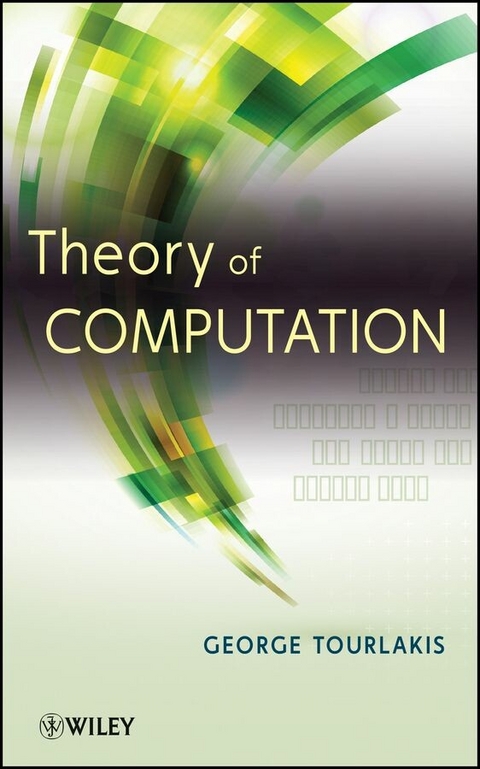
Theory of Computation (eBook)
416 Seiten
John Wiley & Sons (Verlag)
978-1-118-31533-0 (ISBN)
theoretical limitations of computer programming
Offering an accessible approach to the topic, Theory of
Computation focuses on the metatheory of computing and the
theoretical boundaries between what various computational models
can do and not do--from the most general model, the URM
(Unbounded Register Machines), to the finite automaton. A wealth of
programming-like examples and easy-to-follow explanations build the
general theory gradually, which guides readers through the modeling
and mathematical analysis of computational phenomena and provides
insights on what makes things tick and also what restrains the
ability of computational processes.
Recognizing the importance of acquired practical experience, the
book begins with the metatheory of general purpose computer
programs, using URMs as a straightforward, technology-independent
model of modern high-level programming languages while also
exploring the restrictions of the URM language. Once readers gain
an understanding of computability theory--including the
primitive recursive functions--the author presents automata
and languages, covering the regular and context-free languages as
well as the machines that recognize these languages. Several
advanced topics such as reducibilities, the recursion theorem,
complexity theory, and Cook's theorem are also discussed. Features
of the book include:
* A review of basic discrete mathematics, covering logic and
induction while omitting specialized combinatorial topics
* A thorough development of the modeling and mathematical analysis
of computational phenomena, providing a solid foundation of
un-computability
* The connection between un-computability and un-provability:
Gödel's first incompleteness theorem
The book provides numerous examples of specific URMs as well as
other programming languages including Loop Programs, FA
(Deterministic Finite Automata), NFA (Nondeterministic Finite
Automata), and PDA (Pushdown Automata). Exercises at the end of
each chapter allow readers to test their comprehension of the
presented material, and an extensive bibliography suggests
resources for further study.
Assuming only a basic understanding of general computer
programming and discrete mathematics, Theory of Computation
serves as a valuable book for courses on theory of computation at
the upper-undergraduate level. The book also serves as an excellent
resource for programmers and computing professionals wishing to
understand the theoretical limitations of their craft.
George Tourlakis, PHD, is University Professor of Computer Science and Engineering at York University in Toronto, Canada. He has published extensively in his areas of research interest, which include calculational logic, modal logic, computability, and complexity theory. Dr. Tourlakis is the author of Mathematical Logic, also published by Wiley.
Preface xi
1. Mathematical Foundations 1
1.1 Sets and Logic; Naïvely 1
1.2 Relations and Functions 40
1.3 Big and Small Infinite Sets; Diagonalization 52
1.4 Induction from a User's Perspective 61
1.5 Why Induction Ticks 68
1.6 Inductively Defined Sets
1.7 Recursive Definitions of Functions
1.8 Additional Exercises 85
2. Algorithms, Computable Functions and Computations
91
2.1 A Theory of Computability 91
2.2 A programming Formalism for the Primitive Recursive
Functions Function Class 147
2.3 URM Computations and their Arithmetization 141
2.4 A double-recursion that leads outside the Primitive
Recursive Function Class
2.5 Semi-computable Relations: Unsolvability
2.6 The Iteration Theorem of Kleene 172
2.7 Diagonalization Revisited; Unsolvability via Reductions
175
2.8 Productive and Creative Sets 209
2.9 The Recursion Theorem 214
2. 10 Completeness 217
2.11 Unprovability from Unsolvability 221
2.12 Additional Exercises 234
3. A Subset of the URM Language; FA and NFA 241
3.1 Deterministic Finite Automata and their Languages 243
3.2 Nondeterministic Finite Automata
3.3 Regular Expressions 266
3.4 Regular Grammars and Languages 277
3.5 Additional Exercises 287
4. Adding a stack of a NFA: Pushdown Automata
4.1 The PDA 294
4.2 PDA Computations 294
4.3 The PDA-acceptable Languages are the Context Free Languages
305
4.4 Non-Context Free Languages; Another Pumping Lemma 312
4.5 Additional Exercise 322
5. Computational Complexity 325
5.1 Adding a second stack; Turning Machines 325
5.2 Axt, loop program, and Grzegorczyk hierarchies
5.3 Additional Exercised
"This is an outstanding book, and I recommend it highly to
students and practitioners alike." (Computing
Reviews, 8 April 2013)
| Erscheint lt. Verlag | 23.4.2012 |
|---|---|
| Sprache | englisch |
| Themenwelt | Mathematik / Informatik ► Informatik ► Theorie / Studium |
| Mathematik / Informatik ► Mathematik | |
| Technik | |
| Schlagworte | Computer Science • Computer Science Special Topics • Discrete Mathematics • Diskrete Mathematik • Informatik • Logic & Foundations • Logik u. Grundlagen der Mathematik • Mathematics • Mathematik • Spezialthemen Informatik |
| ISBN-10 | 1-118-31533-2 / 1118315332 |
| ISBN-13 | 978-1-118-31533-0 / 9781118315330 |
| Informationen gemäß Produktsicherheitsverordnung (GPSR) | |
| Haben Sie eine Frage zum Produkt? |
 PDF (Adobe DRM)
Kopierschutz: Adobe-DRM
Adobe-DRM ist ein Kopierschutz, der das eBook vor Mißbrauch schützen soll. Dabei wird das eBook bereits beim Download auf Ihre persönliche Adobe-ID autorisiert. Lesen können Sie das eBook dann nur auf den Geräten, welche ebenfalls auf Ihre Adobe-ID registriert sind.
Details zum Adobe-DRM
Dateiformat: PDF (Portable Document Format)
Mit einem festen Seitenlayout eignet sich die PDF besonders für Fachbücher mit Spalten, Tabellen und Abbildungen. Eine PDF kann auf fast allen Geräten angezeigt werden, ist aber für kleine Displays (Smartphone, eReader) nur eingeschränkt geeignet.
Systemvoraussetzungen:
PC/Mac: Mit einem PC oder Mac können Sie dieses eBook lesen. Sie benötigen eine
eReader: Dieses eBook kann mit (fast) allen eBook-Readern gelesen werden. Mit dem amazon-Kindle ist es aber nicht kompatibel.
Smartphone/Tablet: Egal ob Apple oder Android, dieses eBook können Sie lesen. Sie benötigen eine
Geräteliste und zusätzliche Hinweise
Buying eBooks from abroad
For tax law reasons we can sell eBooks just within Germany and Switzerland. Regrettably we cannot fulfill eBook-orders from other countries.
aus dem Bereich