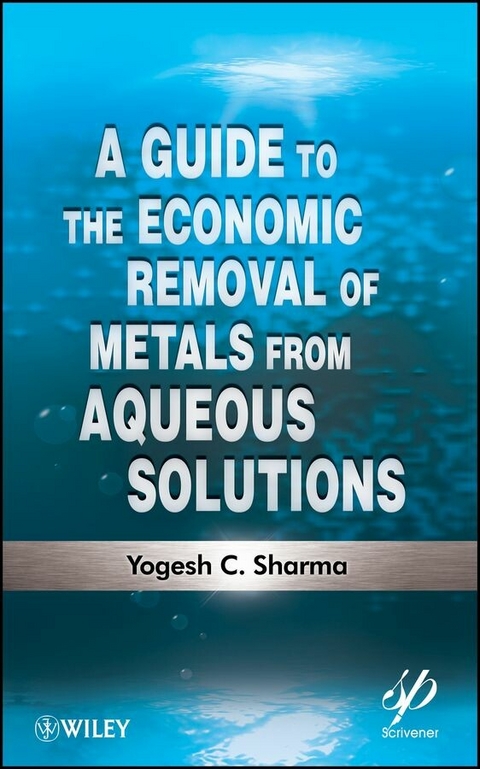
A Guide to the Economic Removal of Metals from Aqueous Solutions (eBook)
John Wiley & Sons (Verlag)
978-1-118-25951-1 (ISBN)
Water pollution is topic of immense and common concern throughout the world. This book presents the results and data from research and adsorption experiments carried out on the removal of nickel and chromium (as well as other metals) from aqueous solutions using modified silica sand.
Yogesh Sharma is a professor in the Department of Applied Chemistry, Institute of Technology, Banaras Hindu University. Prior to this he was at the National Institute of Foundry and Forge Technology, Ranchi, where he was involved with consultancy and testing of metals and alloys, drinking water, and industrial effluents. Dr. Sharma has published widely on the removal of metallic species from aqueous solutions.
Provides public health, sanitary and water engineers baseline data for designing plants for the treatment of industrial effluents rich in the metallic species in general and that of nickel and chromium in particular. DescriptionWater pollution is a topic of immense and common concern throughout the world. With a rapidly escalating global population and increased industrial development in a growing number of countries, the world's freshwater resources have become stressed. One way to get more out of less is 'treatment and reuse'. Nickel and chromium are toxic metals and they are used extensively in numerous industries such as textiles, beverages, steel, pulp and paper, and electroplating. Their industrial effluent contains large measures of non-biodegradable traces that are harmful to flora, fauna, and human beings. Although there are a number of methodologies used for treatment of metal-containing industrial effluents and waste water, there is not one up to now that offers a high capacity removal rate at an economical cost. This book presents the results and data from research and adsorption experiments carried out on the removal of nickel and chromium (as well as other metals) from aqueous solutions using modified silica sand. The data resulting from detailed kinetic, equilibrium and thermodynamic studies, show that the removal capacity is increased so the treated water has a higher quality or purity. It also demonstrates that the extraction of metals is achieved at a significant lower cost because the treated water adsorption is a simple process with less maintenance, and because silica is a nontoxic natural material widely available in all parts of the world.
Yogesh Sharma is a professor in the Department of Applied Chemistry, Institute of Technology, Banaras Hindu University. Prior to this he was at the National Institute of Foundry and Forge Technology, Ranchi, where he was involved with consultancy and testing of metals and alloys, drinking water, and industrial effluents. Dr. Sharma has published widely on the removal of metallic species from aqueous solutions.
Preface ix
1. Introduction 1
1.1 Environment 1
1.2 World Water Distribution 2
1.3 Environmental Pollution 5
1.4 Chromium 11
1.5 Nickel 16
1.6 Objectives 20
1.7 Literature Review 20
1.8 Adsorption 31
1.9 Adsorption Forces 35
1.10 Adsorption Theories 36
2. Material and Methods 39
2.1 Adsorbent Collection and Storage 39
2.2 Adsorbent Modification 39
2.3 Preparation of Adsorbate Cr (VI) and Ni (II) Solution 40
2.4 Instrumentation 40
2.5 Batch Adsorption Experiment 41
3. Results and Discussions 45
3.1 Characterization of Silica Sand 45
3.2 Effect of Contact Time and Initial Concentration of Cr (VI)
and Ni (II) 52
3.3 Effect of pH on the Removal of Cr (VI) and Ni (II) 56
3.4 Effect of Temperature on the Removal of Cr (VI) and Ni (II)
60
3.5 Effect of Adsorbent Dosage on the Removal of Cr (VI) and Ni
(II) 66
3.6 Adsorption Isotherm 73
3.7 Adsorption Kinetics 79
3.8 Thermodynamic Studies 86
4. Conclusions 91
References 94
| Erscheint lt. Verlag | 10.1.2012 |
|---|---|
| Sprache | englisch |
| Themenwelt | Naturwissenschaften ► Chemie ► Organische Chemie |
| Technik ► Umwelttechnik / Biotechnologie | |
| Schlagworte | Chemie • Chemistry • Common • Countries • Data • descriptionwater • effluents • engineers • Environmental Chemistry • Environmental Science • Environmental Studies • escalating • Freshwater • Global • growing • immense • Industrial • Metallic • Number • plants • pollution • Population • rapidly • species • Stressed • topic • Treatment • Umweltchemie • Umweltforschung • Umweltwissenschaften • Wasserchemie • Water • water chemistry • World • Worlds |
| ISBN-10 | 1-118-25951-3 / 1118259513 |
| ISBN-13 | 978-1-118-25951-1 / 9781118259511 |
| Informationen gemäß Produktsicherheitsverordnung (GPSR) | |
| Haben Sie eine Frage zum Produkt? |
 PDF (Adobe DRM)
Größe: 5,5 MB
Kopierschutz: Adobe-DRM
Adobe-DRM ist ein Kopierschutz, der das eBook vor Mißbrauch schützen soll. Dabei wird das eBook bereits beim Download auf Ihre persönliche Adobe-ID autorisiert. Lesen können Sie das eBook dann nur auf den Geräten, welche ebenfalls auf Ihre Adobe-ID registriert sind.
Details zum Adobe-DRM
Dateiformat: PDF (Portable Document Format)
Mit einem festen Seitenlayout eignet sich die PDF besonders für Fachbücher mit Spalten, Tabellen und Abbildungen. Eine PDF kann auf fast allen Geräten angezeigt werden, ist aber für kleine Displays (Smartphone, eReader) nur eingeschränkt geeignet.
Systemvoraussetzungen:
PC/Mac: Mit einem PC oder Mac können Sie dieses eBook lesen. Sie benötigen eine
eReader: Dieses eBook kann mit (fast) allen eBook-Readern gelesen werden. Mit dem amazon-Kindle ist es aber nicht kompatibel.
Smartphone/Tablet: Egal ob Apple oder Android, dieses eBook können Sie lesen. Sie benötigen eine
Geräteliste und zusätzliche Hinweise
Buying eBooks from abroad
For tax law reasons we can sell eBooks just within Germany and Switzerland. Regrettably we cannot fulfill eBook-orders from other countries.
 EPUB (Adobe DRM)
Kopierschutz: Adobe-DRM
Adobe-DRM ist ein Kopierschutz, der das eBook vor Mißbrauch schützen soll. Dabei wird das eBook bereits beim Download auf Ihre persönliche Adobe-ID autorisiert. Lesen können Sie das eBook dann nur auf den Geräten, welche ebenfalls auf Ihre Adobe-ID registriert sind.
Details zum Adobe-DRM
Dateiformat: EPUB (Electronic Publication)
EPUB ist ein offener Standard für eBooks und eignet sich besonders zur Darstellung von Belletristik und Sachbüchern. Der Fließtext wird dynamisch an die Display- und Schriftgröße angepasst. Auch für mobile Lesegeräte ist EPUB daher gut geeignet.
Systemvoraussetzungen:
PC/Mac: Mit einem PC oder Mac können Sie dieses eBook lesen. Sie benötigen eine
eReader: Dieses eBook kann mit (fast) allen eBook-Readern gelesen werden. Mit dem amazon-Kindle ist es aber nicht kompatibel.
Smartphone/Tablet: Egal ob Apple oder Android, dieses eBook können Sie lesen. Sie benötigen eine
Geräteliste und zusätzliche Hinweise
Buying eBooks from abroad
For tax law reasons we can sell eBooks just within Germany and Switzerland. Regrettably we cannot fulfill eBook-orders from other countries.
aus dem Bereich