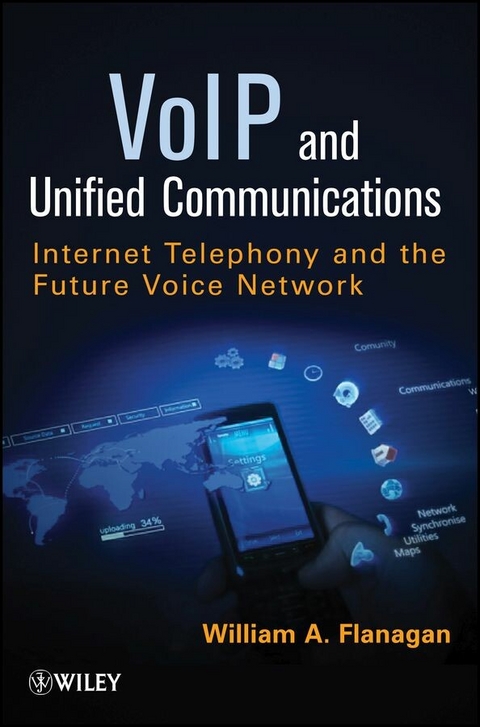
VoIP and Unified Communications (eBook)
John Wiley & Sons (Verlag)
978-1-118-16601-7 (ISBN)
This book takes readers from traditional voice, fax, video, and data services delivered via separate platforms to a single, unified platform delivering all of these services seamlessly via the Internet. With its clear, jargon-free explanations, the author enables all readers to better understand and assess the growing number of voice over Internet protocol (VoIP) and unified communications (UC) products and services that are available for businesses.
VoIP and Unified Communications is based on the author's careful review and synthesis of more than 7,000 pages of published standards as well as a broad range of datasheets, websites, white papers, and webinars. It begins with an introduction to IP technology and then covers such topics as:
-
Packet transmission and switching
-
VoIP signaling and call processing
-
How VoIP and UC are defining the future
-
Interconnections with global services
-
Network management for VoIP and UC
This book features a complete chapter dedicated to cost analyses and payback calculations, enabling readers to accurately determine the short- and long-term financial impact of migrating to various VoIP and UC products and services. There's also a chapter detailing major IP systems hardware and software. Throughout the book, diagrams illustrate how various VoIP and UC components and systems work. In addition, the author highlights potential problems and threats to UC services, steering readers away from common pitfalls.
Concise and to the point, this text enables readers-from novices to experienced engineers and technical managers-to understand how VoIP and UC really work so that everyone can confidently deal with network engineers, data center gurus, and top management.
WILLIAM A. FLANAGAN is President and founder of Flanagan Consulting. With three decades of telecommunications experience, Mr. Flanagan is an expert in voice and data technologies, products, markets, and customers. His network designs have solved problems for enterprises, government agencies, and carriers.
Translates technical jargon into practical business communications solutions This book takes readers from traditional voice, fax, video, and data services delivered via separate platforms to a single, unified platform delivering all of these services seamlessly via the Internet. With its clear, jargon-free explanations, the author enables all readers to better understand and assess the growing number of voice over Internet protocol (VoIP) and unified communications (UC) products and services that are available for businesses. VoIP and Unified Communications is based on the author's careful review and synthesis of more than 7,000 pages of published standards as well as a broad range of datasheets, websites, white papers, and webinars. It begins with an introduction to IP technology and then covers such topics as: Packet transmission and switching VoIP signaling and call processing How VoIP and UC are defining the future Interconnections with global services Network management for VoIP and UC This book features a complete chapter dedicated to cost analyses and payback calculations, enabling readers to accurately determine the short- and long-term financial impact of migrating to various VoIP and UC products and services. There's also a chapter detailing major IP systems hardware and software. Throughout the book, diagrams illustrate how various VoIP and UC components and systems work. In addition, the author highlights potential problems and threats to UC services, steering readers away from common pitfalls. Concise and to the point, this text enables readers from novices to experienced engineers and technical managers to understand how VoIP and UC really work so that everyone can confidently deal with network engineers, data center gurus, and top management.
WILLIAM A. FLANAGAN is President and founder of Flanagan Consulting. With three decades of telecommunications experience, Mr. Flanagan is an expert in voice and data technologies, products, markets, and customers. His network designs have solved problems for enterprises, government agencies, and carriers.
1. IP Technology Disrupts Voice Telephony 1
1.A Introduction to the Public Switched Telephone Network 1
1.B The Digital PSTN 2
1.C The Packet Revolution in Telephony 7
2. Traditional Telephones Still Set Expectations 16
2.A Availability: How the Bell System ensured service 16
2.B Call Completion 18
2.C Sound Quality: encoding for recognizable voices 18
2.D Low Latency 20
2.E Call Setup Delays 21
2.F Impairments controlled: echo, singing, distortion, noise 22
3. From Circuits to Packets 25
3.A Data and Signaling Preceded Voice 25
3.B Putting Voice into Packets 27
4. Packet Transmission and Switching 33
4.A The Physical Layer: Transmission 34
4.B Data Link Protocols 36
4.C IP, the Network Protocol 38
4.D Layer 4 Transport Protocols 40
4.E Higher Layer Processes 47
4.F Saving Bandwidth 55
4.G Differences: Circuit vs. Packet Switched 61
5. VoIP Signaling and Call Processing 67
5.A What packet voice and UC systems share 67
5.B Session Initiation Protocol (SIP) 69
5.C Session Description Protocol 91
5.D Media Gateway Control Protocol 95
5.E H. 323 108
5.F Directory services 120
6. VoIP and Unified Communications Define the Future 123
6.A Voice As Before, with Additions 123
6.B Legacy Services to Keep and Improve with VoIP 123
6.C Facsimile transmission 134
6.D Phone Features Added with VoIP/UC 143
7. How VoIP and UC Features to Consider 149
7.A Space, Power, and Cooling 150
7.B Priority for voice, Video, Fax Pakets 150
7.C Packets per Second 152
7.D Bandwidth 152
7.E Security Issues 153
7.F First Migration Steps While Keeping Legacy Equipment 159
8. Interconnections to Global Services 163
8.A Media Gateways 163
8.B SIP Trunking 166
8.C Operating VoIP Across Network Address Translation 170
8.D Session Border Controller 179
8.E Supporting multiple carrier connections 183
8.F Mobility and Wireless Access 184
9. Network Management for VoIP and UC 188
9.A Starting Right 189
9.B Continuous Monitoring and Management 191
9.C Troubleshooting and Repair 195
10. Cost Analysis and Payback Calculation 199
11. Examples of Hardware and Software203
11.A IP Phones 203
11.B Gateways 206
11.C Session Border Controllers 209
11.D Call Switching Servers 209
11.E Hosted VoIP/UC Service.
11.F Management Systems/Workstations 215
12. Appendices 217
12.A Acronyms and Definitions 217
12.B Reference Documents 226
12.C Message and Error Codes 233
13. Index 236
| Erscheint lt. Verlag | 15.2.2012 |
|---|---|
| Sprache | englisch |
| Themenwelt | Technik ► Elektrotechnik / Energietechnik |
| Technik ► Nachrichtentechnik | |
| Schlagworte | Communication technology • Communication Technology - Networks • Drahtlose Kommunikation • Electrical & Electronics Engineering • Elektrotechnik u. Elektronik • Kommunikationsnetz • Kommunikationsnetze • Kommunikationstechnik • Mobile & Wireless Communications • voice services, Voice over IP, VoIP, Unified Communications, UC, packet networks, IP networks, data centers |
| ISBN-10 | 1-118-16601-9 / 1118166019 |
| ISBN-13 | 978-1-118-16601-7 / 9781118166017 |
| Informationen gemäß Produktsicherheitsverordnung (GPSR) | |
| Haben Sie eine Frage zum Produkt? |
 PDF (Adobe DRM)
Kopierschutz: Adobe-DRM
Adobe-DRM ist ein Kopierschutz, der das eBook vor Mißbrauch schützen soll. Dabei wird das eBook bereits beim Download auf Ihre persönliche Adobe-ID autorisiert. Lesen können Sie das eBook dann nur auf den Geräten, welche ebenfalls auf Ihre Adobe-ID registriert sind.
Details zum Adobe-DRM
Dateiformat: PDF (Portable Document Format)
Mit einem festen Seitenlayout eignet sich die PDF besonders für Fachbücher mit Spalten, Tabellen und Abbildungen. Eine PDF kann auf fast allen Geräten angezeigt werden, ist aber für kleine Displays (Smartphone, eReader) nur eingeschränkt geeignet.
Systemvoraussetzungen:
PC/Mac: Mit einem PC oder Mac können Sie dieses eBook lesen. Sie benötigen eine
eReader: Dieses eBook kann mit (fast) allen eBook-Readern gelesen werden. Mit dem amazon-Kindle ist es aber nicht kompatibel.
Smartphone/Tablet: Egal ob Apple oder Android, dieses eBook können Sie lesen. Sie benötigen eine
Geräteliste und zusätzliche Hinweise
Buying eBooks from abroad
For tax law reasons we can sell eBooks just within Germany and Switzerland. Regrettably we cannot fulfill eBook-orders from other countries.
aus dem Bereich