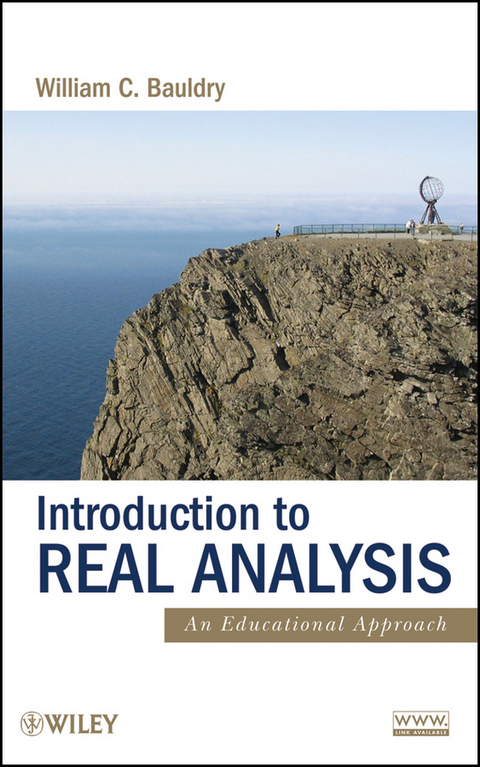
Introduction to Real Analysis (eBook)
280 Seiten
John Wiley & Sons (Verlag)
978-1-118-16443-3 (ISBN)

to elementary calculus
Bridging the gap between the development and history of real
analysis, Introduction to Real Analysis: An Educational
Approach presents a comprehensive introduction to real analysis
while also offering a survey of the field. With its balance of
historical background, key calculus methods, and hands-on
applications, this book provides readers with a solid foundation
and fundamental understanding of real analysis.
The book begins with an outline of basic calculus, including a
close examination of problems illustrating links and potential
difficulties. Next, a fluid introduction to real analysis is
presented, guiding readers through the basic topology of real
numbers, limits, integration, and a series of functions in natural
progression. The book moves on to analysis with more rigorous
investigations, and the topology of the line is presented along
with a discussion of limits and continuity that includes unusual
examples in order to direct readers' thinking beyond intuitive
reasoning and on to more complex understanding. The dichotomy of
pointwise and uniform convergence is then addressed and is followed
by differentiation and integration. Riemann-Stieltjes integrals and
the Lebesgue measure are also introduced to broaden the presented
perspective. The book concludes with a collection of advanced
topics that are connected to elementary calculus, such as modeling
with logistic functions, numerical quadrature, Fourier series, and
special functions.
Detailed appendices outline key definitions and theorems in
elementary calculus and also present additional proofs, projects,
and sets in real analysis. Each chapter references historical
sources on real analysis while also providing proof-oriented
exercises and examples that facilitate the development of
computational skills. In addition, an extensive bibliography
provides additional resources on the topic.
Introduction to Real Analysis: An Educational Approach is
an ideal book for upper- undergraduate and graduate-level real
analysis courses in the areas of mathematics and education. It is
also a valuable reference for educators in the field of applied
mathematics.
WILLIAM C. BAULDRY, PhD, is Professor in the Department of Mathematical Sciences at Appalachian State University. Dr. Bauldry has published numerous articles in his areas of interest, which include the pedagogical uses of computer algebra systems and cryptography.
Preface.
Acknowledgments.
1 Elementary Calculus.
1.1 Preliminary Concepts.
1.2 Limits and Continuity.
1.3 Differentiation.
1.4 Integration.
1.5 Sequences and Series of Constants.
1.6 Power Series and Taylor Series.
Summary.
Exercises.
Interlude: Fermat, Descartes, and theTangent Problem.
2 Introduction to Real Analysis.
2.1 Basic Topology of the Real Numbers.
2.2 Limits and Continuity.
2.3 Differentiation.
2.4 Riemann and Riemann-Stieltjes Integration.
2.5 Sequences, Series, and Convergence Tests.
2.6 Pointwise and Uniform Convergence.
Summary.
Exercises.
Interlude: Euler and the "Basel Problem".
3 A Brief Introduction to Lebesgue Theory.
3.1 Lebesgue Measure and Measurable Sets.
3.2 The Lebesgue Integral.
3.3 Measure, Integral, and Convergence.
3.4 Littlewood's Three Principles.
Summary.
Exercises.
Interlude: The Set of Rational Numbers isVery Large andVery
Small.
4 Special Topics.
4.1 Modeling with Logistic Functions--Numerical
Derivatives.
4.2 Numerical Quadrature.
4.3 Fourier Series.
4.4 Special Functions--The Gamma Function.
4.5 Calculus Without Limits: Differential Algebra.
Summary.
Exercises.
Appendix A: Definitions and Theorems of Elementary Real
Analysis.
A.1 Limits.
A.2 Continuity.
A.3 The Derivative.
A.4 Riemann Integration.
A.5 Riemann-Stieltjes Integration.
A.6 Sequences and Series of Constants.
A.7 Sequences and Series of Functions.
Appendix B: A Very Brief Calculus Chronology.
Appendix C: Projects in Real Analysis.
C.1 Historical Writing Projects.
C.2 Induction Proofs: Summations, Inequalities, and
Divisibility.
C.3 Series Rearrangements.
C.4 Newton and the Binomial Theorem.
C.5 Symmetric Sums of Logarithms.
C.6 Logical Equivalence: Completeness of the Real Numbers.
C.7 Vitali's Nonmeasurable Set.
C.8 Sources for Real Analysis Projects.
C.9 Sources for Projects for Calculus Students.
Bibliography.
Index.
| Erscheint lt. Verlag | 9.9.2011 |
|---|---|
| Sprache | englisch |
| Themenwelt | Mathematik / Informatik ► Mathematik ► Analysis |
| Technik | |
| Schlagworte | Bildungswesen • Education • Lehrpläne / Mathematik • Lehrpläne / Mathematik • Mathematical Analysis • Mathematics • Mathematik • Mathematische Analyse • Real analysis • reelle Analysis |
| ISBN-10 | 1-118-16443-1 / 1118164431 |
| ISBN-13 | 978-1-118-16443-3 / 9781118164433 |
| Informationen gemäß Produktsicherheitsverordnung (GPSR) | |
| Haben Sie eine Frage zum Produkt? |
 PDF (Adobe DRM)
Kopierschutz: Adobe-DRM
Adobe-DRM ist ein Kopierschutz, der das eBook vor Mißbrauch schützen soll. Dabei wird das eBook bereits beim Download auf Ihre persönliche Adobe-ID autorisiert. Lesen können Sie das eBook dann nur auf den Geräten, welche ebenfalls auf Ihre Adobe-ID registriert sind.
Details zum Adobe-DRM
Dateiformat: PDF (Portable Document Format)
Mit einem festen Seitenlayout eignet sich die PDF besonders für Fachbücher mit Spalten, Tabellen und Abbildungen. Eine PDF kann auf fast allen Geräten angezeigt werden, ist aber für kleine Displays (Smartphone, eReader) nur eingeschränkt geeignet.
Systemvoraussetzungen:
PC/Mac: Mit einem PC oder Mac können Sie dieses eBook lesen. Sie benötigen eine
eReader: Dieses eBook kann mit (fast) allen eBook-Readern gelesen werden. Mit dem amazon-Kindle ist es aber nicht kompatibel.
Smartphone/Tablet: Egal ob Apple oder Android, dieses eBook können Sie lesen. Sie benötigen eine
Geräteliste und zusätzliche Hinweise
Buying eBooks from abroad
For tax law reasons we can sell eBooks just within Germany and Switzerland. Regrettably we cannot fulfill eBook-orders from other countries.
aus dem Bereich