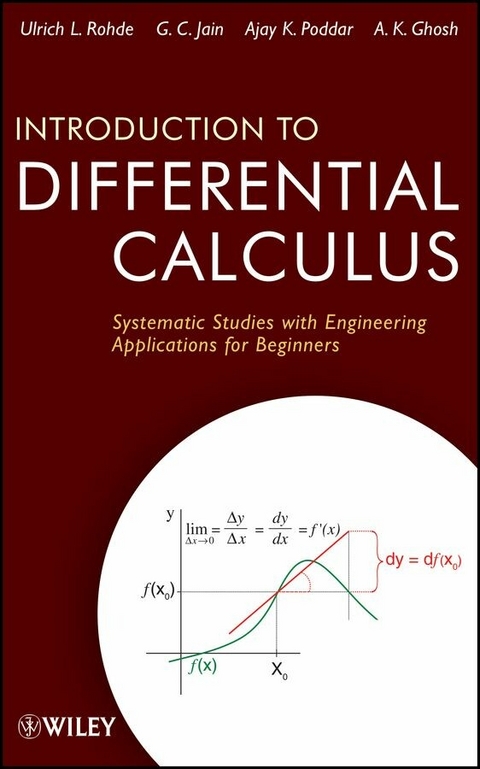
Introduction to Differential Calculus (eBook)
784 Seiten
John Wiley & Sons (Verlag)
978-1-118-13012-4 (ISBN)
calculus to solve real-life problems in engineering and the
physical sciences
Introduction to Differential Calculus fully engages readers by
presenting the fundamental theories and methods of differential
calculus and then showcasing how the discussed concepts can be
applied to real-world problems in engineering and the physical
sciences. With its easy-to-follow style and accessible
explanations, the book sets a solid foundation before advancing to
specific calculus methods, demonstrating the connections between
differential calculus theory and its applications.
The first five chapters introduce underlying concepts such as
algebra, geometry, coordinate geometry, and trigonometry.
Subsequent chapters present a broad range of theories, methods, and
applications in differential calculus, including:
* Concepts of function, continuity, and derivative
* Properties of exponential and logarithmic function
* Inverse trigonometric functions and their properties
* Derivatives of higher order
* Methods to find maximum and minimum values of a function
* Hyperbolic functions and their properties
Readers are equipped with the necessary tools to quickly learn
how to understand a broad range of current problems throughout the
physical sciences and engineering that can only be solved with
calculus. Examples throughout provide practical guidance, and
practice problems and exercises allow for further development and
fine-tuning of various calculus skills. Introduction to
Differential Calculus is an excellent book for upper-undergraduate
calculus courses and is also an ideal reference for students and
professionals alike who would like to gain a further understanding
of the use of calculus to solve problems in a simplified
manner.
Ulrich L. Rohde, PhD, ScD, Dr-Ing, is Chairman of Synergy Microwave Corporation, President of Communications Consulting Corporation, and a Partner of Rohde & Schwarz. A Fellow of the IEEE, Professor Rohde holds several patents and has published more than 200 scientific papers. G. C. Jain, BSc, is a retired scientist from the Defense Research and Development Organization in India. Ajay K. Poddar, PhD, is Chief Scientist at Synergy Microwave Corporation. A Senior Member of the IEEE, Dr. Poddar holds several dozen patents and has published more than 180 scientific papers. A. K. Ghosh, PhD, is Professor in the Department of Aerospace Engineering at IIT Kanpur, India. He has published more than 120 scientific papers.
Chapter One. From Arithmetic to Algebra.
Chapter Two. The Concept of Function.
Chapter Three. Discovery of Real Numbers (Through Traditional Algebra).
Chapter Four. From Geometry to Co-ordinate Geometry.
Chapter Five. Trigonometry and Trigonometric Functions.
Chapter Six. More about Functions.
Chapter Seven. (a): The Concept of Limit of a Function.
Chapter Seven. (b): Methods for Computing Limits of Algebraic Functions.
Chapter Eight. The Concept of Continuity of a Function and the Points of Discontinuity.
Chapter Nine. The Idea of Derivative of a Function.
Chapter Ten. Algebra of Derivatives: Rules for Computing Derivatives of Various Combinations of Differentiable Functions.
Chapter Eleven. (a): Basic Trigonometric Limits and Their Applications in Computing Derivatives of Trigonometric Functions.
Chapter Eleven. (b): Methods of Computing Limits of Trigonometric Functions.
Chapter Twelve: Exponential Form(s) of a Positive Real Numbers and its Logarithms.
Chapter Thirteen. (a): Exponential and Logarithmic Functions as Their Derivatives.
Chapter Thirteen. (b): Methods for Computing Limits and Exponential and Logarithmic Functions.
Chapter Fourteen. Inverse Trigonometric Functions and Their Derivatives.
Chapter Fifteen. (a): Implicit Functions and Their Differentiation.
Chapter Fifteen. (b): Parametric Functions and Their Differentiation.
Chapter Sixteen. Differentials 'dy' and 'dx': Meanings and Applications.
Chapter Seventeen. Derivatives and Differentials of Higher Order.
Chapter Eighteen. Applications of Derivatives in Studying Motion in a Straight Line.
Chapter Nineteen. (a): Increasing and Decreasing Functions and the Sign of the First Derivative.
Chapter Nineteen. (b): Maximum and Minimum Values of a Function.
Chapter Twenty. Rolle's Theorem and the Mean Value Theorem (MVT).
Chapter Twenty One. The Generalized Mean Value Theorem (Cauchy's MVT), L'Hospital's Rule, and Its Applications.
Chapter Twenty Two. Extending the Mean Value Theorem to taylor's Formula: Taylor Polynomials for Certain Functions.
Chapter Twenty Three. Hyperbolic Functions and Their Properties.
"The book is addressed mainly to students studying
non-mathematical subjects. It will be also helpful for those who
want to understand why it is important to study Calculus and how to
apply it." (Zentralblatt MATH, 1 December
2012)
| Erscheint lt. Verlag | 29.11.2011 |
|---|---|
| Sprache | englisch |
| Themenwelt | Mathematik / Informatik ► Mathematik ► Analysis |
| Technik | |
| Schlagworte | Analysis • Analysis f. mehrere Variable • Applied Mathematics in Engineering • Applied Mathmatics in Engineering • Calculus • Mathematics • Mathematik • Mathematik in den Ingenieurwissenschaften • Multivariate Calculus |
| ISBN-10 | 1-118-13012-X / 111813012X |
| ISBN-13 | 978-1-118-13012-4 / 9781118130124 |
| Informationen gemäß Produktsicherheitsverordnung (GPSR) | |
| Haben Sie eine Frage zum Produkt? |
 PDF (Adobe DRM)
Kopierschutz: Adobe-DRM
Adobe-DRM ist ein Kopierschutz, der das eBook vor Mißbrauch schützen soll. Dabei wird das eBook bereits beim Download auf Ihre persönliche Adobe-ID autorisiert. Lesen können Sie das eBook dann nur auf den Geräten, welche ebenfalls auf Ihre Adobe-ID registriert sind.
Details zum Adobe-DRM
Dateiformat: PDF (Portable Document Format)
Mit einem festen Seitenlayout eignet sich die PDF besonders für Fachbücher mit Spalten, Tabellen und Abbildungen. Eine PDF kann auf fast allen Geräten angezeigt werden, ist aber für kleine Displays (Smartphone, eReader) nur eingeschränkt geeignet.
Systemvoraussetzungen:
PC/Mac: Mit einem PC oder Mac können Sie dieses eBook lesen. Sie benötigen eine
eReader: Dieses eBook kann mit (fast) allen eBook-Readern gelesen werden. Mit dem amazon-Kindle ist es aber nicht kompatibel.
Smartphone/Tablet: Egal ob Apple oder Android, dieses eBook können Sie lesen. Sie benötigen eine
Geräteliste und zusätzliche Hinweise
Buying eBooks from abroad
For tax law reasons we can sell eBooks just within Germany and Switzerland. Regrettably we cannot fulfill eBook-orders from other countries.
aus dem Bereich