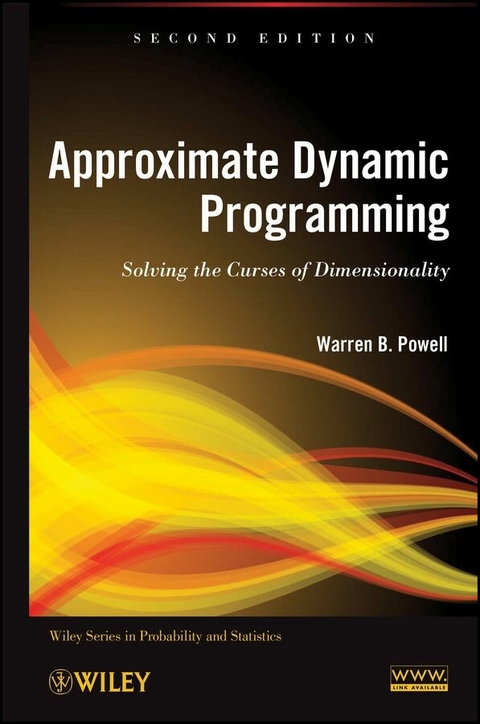
Approximate Dynamic Programming (eBook)
John Wiley & Sons (Verlag)
978-1-118-02915-2 (ISBN)
'Finally, a book devoted to dynamic programming and written using the language of operations research (OR)! This beautiful book fills a gap in the libraries of OR specialists and practitioners.'
-Computing Reviews
This new edition showcases a focus on modeling and computation for complex classes of approximate dynamic programming problems
Understanding approximate dynamic programming (ADP) is vital in order to develop practical and high-quality solutions to complex industrial problems, particularly when those problems involve making decisions in the presence of uncertainty. Approximate Dynamic Programming, Second Edition uniquely integrates four distinct disciplines-Markov decision processes, mathematical programming, simulation, and statistics-to demonstrate how to successfully approach, model, and solve a wide range of real-life problems using ADP.
The book continues to bridge the gap between computer science, simulation, and operations research and now adopts the notation and vocabulary of reinforcement learning as well as stochastic search and simulation optimization. The author outlines the essential algorithms that serve as a starting point in the design of practical solutions for real problems. The three curses of dimensionality that impact complex problems are introduced and detailed coverage of implementation challenges is provided. The Second Edition also features:
-
A new chapter describing four fundamental classes of policies for working with diverse stochastic optimization problems: myopic policies, look-ahead policies, policy function approximations, and policies based on value function approximations
-
A new chapter on policy search that brings together stochastic search and simulation optimization concepts and introduces a new class of optimal learning strategies
-
Updated coverage of the exploration exploitation problem in ADP, now including a recently developed method for doing active learning in the presence of a physical state, using the concept of the knowledge gradient
-
A new sequence of chapters describing statistical methods for approximating value functions, estimating the value of a fixed policy, and value function approximation while searching for optimal policies
The presented coverage of ADP emphasizes models and algorithms, focusing on related applications and computation while also discussing the theoretical side of the topic that explores proofs of convergence and rate of convergence. A related website features an ongoing discussion of the evolving fields of approximation dynamic programming and reinforcement learning, along with additional readings, software, and datasets.
Requiring only a basic understanding of statistics and probability, Approximate Dynamic Programming, Second Edition is an excellent book for industrial engineering and operations research courses at the upper-undergraduate and graduate levels. It also serves as a valuable reference for researchers and professionals who utilize dynamic programming, stochastic programming, and control theory to solve problems in their everyday work.
WARREN B. POWELL, PhD, is Professor of Operations Research and Financial Engineering at Princeton University, where he is founder and Director of CASTLE Laboratory, a research unit that works with industrial partners to test new ideas found in operations research. The recipient of the 2004 INFORMS Fellow Award, Dr. Powell has authored more than 160 published articles on stochastic optimization, approximate dynamicprogramming, and dynamic resource management.
Praise for the First Edition "e;Finally, a book devoted to dynamic programming and written using the language of operations research (OR)! This beautiful book fills a gap in the libraries of OR specialists and practitioners."e; Computing Reviews This new edition showcases a focus on modeling and computation for complex classes of approximate dynamic programming problems Understanding approximate dynamic programming (ADP) is vital in order to develop practical and high-quality solutions to complex industrial problems, particularly when those problems involve making decisions in the presence of uncertainty. Approximate Dynamic Programming, Second Edition uniquely integrates four distinct disciplines Markov decision processes, mathematical programming, simulation, and statistics to demonstrate how to successfully approach, model, and solve a wide range of real-life problems using ADP. The book continues to bridge the gap between computer science, simulation, and operations research and now adopts the notation and vocabulary of reinforcement learning as well as stochastic search and simulation optimization. The author outlines the essential algorithms that serve as a starting point in the design of practical solutions for real problems. The three curses of dimensionality that impact complex problems are introduced and detailed coverage of implementation challenges is provided. The Second Edition also features: A new chapter describing four fundamental classes of policies for working with diverse stochastic optimization problems: myopic policies, look-ahead policies, policy function approximations, and policies based on value function approximations A new chapter on policy search that brings together stochastic search and simulation optimization concepts and introduces a new class of optimal learning strategies Updated coverage of the exploration exploitation problem in ADP, now including a recently developed method for doing active learning in the presence of a physical state, using the concept of the knowledge gradient A new sequence of chapters describing statistical methods for approximating value functions, estimating the value of a fixed policy, and value function approximation while searching for optimal policies The presented coverage of ADP emphasizes models and algorithms, focusing on related applications and computation while also discussing the theoretical side of the topic that explores proofs of convergence and rate of convergence. A related website features an ongoing discussion of the evolving fields of approximation dynamic programming and reinforcement learning, along with additional readings, software, and datasets. Requiring only a basic understanding of statistics and probability, Approximate Dynamic Programming, Second Edition is an excellent book for industrial engineering and operations research courses at the upper-undergraduate and graduate levels. It also serves as a valuable reference for researchers and professionals who utilize dynamic programming, stochastic programming, and control theory to solve problems in their everyday work.
WARREN B. POWELL, PhD, is Professor of Operations Research and Financial Engineering at Princeton University, where he is founder and Director of CASTLE Laboratory, a research unit that works with industrial partners to test new ideas found in operations research. The recipient of the 2004 INFORMS Fellow Award, Dr. Powell has authored more than 160 published articles on stochastic optimization, approximate dynamicprogramming, and dynamic resource management.
| Erscheint lt. Verlag | 9.9.2011 |
|---|---|
| Reihe/Serie | Wiley Series in Probability and Statistics |
| Wiley Series in Probability and Statistics | Wiley Series in Probability and Statistics |
| Zusatzinfo | Charts: 5 B&W, 0 Color; Photos: 5 B&W, 0 Color; Drawings: 63 B&W, 0 Color; Maps: 2 B&W, 0 Color; Tables: 0 B&W, 0 Color; Graphs: 39 B&W, 0 Color |
| Sprache | englisch |
| Themenwelt | Mathematik / Informatik ► Mathematik ► Angewandte Mathematik |
| Mathematik / Informatik ► Mathematik ► Statistik | |
| Mathematik / Informatik ► Mathematik ► Wahrscheinlichkeit / Kombinatorik | |
| Technik | |
| Schlagworte | Approximate • Beautiful • Book • Classes • Complex • Computation • Computer Science • Control Systems Technology • Decisions • dynamic • Edition • Electrical & Electronics Engineering • Elektrotechnik u. Elektronik • Engineering statistics • First • focus • GAP • Informatik • involve • language • libraries • New • operations • particularly • Presence • Problems • Programmierung / Benutzeroberflächen • Programmierung / Benutzeroberflächen • programming • Programming / User Interface Design • Regelungstechnik • Research • showcases • Statistics • Statistik • Statistik in den Ingenieurwissenschaften • Technische Statistik • Uncertainty |
| ISBN-10 | 1-118-02915-1 / 1118029151 |
| ISBN-13 | 978-1-118-02915-2 / 9781118029152 |
| Informationen gemäß Produktsicherheitsverordnung (GPSR) | |
| Haben Sie eine Frage zum Produkt? |
 PDF (Adobe DRM)
Kopierschutz: Adobe-DRM
Adobe-DRM ist ein Kopierschutz, der das eBook vor Mißbrauch schützen soll. Dabei wird das eBook bereits beim Download auf Ihre persönliche Adobe-ID autorisiert. Lesen können Sie das eBook dann nur auf den Geräten, welche ebenfalls auf Ihre Adobe-ID registriert sind.
Details zum Adobe-DRM
Dateiformat: PDF (Portable Document Format)
Mit einem festen Seitenlayout eignet sich die PDF besonders für Fachbücher mit Spalten, Tabellen und Abbildungen. Eine PDF kann auf fast allen Geräten angezeigt werden, ist aber für kleine Displays (Smartphone, eReader) nur eingeschränkt geeignet.
Systemvoraussetzungen:
PC/Mac: Mit einem PC oder Mac können Sie dieses eBook lesen. Sie benötigen eine
eReader: Dieses eBook kann mit (fast) allen eBook-Readern gelesen werden. Mit dem amazon-Kindle ist es aber nicht kompatibel.
Smartphone/Tablet: Egal ob Apple oder Android, dieses eBook können Sie lesen. Sie benötigen eine
Geräteliste und zusätzliche Hinweise
Buying eBooks from abroad
For tax law reasons we can sell eBooks just within Germany and Switzerland. Regrettably we cannot fulfill eBook-orders from other countries.
aus dem Bereich