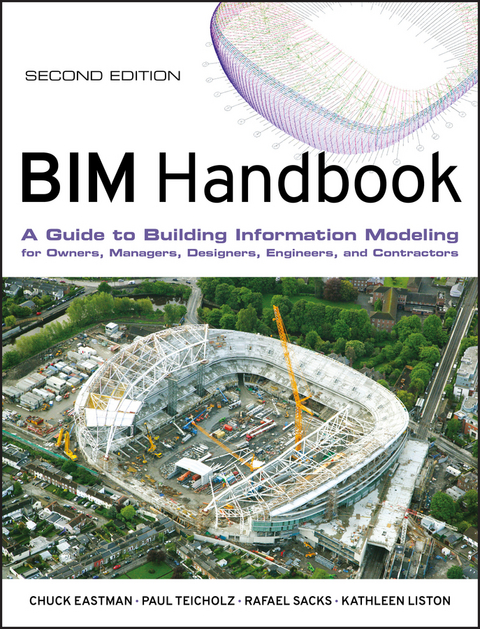
BIM Handbook (eBook)
640 Seiten
John Wiley & Sons (Verlag)
978-1-118-02167-5 (ISBN)
DISCOVER BIM: A BETTER WAY TO BUILD BETTER BUILDINGS
Building Information Modeling (BIM) offers a novel approach to design, construction, and facility management in which a digital representation of the building process is used to facilitate the exchange and interoperability of information in digital format. BIM is beginning to change the way buildings look, the way they function, and the ways in which they are designed and built.
The BIM Handbook, Second Edition provides an in-depth understanding of BIM technologies, the business and organizational issues associated with its implementation, and the profound advantages that effective use of BIM can provide to all members of a project team. Updates to this edition include:
* Completely updated material covering the current practice and technology in this fast-moving field
* Expanded coverage of lean construction and its use of BIM, with special focus on Integrated Project Delivery throughout the book
* New insight on the ways BIM facilitates sustainable building
* New information on interoperability schemas and collaboration tools
* Six new case studies
Painting a colorful and thorough picture of the state of the art in building information modeling, the BIM Handbook, Second Edition guides readers to successful implementations, helping them to avoid needless frustration and costs and take full advantage of this paradigm-shifting approach to construct better buildings that consume fewer materials and require less time, labor, and capital resources.
CHUCK EASTMAN is a Professor in the Colleges of Architecture and Computing at Georgia Institute of Technology, Atlanta, and Director of the Digital Building Laboratory, a university-industry consortium, where heleads research in IT in building design and construction. He has been active in building modeling research since the 1970s and currently works with a variety of industry groups developing BIM technology. PAUL TEICHOLZ is Professor Emeritus at Stanford University. After twenty-five years innovating with IT solutions in the construction industry, he founded the Center for Integrated Facility Engineering (CIFE) at Stanford in 1988 and directed that program for tenyears. He was named the Construction Management "Man of the Year" by the American Society of Civil Engineers in 1985 and awarded the Henry C. Turner Prize for Innovation in Construction Technology by the National Building Museum in 2006. RAFAEL SACKS is an Associate Professor in Structural Engineering and Construction Management at Technion-Israel Institute of Technology. He founded and leads the Virtual Construction and BIM Laboratory at the Israel National Building Research Institute, and has conducted primary and applied BIM research for industry, government, and public organizations in North America, Europe, and Israel. KATHLEEN LISTON is CEO of Eco Offsite, a modular construction company. She co-founded Common Point Technologies, Inc., a construction simulation software company. She has worked with a variety of organizations, including Autodesk, Walt Disney, DPR Construction, and Mortenson Construction, developing technologies and processes to implement BIM. She has a PhD and master's from Stanford University in civil and environmental engineering and a bachelor of architecture from the University of Notre Dame.
Foreword vii
Preface xi
CHAPTER 1
BIM Handbook Introduction 1
1.0 Executive Summary 1
1.1 Introduction 2
1.2 The Current AEC Business Model 2
1.3 Documented Inefficiencies of Traditional Approaches 10
1.4 BIM: New Tools and New Processes 15
1.5 What Is Not BIM Technology? 19
1.6 What Are the Benefits of BIM? What Problems Does It Address? 19
1.7 What Challenges Can Be Expected? 26
1.8 Future of Designing and Building with BIM (Chapter 8) 29
1.9 Case Studies (Chapter 9) 29
Chapter 1 Discussion Questions 29
CHAPTER 2 BIM Tools and Parametric Modeling 31
2.0 Executive Summary 31
2.1 The Evolution to Object-Based Parametric Modeling 32
2.2 Parametric Modeling of Buildings 45
2.3 Beyond Parametric Shapes 57
2.4 BIM Environments, Platforms, and Tools 70
2.5 Overview of the Major BIM Design Platforms 71
2.6 BIM Platforms 77
2.7 Lightweight Modeling Applications 94
2.8 Conclusion 95
Chapter 2 Discussion Questions 97
CHAPTER 3 Interoperability 99
3.0 Executive Summary 99
3.1 Introduction 100
3.2 Different Kinds of Exchange Formats 105
3.3 Background of Product Data Models 110
3.4 Other Efforts Supporting Standardization 129
3.5 The Evolution from File-Based Exchange to Building Model Repositories 136
3.6 Summary 148
Chapter 3 Discussion Questions 148
CHAPTER 4 BIM for Owners and Facility Managers 151
4.0 Executive Summary 151
4.1 Introduction: Why Owners Should Care About BIM 152
4.2 BIM Application Areas for Owners 155
4.3 BIM Tool Guide for Owners169
4.4 An Owner and Facility Manager's Building Model 172
4.5 Leading the BIM Implementation on a Project 175
4.6 Barriers to Implementing BIM: Risks and Common Myths 185
4.7 Guidelines and Issues for Owners to ConsiderWhen Adopting BIM 189
Chapter 4 Discussion Questions 191
CHAPTER 5 BIM for Architects and Engineers 193
5.0 Executive Summary 193
5.1 Introduction 194
5.2 Scope of Design Services 197
5.3 BIM Use in Design Processes 203
5.4 Building Object Models and Libraries 240
5.5 Considerations in Adoption for Design Practice 253
5.6 New and Changed Staffing within Design Firms 258
Chapter 5 Discussion Questions 260
CHAPTER 6 BIM for Contractors 263
6.0 Executive Summary 263
6.1 Introduction 264
6.2 Types of Construction Firms265
6.3 Information Contractors Want from BIM 268
| Erscheint lt. Verlag | 29.3.2011 |
|---|---|
| Sprache | englisch |
| Themenwelt | Technik ► Architektur |
| Technik ► Bauwesen | |
| Schlagworte | Architecture • Architecture Special Topics • Architektur • Bauingenieur- u. Bauwesen • Civil Engineering & Construction • Computer Science • Informatik • Informationstechnologie • Information Technologies • Spezialthemen Architektur • Structural & Building Engineering • Tief- u. Hochbau / Massivbau |
| ISBN-10 | 1-118-02167-3 / 1118021673 |
| ISBN-13 | 978-1-118-02167-5 / 9781118021675 |
| Informationen gemäß Produktsicherheitsverordnung (GPSR) | |
| Haben Sie eine Frage zum Produkt? |
 PDF (Adobe DRM)
Kopierschutz: Adobe-DRM
Adobe-DRM ist ein Kopierschutz, der das eBook vor Mißbrauch schützen soll. Dabei wird das eBook bereits beim Download auf Ihre persönliche Adobe-ID autorisiert. Lesen können Sie das eBook dann nur auf den Geräten, welche ebenfalls auf Ihre Adobe-ID registriert sind.
Details zum Adobe-DRM
Dateiformat: PDF (Portable Document Format)
Mit einem festen Seitenlayout eignet sich die PDF besonders für Fachbücher mit Spalten, Tabellen und Abbildungen. Eine PDF kann auf fast allen Geräten angezeigt werden, ist aber für kleine Displays (Smartphone, eReader) nur eingeschränkt geeignet.
Systemvoraussetzungen:
PC/Mac: Mit einem PC oder Mac können Sie dieses eBook lesen. Sie benötigen eine
eReader: Dieses eBook kann mit (fast) allen eBook-Readern gelesen werden. Mit dem amazon-Kindle ist es aber nicht kompatibel.
Smartphone/Tablet: Egal ob Apple oder Android, dieses eBook können Sie lesen. Sie benötigen eine
Geräteliste und zusätzliche Hinweise
Buying eBooks from abroad
For tax law reasons we can sell eBooks just within Germany and Switzerland. Regrettably we cannot fulfill eBook-orders from other countries.
aus dem Bereich