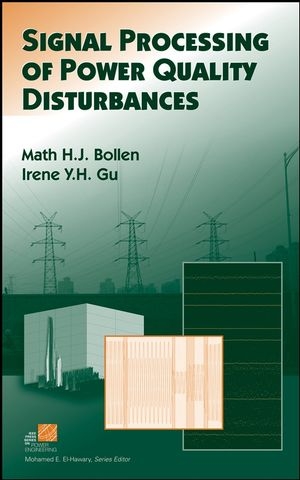
Signal Processing of Power Quality Disturbances (eBook)
888 Seiten
John Wiley & Sons (Verlag)
978-0-471-93130-0 (ISBN)
This innovative new text brings together two leading experts, one
from signal processing and the other from power quality. Combining
their fields of expertise, they set forth and investigate various
types of power quality disturbances, how measurements of these
disturbances are processed and interpreted, and, finally, the use
and interpretation of power quality standards documents.
As a practical aid to readers, the authors make a clear distinction
between two types of power quality disturbances:
* Variations: disturbances that are continuously present
* Events: disturbances that occur occasionally
A complete analysis and full set of tools are provided for each
type of disturbance:
* Detailed examination of the origin of the disturbance
* Signal processing measurement techniques, including advanced
techniques and those techniques set forth in standards
documents
* Interpretation and analysis of measurement data
* Methods for further processing the features extracted from the
signal processing into site and system indices
The depth of coverage is outstanding: the authors present and
analyze material that is not covered in the standards nor found in
the scientific literature.
This text is intended for two groups of readers: students and
researchers in power engineering who need to use signal processing
techniques for power system applications, and students and
researchers in signal processing who need to perform power system
disturbance analyses and diagnostics. It is also highly recommended
for any engineer or utility professional involved in power quality
monitoring.
Math H.J. Bollen grew up in Geulle, The Netherlands, and received the PhD degree in 1989. Currently, he is manager of EMC and Power Quality at STRI, Ludvika, Sweden, and a guest professor at Luleå University of Technology. Math is known for his contributions to power quality analysis through numerous papers, working-group activities, and an earlier textbook, Understanding Power Quality Problems: Voltage Sags and Interruptions, (Wiley-IEEE Press). In 2005, he became an IEEE Fellow for his contributions to methods for reliability and power quality analysis. Irene Y.H. Gu grew up in Shanghai, China. She moved to The Netherlands in 1988 and received the PhD degree in 1992. Since 1996 she has been with the Department of Signals and Systems, Chalmers University of Technology (Gothenburg, Sweden) and has been a professor in signal processing there since 2004. She is also a guest professor at Shanghai Jiao Tong University (China). Irene Gu and Math Bollen were married in Eindhoven in 1992.
PREFACE.
ACKNOWLEDGMENTS.
1 INTRODUCTION.
1.1 Modern View of Power Systems.
1.2 Power Quality.
1.3 Signal Processing and Power Quality.
1.4 Electromagnetic Compatibility Standards.
1.5 Overview of Power Quality Standards.
1.6 Compatibility Between Equipment and Supply.
1.7 Distributed Generation.
1.8 Conclusions.
1.9 About This Book.
2 ORIGIN OF POWER QUALITY VARIATIONS.
2.1 Voltage Frequency Variations.
2.2 Voltage Magnitude Variations.
2.3 Voltage Unbalance.
2.4 Voltage Fluctuations and Light Flicker.
2.5 Waveform Distortion.
2.6 Summary and Conclusions.
3 PROCESSING OF STATIONARY SIGNALS.
3.1 Overview of Methods.
3.2 Parameters That Characterize Variations.
3.3 Power Quality Indices.
3.4 Frequency-Domain Analysis and Signal Transformation.
3.5 Estimation of Harmonics and Interharmonics.
3.6 Estimation of Broadband Spectrum.
3.7 Summary and Conclusions.
3.8 Further Reading.
4 PROCESSING OF NONSTATIONARY SIGNALS.
4.1 Overview of Some Nonstationary Power Quality DataAnalysis Methods.
4.2 Discrete STFT for Analyzing Time-Evolving SignalComponents.
4.3 Discrete Wavelet Transforms for Time-Scale Analysis ofDisturbances.
4.4 Block-Based Modeling.
4.5 Models Directly Applicable to Nonstationary Data.
4.6 Summary and Conclusion.
4.7 Further Reading.
5 STATISTICS OF VARIATIONS.
5.1 From Features to System Indices.
5.2 Time Aggregation.
5.3 Characteristics Versus Time.
5.4 Site Indices.
5.5 System Indices.
5.6 Power Quality Objectives.
5.7 Summary and Conclusions.
6 ORIGIN OF POWER QUALITY EVENTS.
6.1 Interruptions.
6.2 Voltage Dips.
6.3 Transients.
6.4 Summary and Conclusions.
7 TRIGGERING AND SEGMENTATION.
7.1 Overview of Existing Methods.
7.2 Basic Concepts of Triggering and Segmentation.
7.3 Triggering Methods.
7.4 Segmentation.
7.5 Summary and Conclusions.
8 CHARACTERIZATION OF POWER QUALITY EVENTS.
8.1 Voltage Magnitude Versus Time.
8.2 Phase Angle Versus Time.
8.3 Three-Phase Characteristics Versus Time.
8.4 Distortion During Event.
8.5 Single-Event Indices: Interruptions.
8.6 Single-Event Indices: Voltage Dips.
8.7 Single-Event Indices: Voltage Swells.
8.8 Single-Event Indices Based on Three-PhaseCharacteristics.
8.9 Additional Information from Dips and Interruptions.
8.10 Transients.
8.11 Summary and Conclusions.
9 EVENT CLASSIFICATION.
9.1 Overview of Machine Data Learning Methods for EventClassification.
9.2 Typical Steps Used in Classification System.
9.3 Learning Machines Using Linear Discriminants.
9.4 Learning and Classification Using ProbabilityDistributions.
9.5 Learning and Classification Using Artificial NeuralNetworks.
9.6 Learning and Classification Using Support VectorMachines.
9.7 Rule-Based Expert Systems for Classification of Power SystemEvents.
9.8 Summary and Conclusions.
10 EVENT STATISTICS.
10.1 Interruptions.
10.2 Voltage Dips: Site Indices.
10.3 Voltage Dips: Time Aggregation.
10.4 Voltage Dips: System Indices.
10.5 Summary and Conclusions.
11 CONCLUSIONS.
11.1 Events and Variations.
11.2 Power Quality Variations.
11.3 Power Quality Events.
11.4 Itemization of Power Quality.
11.5 Signal-Processing Needs.
APPENDIX A IEC STANDARDS ON POWER QUALITY.
APPENDIX B IEEE STANDARDS ON POWER QUALITY.
BIBLIOGRAPHY.
INDEX.
"This book provides an excellent description of power quality issues and the methods used to measure these signals. It is an excellent resources for learning about the latest signal processing methods used for power quality monitoring as well as power quality in general." (IEEE Electrical Insulation Magazine, January/February 2008)
| Erscheint lt. Verlag | 4.1.2007 |
|---|---|
| Reihe/Serie | IEEE Press Series on Power Engineering | IEEE Press Series on Power Engineering |
| Sprache | englisch |
| Themenwelt | Technik ► Elektrotechnik / Energietechnik |
| Schlagworte | Electrical & Electronics Engineering • Elektrotechnik u. Elektronik • Energie • Energietechnik • Energy • Power Technology & Power Engineering • Qualität u. Zuverlässigkeit • Qualität u. Zuverlässigkeit • Quality & Reliability |
| ISBN-10 | 0-471-93130-6 / 0471931306 |
| ISBN-13 | 978-0-471-93130-0 / 9780471931300 |
| Informationen gemäß Produktsicherheitsverordnung (GPSR) | |
| Haben Sie eine Frage zum Produkt? |
 PDF (Adobe DRM)
Kopierschutz: Adobe-DRM
Adobe-DRM ist ein Kopierschutz, der das eBook vor Mißbrauch schützen soll. Dabei wird das eBook bereits beim Download auf Ihre persönliche Adobe-ID autorisiert. Lesen können Sie das eBook dann nur auf den Geräten, welche ebenfalls auf Ihre Adobe-ID registriert sind.
Details zum Adobe-DRM
Dateiformat: PDF (Portable Document Format)
Mit einem festen Seitenlayout eignet sich die PDF besonders für Fachbücher mit Spalten, Tabellen und Abbildungen. Eine PDF kann auf fast allen Geräten angezeigt werden, ist aber für kleine Displays (Smartphone, eReader) nur eingeschränkt geeignet.
Systemvoraussetzungen:
PC/Mac: Mit einem PC oder Mac können Sie dieses eBook lesen. Sie benötigen eine
eReader: Dieses eBook kann mit (fast) allen eBook-Readern gelesen werden. Mit dem amazon-Kindle ist es aber nicht kompatibel.
Smartphone/Tablet: Egal ob Apple oder Android, dieses eBook können Sie lesen. Sie benötigen eine
Geräteliste und zusätzliche Hinweise
Buying eBooks from abroad
For tax law reasons we can sell eBooks just within Germany and Switzerland. Regrettably we cannot fulfill eBook-orders from other countries.
aus dem Bereich