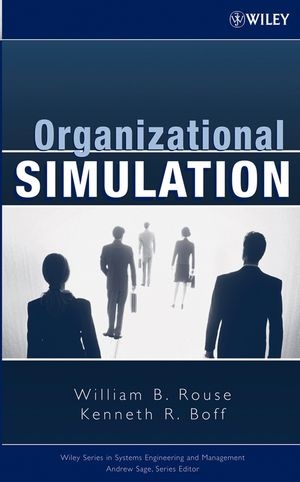
Organizational Simulation (eBook)
688 Seiten
John Wiley & Sons (Verlag)
978-0-471-73943-2 (ISBN)
With contributions from leaders in systems and organizational
modeling, behavioral and social sciences, computing and
visualization, and gaming and entertainment, Organizational
Simulation both articulates the grand vision of immersive
environments and shows, in detail, how to realize it. This book
offers unparalleled insight into the cutting edge of the field,
since it was written by those who actually researched, designed,
developed, deployed, marketed, sold, and critiqued today's best
organizational simulations.
The coverage is divided into four sections:
* Introduction outlines the need for organizational simulation to
support strategic thinking, design of unprecedented systems, and
organizational learning, including the functionality and technology
required to enable this support
* Behaviors covers the state of knowledge of individual, group, and
team behaviors and performance, how performance can best be
supported, how performance is affected by national differences, and
how organizational performance can best be measured
* Modeling describes the latest approaches to modeling and
simulating people, groups, teams, and organizations, as well as
narrative contexts and organizational environments within which
these entities act, drawing from a rich set of modeling methods and
tools
* Simulations and Games illustrates a wide range of fielded
simulations, games, and entertainment, including the methods and
tools employed for designing, developing, deploying, and evaluating
these systems, as well as the social implications for the
associated communities that have emerged
Addressing all levels of organizational simulation architecture
with theories and applications, and enabling technologies for each,
Organizational Simulation offers students and professionals the
premier reference and practical toolbox for this dynamic field.
WILLIAM B. ROUSE, PhD, is Executive Director of the Tennenbaum Institute at Georgia Tech and a professor in the College of Computing and the School of Industrial and Systems Engineering. Dr. Rouse has over thirty years of experience in the field of individual and organizational performance, decision support systems, and information systems. He has written hundreds of articles and book chapters, and has authored several Wiley books, including Essential Challenges of Strategic Management, and is a coeditor of Handbook of Systems Engineering and Management. He is a Fellow of IEEE, INFORMS, and HFES, as well as a member of the National Academy of Engineering. KENNETH R. BOFF, PhD, is a Chief Scientist of the Human Effectiveness Directorate, Air Force Research Laboratory, headquartered at Wright-Patterson Air Force Base, in Dayton, Ohio. His research includes human engineering of complex systems, training, safety, protection, and deployment logistics. He has authored numerous articles and book chapters, and has edited several books. He is a founder and technical director of the Department of Defense Human System Information Analysis Center, and is a founding member and former chair of the DoD Reliance Human-Systems Interface Technology Panel.
Forward.
Preface.
Contributors.
1. Introduction and Overview (W. Rouse & K. Boff).
2. Strategic Thinking Via Organizational Simulation (W.
Rouse).
3. Using Organizational Simulation to Develop Unprecedented
Systems (S. Cross).
4. The Learning Organization and Organizational Simulation (D.
Andrews, et al.).
5. Requirements and Approaches For Modeling Individuals Within
Organizational Simulations (E. Hudlicka &
G. Zacharias).
6. Common Ground and Coordination in Joint Activity (G. Klein,
et al.).
7. Modeling Team Performance: The Basic Ingredients and
Research Needs (E. Salas, et al.).
8. National Differences in Teamwork (H. Klein & A.
McHugh).
9. How Well Did It Work? Measuring Organizational Performance in
Simulation Environments (J. MacMillan, et al.).
10. Technical and Conceptual Challenges in Organizational
Simulation (L. McGinnis).
11. Narrative Abstraction For Organizational Simulations (J.
Murray).
12. Agent-Based Modeling and Simulation of Socio-Technical
Systems (A. Shah & A. Pritchett).
13. Executable Models of Decision Making Organizations (A.
Levis).
14. Organizational Design and Assessment in Cyber-Space (K.
Carley).
15. Artificial Intelligence and Its Applications to
Organizational Simulation (S. Cross & S. Fouse).
16. Simulating Humans (I. Essa & A. Bobick).
17. Modeling Crowd Behavior For Military Simulation Applications
(R. Loftin, et al.).
18. Application of Immersive Technology For Next Generation
Simulation (R. Lindheim & J. Korris).
19. From Viz-Sim to VR to Games: How We Build a Hit Game-Based
Simulation (M. Zyda, et al.).
20. Distributed Simulation and the High Level Architecture (R.
Fujimoto).
21. Harnessing the Hive: Innovation as a Distributed Function in
The Online Game Community (J. Herz).
Author Index.
Subject Index.
"...researchers and students in organization science and computational organization theory will find it useful...informative reading for professionals and technical management personnel." (Computing Reviews.com, May 24, 2007)
| Erscheint lt. Verlag | 22.7.2005 |
|---|---|
| Reihe/Serie | Wiley Series in Systems Engineering and Management | Wiley Series in Systems Engineering and Management |
| Sprache | englisch |
| Themenwelt | Technik ► Elektrotechnik / Energietechnik |
| Wirtschaft ► Betriebswirtschaft / Management ► Unternehmensführung / Management | |
| Schlagworte | Electrical & Electronics Engineering • Elektrotechnik u. Elektronik • Systems Engineering & Management • Systemtechnik u. -management |
| ISBN-10 | 0-471-73943-X / 047173943X |
| ISBN-13 | 978-0-471-73943-2 / 9780471739432 |
| Informationen gemäß Produktsicherheitsverordnung (GPSR) | |
| Haben Sie eine Frage zum Produkt? |
 PDF (Adobe DRM)
Kopierschutz: Adobe-DRM
Adobe-DRM ist ein Kopierschutz, der das eBook vor Mißbrauch schützen soll. Dabei wird das eBook bereits beim Download auf Ihre persönliche Adobe-ID autorisiert. Lesen können Sie das eBook dann nur auf den Geräten, welche ebenfalls auf Ihre Adobe-ID registriert sind.
Details zum Adobe-DRM
Dateiformat: PDF (Portable Document Format)
Mit einem festen Seitenlayout eignet sich die PDF besonders für Fachbücher mit Spalten, Tabellen und Abbildungen. Eine PDF kann auf fast allen Geräten angezeigt werden, ist aber für kleine Displays (Smartphone, eReader) nur eingeschränkt geeignet.
Systemvoraussetzungen:
PC/Mac: Mit einem PC oder Mac können Sie dieses eBook lesen. Sie benötigen eine
eReader: Dieses eBook kann mit (fast) allen eBook-Readern gelesen werden. Mit dem amazon-Kindle ist es aber nicht kompatibel.
Smartphone/Tablet: Egal ob Apple oder Android, dieses eBook können Sie lesen. Sie benötigen eine
Geräteliste und zusätzliche Hinweise
Buying eBooks from abroad
For tax law reasons we can sell eBooks just within Germany and Switzerland. Regrettably we cannot fulfill eBook-orders from other countries.
aus dem Bereich