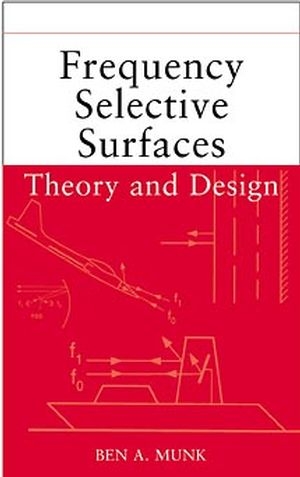
Frequency Selective Surfaces (eBook)
440 Seiten
John Wiley & Sons (Verlag)
978-0-471-72376-9 (ISBN)
Mr. W. Bahret was with the United States Air Force but is nowretired. From the early 50s he sponsored numerous projectsconcerning Radar Cross Section of airborne platforms in particularantennas and absorbers. Under his leadership grew many of theconcepts used extensively today, as for example the metallicradome. In fact, he is by many considered to be the father ofstealth technology.
"This book compiles under one cover most of Munk's research overthe past three decades. It is woven with the physical insight thathe has gained and further developed as his career has grown. Benuses mathematics to whatever extent is needed, and only as needed.This material is written so that it should be useful to engineerswith a background in electromagnetics. I strongly recommend thisbook to any engineer with any interest in phased arrays and/orfrequency selective surfaces. The physical insight that may begained from this book will enhance their ability to treatadditional array problems of their own." -Leon Peters, Jr.
Professor Leon Peters, Jr., was a professor at the Ohio StateUniversity but is now retired. From the early sixties he worked on,among many other things, RCS problems involving antennas andabsorbers.
This book presents the complete derivation of the Periodic Methodof Moments, which enables the reader to calculate quickly andefficiently the transmission and reflection properties ofmulti-layered Frequency Selective Surfaces comprised of either wireand/or slot elements of arbitrary shape and located in a stratifiedmedium. However, it also gives the reader the tools to analyzemulti-layered FSS's leading to specific designs of the veryimportant Hybrid Radome, which is characterized by constant bandwidth with angle of incidence and polarization. Further, itinvestigates in great detail bandstop filters with large as well asnarrow bandwidth (dichroic surfaces). It also discusses for thefirst time, lossy elements used in producing Circuit Analogabsorbers. Finally, the last chapter deals with power breakdown ofFSS's when exposed to pulsed signals with high peak power.
The approach followed by most other presentations simply consistsof expanding the fields around the FSS, matching the boundaryconditions and writing a computer program. While this enables theuser to obtain calculated results, it gives very little physicalinsight and no help in how to design actual multi-layered FSS's. Incontrast, the approach used in this title analyzes all curves ofdesired shapes. In particular, it discusses in great detail how toproduce radomes made of FSS's located in a stratified medium(Hybrid Radomes), with constant band width for all angles ofincidence and polarizations. Numerous examples are given of greatpractical interest. More specifically, Chapter 7 deals with thetheory and design of bandpass radomes with constant bandwidth andflat tops. Examples are given for mono-, bi- and tri-planardesigns. Chapter 8 deals with bandstop filters with broad as wellas narrow bandwidth. Chapter 9 deals with multi-layered FSS oflossy elements, namely the so-called Circuit Analog Absorbers,designed to yield outstanding absorption with more than a decade ofbandwidth.
Features material previously labeled as classified by the UnitedStates Air Force.
BEN A. MUNK, PhD, is Professor of Electrical Engineering at Ohio State University and a major contributor to the theory and design of periodic structures, particularly frequency selective surfaces, circuit analog absorbers, and phased arrays.
General Overview.
Element Types: A Comparison.
Evaluating Periodic Structures: An Overview.
Spectral Expansion of One- and Two-Dimensional Periodic Structures.
Dipole Arrays in a Stratified Medium.
Slot Arrays in a Stratified Medium.
Band-Pass Filter Designs: The Hybrid Radome.
Band-Stop and Dichroic Filter Designs.
Jaumann and Circuit Analog Absorbers.
Power Handling of Periodic Surfaces.
Concluding Remarks and Future Trends.
Appendices.
References.
Index.
"...well-organized and worth reading...The analysis and design concepts, as well as physical insight, presented in this book would provide the reader a great benefit." (IEEE Circuits & Devices Magazine, Jan/Feb 2005)
"This book provides: a complete derivation of the Periodic Method of Moments, band pass and bandstop filters..." (IEE Signal Processing, Vol. 18, No. 1, January 2001)
| Erscheint lt. Verlag | 11.3.2005 |
|---|---|
| Sprache | englisch |
| Themenwelt | Technik ► Elektrotechnik / Energietechnik |
| Technik ► Nachrichtentechnik | |
| Schlagworte | Electrical & Electronics Engineering • Elektromagnetische Strahlung • Elektrotechnik u. Elektronik • Mikrowellen- u. Hochfrequenztechnik u. Theorie • Oberfläche • Oberfläche • RF / Microwave Theory & Techniques |
| ISBN-10 | 0-471-72376-2 / 0471723762 |
| ISBN-13 | 978-0-471-72376-9 / 9780471723769 |
| Informationen gemäß Produktsicherheitsverordnung (GPSR) | |
| Haben Sie eine Frage zum Produkt? |
 PDF (Adobe DRM)
Kopierschutz: Adobe-DRM
Adobe-DRM ist ein Kopierschutz, der das eBook vor Mißbrauch schützen soll. Dabei wird das eBook bereits beim Download auf Ihre persönliche Adobe-ID autorisiert. Lesen können Sie das eBook dann nur auf den Geräten, welche ebenfalls auf Ihre Adobe-ID registriert sind.
Details zum Adobe-DRM
Dateiformat: PDF (Portable Document Format)
Mit einem festen Seitenlayout eignet sich die PDF besonders für Fachbücher mit Spalten, Tabellen und Abbildungen. Eine PDF kann auf fast allen Geräten angezeigt werden, ist aber für kleine Displays (Smartphone, eReader) nur eingeschränkt geeignet.
Systemvoraussetzungen:
PC/Mac: Mit einem PC oder Mac können Sie dieses eBook lesen. Sie benötigen eine
eReader: Dieses eBook kann mit (fast) allen eBook-Readern gelesen werden. Mit dem amazon-Kindle ist es aber nicht kompatibel.
Smartphone/Tablet: Egal ob Apple oder Android, dieses eBook können Sie lesen. Sie benötigen eine
Geräteliste und zusätzliche Hinweise
Buying eBooks from abroad
For tax law reasons we can sell eBooks just within Germany and Switzerland. Regrettably we cannot fulfill eBook-orders from other countries.
aus dem Bereich