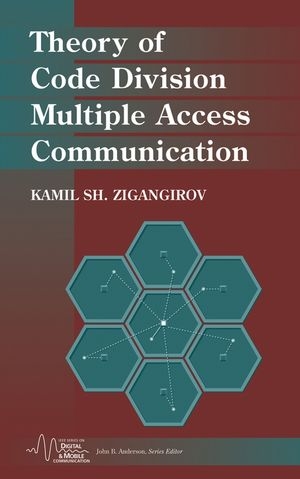
Theory of Code Division Multiple Access Communication (eBook)
John Wiley & Sons (Verlag)
978-0-471-65548-0 (ISBN)
Code division multiple access (CDMA) communication is rapidly replacing time- and frequency-division methods as the cornerstone of wireless communication and mobile radio. Theory of Code Division Multiple Access Communication provides a lucid introduction and overview of CDMA concepts and methods for both the professional and the advanced student.
Emphasizing the role CDMA has played in the development of wireless communication and cellular mobile radio systems, the author leads you through the basic concepts of mobile radio systems and considers the different principles of multiple access-time division, frequency division, and code division. He then analyzes three major CDMA systems-direct sequence (DS) CDMA systems, frequency hopped (FH) CDMA systems, and pulse position hopped (PPH) CDMA systems. Other topics covered include:
* Spread spectrum (SS) technology
* Forward error control coding
* CDMA communication on fading channels
* Pseudorandom signals
* Information theory in relation to CDMA communication
* CDMA cellular networks
Complete with useful appendices providing analyses of the moments of CDMA system decision statistics, Theory of Code Division Multiple Access Communication is a ready reference for every engineer seeking an understanding of the history and concepts of this key communications technology.
A comprehensive introduction to CDMA theory and application Code division multiple access (CDMA) communication is rapidly replacing time- and frequency-division methods as the cornerstone of wireless communication and mobile radio. Theory of Code Division Multiple Access Communication provides a lucid introduction and overview of CDMA concepts and methods for both the professional and the advanced student. Emphasizing the role CDMA has played in the development of wireless communication and cellular mobile radio systems, the author leads you through the basic concepts of mobile radio systems and considers the different principles of multiple access-time division, frequency division, and code division. He then analyzes three major CDMA systems-direct sequence (DS) CDMA systems, frequency hopped (FH) CDMA systems, and pulse position hopped (PPH) CDMA systems. Other topics covered include: * Spread spectrum (SS) technology * Forward error control coding * CDMA communication on fading channels * Pseudorandom signals * Information theory in relation to CDMA communication * CDMA cellular networks Complete with useful appendices providing analyses of the moments of CDMA system decision statistics, Theory of Code Division Multiple Access Communication is a ready reference for every engineer seeking an understanding of the history and concepts of this key communications technology.
KAMIL SH. ZIGANGIROV received his PhD from the Institute of Radio Engineering and Electronics at the USSR Academy of Sciences in 1966. Since then, he has been a visiting scientist at MIT in Cambridge, Massachusetts, at Napoli University in Napoli, Italy, and at the University of Notre Dame, Notre Dame, Indiana. He is currently a professor in the Department of Information Technology at Lund University in Lund, Sweden.
Preface ix
1 Introduction to Cellular Mobile Radio Communication 1
2 Introduction to Spread Spectrum Communication Systems 36
3 Reception of Spread Spectrum Signals in AWGN Channels 86
4 Forward Error Control Coding in Spread Spectrum Systems 137
5 CDMA Communication on Fading Channels 186
6 Pseudorandom Signal Generation 229
7 Synchronization of Pseudorandom Signals 255
8 Information-Theoretical Aspects of CDMA Communications 300
9 CDMA Cellular Networks 342
Appendix A: Analysis of the Moments of the Decision Statistics for the FH CDMA Communication System 385
Bibliography 390
Index 395
| Erscheint lt. Verlag | 26.4.2004 |
|---|---|
| Reihe/Serie | IEEE Press Series on Digital & Mobile Communication |
| IEEE Press Series on Digital & Mobile Communication | IEEE Series on Digital & Mobile Communication |
| Sprache | englisch |
| Themenwelt | Technik ► Elektrotechnik / Energietechnik |
| Technik ► Nachrichtentechnik | |
| Schlagworte | ACCESS • application • CDMA • Code • Communication • Communication technology • Comprehensive • Concepts • Development • Division • Drahtlose Kommunikation • Electrical & Electronics Engineering • Elektrotechnik u. Elektronik • Introduction • Kommunikationstechnik • Mobile & Wireless Communications • Multiple • Overview • Role • Signal Processing • Signalverarbeitung • theory • Time |
| ISBN-10 | 0-471-65548-1 / 0471655481 |
| ISBN-13 | 978-0-471-65548-0 / 9780471655480 |
| Informationen gemäß Produktsicherheitsverordnung (GPSR) | |
| Haben Sie eine Frage zum Produkt? |
 PDF (Adobe DRM)
Kopierschutz: Adobe-DRM
Adobe-DRM ist ein Kopierschutz, der das eBook vor Mißbrauch schützen soll. Dabei wird das eBook bereits beim Download auf Ihre persönliche Adobe-ID autorisiert. Lesen können Sie das eBook dann nur auf den Geräten, welche ebenfalls auf Ihre Adobe-ID registriert sind.
Details zum Adobe-DRM
Dateiformat: PDF (Portable Document Format)
Mit einem festen Seitenlayout eignet sich die PDF besonders für Fachbücher mit Spalten, Tabellen und Abbildungen. Eine PDF kann auf fast allen Geräten angezeigt werden, ist aber für kleine Displays (Smartphone, eReader) nur eingeschränkt geeignet.
Systemvoraussetzungen:
PC/Mac: Mit einem PC oder Mac können Sie dieses eBook lesen. Sie benötigen eine
eReader: Dieses eBook kann mit (fast) allen eBook-Readern gelesen werden. Mit dem amazon-Kindle ist es aber nicht kompatibel.
Smartphone/Tablet: Egal ob Apple oder Android, dieses eBook können Sie lesen. Sie benötigen eine
Geräteliste und zusätzliche Hinweise
Buying eBooks from abroad
For tax law reasons we can sell eBooks just within Germany and Switzerland. Regrettably we cannot fulfill eBook-orders from other countries.
aus dem Bereich