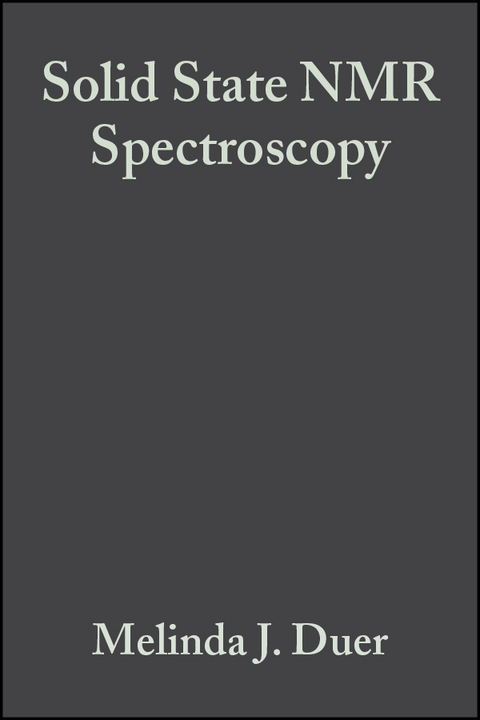
Solid State NMR Spectroscopy (eBook)
John Wiley & Sons (Verlag)
978-0-470-99938-7 (ISBN)
The book is divided into two parts: 'Fundamentals' and 'Further Applications.' The section on Fundamentals contains relatively long chapters that deal with the basic theory and practice of solid-state NMR. The essential differences and extra scope of solid-state NMR over solution-state is dealt with in an introductory chapter. The basic techniques that all chapters rely on are collected into a second chapter to avoid unnecessary repetition later. Remaining chapters in the 'Fundamentals' part deal with the major areas of solid-state NMR which all solid-state NMR spectroscopists should know about. Each begins with an overview of the topic that puts the chapter in context.
The basic principles upon which the techniques in the chapter rely are explained in a separate section. Each of these chapters exemplifies the principles and techniques with the applications most commonly found in current practice.
The 'Further Applications' section contains a series of shorter chapters which describe the NMR techniques used in other, more specific areas. The basic principles upon which these techniques rely will be expounded only if not already in the Fundamentals part.
Melinda Duer is a Lecturer in the Department of Chemistry, University of Cambridge and has worked in the field of solid-state NMR spectroscopy for more than ten years.
This book is for those familiar with solution-state NMR who are encountering solid-state NMR for the first time. It presents the current understanding and applications of solid-state NMR with a rigorous but readable approach, making it easy for someone who merely wishes to gain an overall impression of the subject without details. This dual requirement is met through careful construction of the material within each chapter. The book is divided into two parts: "e;Fundamentals"e; and "e;Further Applications."e; The section on Fundamentals contains relatively long chapters that deal with the basic theory and practice of solid-state NMR. The essential differences and extra scope of solid-state NMR over solution-state is dealt with in an introductory chapter. The basic techniques that all chapters rely on are collected into a second chapter to avoid unnecessary repetition later. Remaining chapters in the "e;Fundamentals"e; part deal with the major areas of solid-state NMR which all solid-state NMR spectroscopists should know about. Each begins with an overview of the topic that puts the chapter in context. The basic principles upon which the techniques in the chapter rely are explained in a separate section. Each of these chapters exemplifies the principles and techniques with the applications most commonly found in current practice. The "e;Further Applications"e; section contains a series of shorter chapters which describe the NMR techniques used in other, more specific areas. The basic principles upon which these techniques rely will be expounded only if not already in the Fundamentals part.
Melinda Duer is a Lecturer in the Department of Chemistry, University of Cambridge and has worked in the field of solid-state NMR spectroscopy for more than ten years.
List of Contributors.
Preface.
Acknowledgements.
Part I - The Theory of Solid-State NMR and its
Experiments.
1. The Basics of Solid-State NMR.
2. Essential Techniques for Spin-1/2 Nuclei.
3. Dipolar Coupling - its Measurements and Uses.
4. Quadrupolar Coupling - its Measurements and Uses.
5. Shielding and Chemical Shift.
Part II - Applications of Solid-state NMR.
6. NMR Techniques for Studying Molecular Motion in Solids.
7. Molecular Structure Determination: Applications in
Biology.
8. NMR Studies of Oxide Glass Structure.
9. Porous Materials.
10. Solid Polymers.
11. Liquid-Crystalline Materials.
References.
Index.
| Erscheint lt. Verlag | 15.4.2008 |
|---|---|
| Sprache | englisch |
| Themenwelt | Naturwissenschaften ► Chemie ► Analytische Chemie |
| Naturwissenschaften ► Chemie ► Physikalische Chemie | |
| Technik | |
| Schlagworte | Analytical Chemistry • Analytische Chemie • Applications • Approach • BASIC • Book • Chapters • Chemie • Chemistry • Contains • Current • Deal • fundamentals • Later • NMR • overall impression • Physical Chemistry • Physikalische Chemie • Practice • readable • Rigorous • Second • section • solidstate • someone • Subject • theory • two • Unnecessary |
| ISBN-10 | 0-470-99938-1 / 0470999381 |
| ISBN-13 | 978-0-470-99938-7 / 9780470999387 |
| Informationen gemäß Produktsicherheitsverordnung (GPSR) | |
| Haben Sie eine Frage zum Produkt? |
 PDF (Adobe DRM)
Kopierschutz: Adobe-DRM
Adobe-DRM ist ein Kopierschutz, der das eBook vor Mißbrauch schützen soll. Dabei wird das eBook bereits beim Download auf Ihre persönliche Adobe-ID autorisiert. Lesen können Sie das eBook dann nur auf den Geräten, welche ebenfalls auf Ihre Adobe-ID registriert sind.
Details zum Adobe-DRM
Dateiformat: PDF (Portable Document Format)
Mit einem festen Seitenlayout eignet sich die PDF besonders für Fachbücher mit Spalten, Tabellen und Abbildungen. Eine PDF kann auf fast allen Geräten angezeigt werden, ist aber für kleine Displays (Smartphone, eReader) nur eingeschränkt geeignet.
Systemvoraussetzungen:
PC/Mac: Mit einem PC oder Mac können Sie dieses eBook lesen. Sie benötigen eine
eReader: Dieses eBook kann mit (fast) allen eBook-Readern gelesen werden. Mit dem amazon-Kindle ist es aber nicht kompatibel.
Smartphone/Tablet: Egal ob Apple oder Android, dieses eBook können Sie lesen. Sie benötigen eine
Geräteliste und zusätzliche Hinweise
Buying eBooks from abroad
For tax law reasons we can sell eBooks just within Germany and Switzerland. Regrettably we cannot fulfill eBook-orders from other countries.
aus dem Bereich