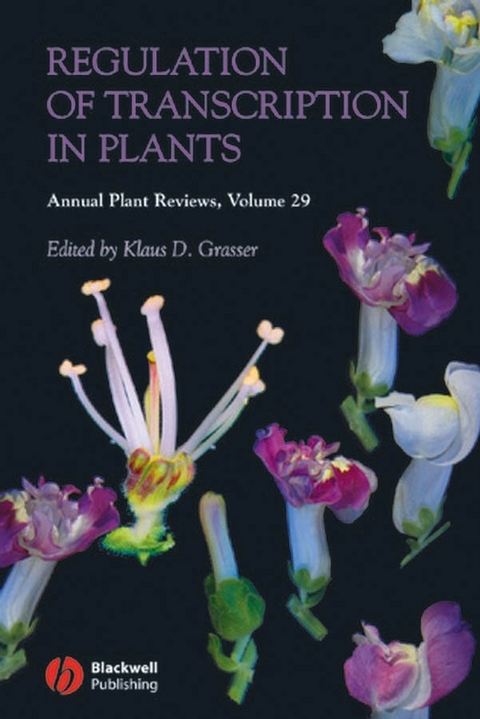
Annual Plant Reviews, Regulation of Transcription in Plants (eBook)
John Wiley & Sons (Verlag)
9780470994283 (ISBN)
This volume provides a broad overview of the regulation of transcription in plants, introducing the key elements, the way in which it works in practice, and the potential within plant biotechnology. It is directed at researchers and professionals in plant molecular biology, biochemistry and biotechnology.
Professor Klaus D. Grasser, Department of Life Sciences, University of Aalborg, Denmark
Regulation of transcription represents a major, controlling step in plant gene expression, as it determines the tissue-specific and developmental stage-specific activity of many genes. Changes in gene expression have been shown to underlie the responses to environmental cues and stresses, the response against pathogens, the regulation of metabolic pathways, and the regulation of photosynthesis, for example. Regulation by transcription factors is an integral part of a highly complex network. In recent years, research on the regulation of transcription has made impressive progress. This volume provides a broad overview of the regulation of transcription in plants, introducing the key elements, the way in which it works in practice, and the potential within plant biotechnology. It is directed at researchers and professionals in plant molecular biology, biochemistry and biotechnology.
Professor Klaus D. Grasser, Department of Life Sciences, University of Aalborg, Denmark
Part 1: Introducing the key players.
1. General transcription factors and the core promoter: ancientroots (William B. Gurley, Kevin O'Grady, EvaCzarnecka-Verner and Shai J. Lawit, Department ofMicrobiology & Cell Science, University of Florida,Gainesville, Florida, USA).
2. Transcription Factors of Arabidopsis and Rice: a genomicperspective (José Luis Riechmann, Division of Biology,California Institute of Technology, Pasadena, California, USA).
3. Chromatin-associated architectural HMGA and HMGB proteinsassist transcription factor function (Klaus D. Grasser andDorte Launholt, Department of Life Sciences, AalborgUniversity, Denmark).
4. Histone Modifications and Transcription in Plants (YiiLeng Chua , Hutchinson MRC Research Centre, Department ofPathology, University of Cambridge, UK. and John C. Gray,Department of Plant Sciences, University of Cambridge, UK).
5. Chromatin remodeling and histone variants in transcriptionalregulation and in maintaining DNA methylation (J.C. Reyes,Instituto de Bioquímica Vegetal y Fotosíntesis, ConsejoSuperior de Investigaciones Científicas - Universidad deSevilla, Spain, J. Brzeski, Institute of Biochemistry andBiophysics, Polish Academy of Sciences, Warsaw, Poland; andDepartment of Plant Sciences, University of Arizona, Tucson, USA.and A. Jerzmanowski, Institute of Biochemistry andBiophysics, Polish Academy of Sciences, Warsaw, Poland; and WarsawUniversity, Laboratory of Plant Molecular Biology, Warsaw,Poland).
6. Matrix attachment regions and transcriptional gene silencing(William F. Thompson. Departments of Botany, Genetics, andCrop Science, North Carolina State University, Raleigh, USASteven Spiker, Department of Genetics, North Carolina StateUniversity, Raleigh, USA and George C. Allen, Department ofCrop Science, North Carolina State University, Raleigh, USA).
7. Polymerase I transcription (JulioSáez-Vásquez and Manuel Echeverría,Laboratoire Génome et Développement de Plantes,Université de Perpignan, France).
Part 2: How transcription regulation in plants works.
8. Transcription of Plastid Genes (Karsten Liere andThomas Börner, Institute of Biology (Genetics),Humboldt University Berlin, Berlin, Germany).
9. Control of Flowering Time (Steven van Nocker,Department of Horticulture, Michigan State University, EastLansing, MI, USA. and Maria Julissa Ek-Ramos, Departamento deBioquimica, Facultad de Quimica, Universidad Nacional Autonoma deMexico, Ciudad Universitaria, Mexico).
10. Combinatorial control of floral organ identity byMADS-domain transcription factors (Günter Theißenand Rainer Melzer, Friedrich-Schiller-Universität Jena,Lehrstuhl für Genetik, Jena, Germany).
11. Networks of transcriptional regulation underlying plantdefense responses towards phytopathogens (Imre E. Somssich,Max-Planck-Institute for Plant Breeding, Department of PlantMicrobe Interactions, Köln, Germany).
12. Temperature regulated gene expression (FriedrichSchöffl and Tressa Jacob Panikulangara, ZMBP,Allgemeine Genetik, Universität Tübingen, Germany).
Part 3: Biotechnology-related issues.
13. Applications of inducible transcription in plant researchand biotechnology (Brian Tomsett, Angela Tregova and MarkCaddick, School of Biological Sciences, The University ofLiverpool, Liverpool, UK).
14. Modulation of transcriptional networks in crop plants(Tong Zhu, Syngenta Biotechnology, Inc., North Carolina,USA).
| Erscheint lt. Verlag | 15.4.2008 |
|---|---|
| Reihe/Serie | Annual Plant Reviews |
| Annual Plant Reviews | Annual Plant Reviews |
| Sprache | englisch |
| Themenwelt | Naturwissenschaften ► Biologie ► Botanik |
| Technik | |
| Schlagworte | Activity • Biowissenschaften • Botanik / Molekularbiologie • changes • Controlling • Cues • Example • Expression • Gene • Life Sciences • Major • many genes • Metabolic Pathways • photosynthesis • plant gene • Plant Molecular Biology • Regulation • responses • shown • stagespecific • STEP • tissuespecific • transcription represents |
| ISBN-13 | 9780470994283 / 9780470994283 |
| Informationen gemäß Produktsicherheitsverordnung (GPSR) | |
| Haben Sie eine Frage zum Produkt? |
 PDF (Adobe DRM)
Kopierschutz: Adobe-DRM
Adobe-DRM ist ein Kopierschutz, der das eBook vor Mißbrauch schützen soll. Dabei wird das eBook bereits beim Download auf Ihre persönliche Adobe-ID autorisiert. Lesen können Sie das eBook dann nur auf den Geräten, welche ebenfalls auf Ihre Adobe-ID registriert sind.
Details zum Adobe-DRM
Dateiformat: PDF (Portable Document Format)
Mit einem festen Seitenlayout eignet sich die PDF besonders für Fachbücher mit Spalten, Tabellen und Abbildungen. Eine PDF kann auf fast allen Geräten angezeigt werden, ist aber für kleine Displays (Smartphone, eReader) nur eingeschränkt geeignet.
Systemvoraussetzungen:
PC/Mac: Mit einem PC oder Mac können Sie dieses eBook lesen. Sie benötigen eine
eReader: Dieses eBook kann mit (fast) allen eBook-Readern gelesen werden. Mit dem amazon-Kindle ist es aber nicht kompatibel.
Smartphone/Tablet: Egal ob Apple oder Android, dieses eBook können Sie lesen. Sie benötigen eine
Geräteliste und zusätzliche Hinweise
Buying eBooks from abroad
For tax law reasons we can sell eBooks just within Germany and Switzerland. Regrettably we cannot fulfill eBook-orders from other countries.
aus dem Bereich