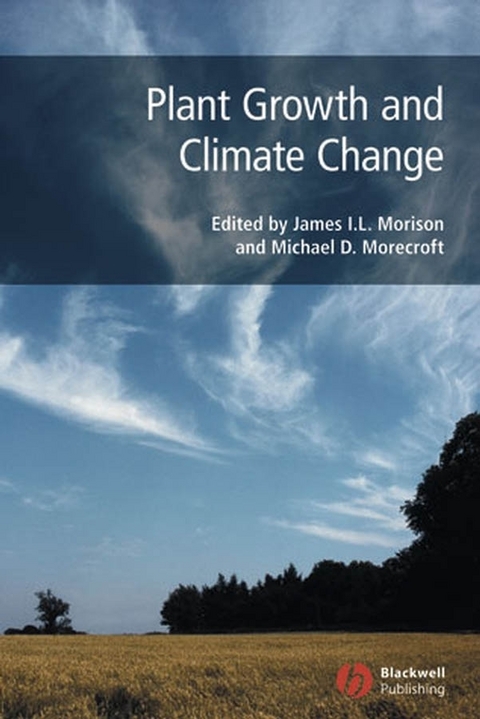
Plant Growth and Climate Change (eBook)
John Wiley & Sons (Verlag)
978-0-470-99418-4 (ISBN)
Plant Growth and Climate Change examines the major aspects of how anthropogenic climate change affects plants, focusing on several key determinants of plant growth: atmospheric CO2, temperature, water availability and the interactions between these factors. The book demonstrates the variety of techniques used across plant science: detailed physiology in controlled environments; observational studies based on long-term data sets; field manipulation experiments and modelling. It is directed at advanced-level university students, researchers and professionals across the range of plant science disciplines, including plant physiology, plant ecology and crop science. It will also be of interest to earth system scientists.
Dr James Morison, Department of Biological Sciences, University of Essex, UK
Dr Michael Morecroft, NERC Centre for Ecology & Hydrology, Wallingford, UK
Evidence grows daily of the changing climate and its impact on plants and animals. Plant function is inextricably linked to climate and atmospheric carbon dioxide concentration. On the shortest and smallest scales, the climate affects the plant s immediate environment and so directly influences physiological processes. At larger scales, the climate influences species distribution and community composition, as well as the viability of different crops in managed ecosystems. Plant growth also influences the local, regional and global climate, through the exchanges of energy and gases between the plants and the air around them. Plant Growth and Climate Change examines the major aspects of how anthropogenic climate change affects plants, focusing on several key determinants of plant growth: atmospheric CO2, temperature, water availability and the interactions between these factors. The book demonstrates the variety of techniques used across plant science: detailed physiology in controlled environments; observational studies based on long-term data sets; field manipulation experiments and modelling. It is directed at advanced-level university students, researchers and professionals across the range of plant science disciplines, including plant physiology, plant ecology and crop science. It will also be of interest to earth system scientists.
Dr James Morison, Department of Biological Sciences, University of Essex, UK Dr Michael Morecroft, NERC Centre for Ecology & Hydrology, Wallingford, UK
List of Contributors.
Preface.
1. Recent and future climate change and its implications for
plant growth.
David Viner, Climatic Research Unit, University of East Anglia,
Norwich, UK, James I.L. Morison, Department of Biological Sciences,
University of Essex, Colchester, UK and Craig Wallace, Climatic
Research Unit, University of East Anglia, Norwich, UK.
2. Plant responses to rising atmospheric carbon dioxide.
Lewis H. Ziska and James A. Bunce, Crop Systems and Global
Change, USDA-ARS, Beltsville, Maryland, USA.
3. The significance of temperature in plant life.
Christian Körner, Institute of Botany, University of Basel,
Basel, Switzerland.
4. Temperature and plant development: phenology and
seasonality.
Annette Menzel, Department of Ecology, Technical University of
Munich, Germany and Tim Sparks, Centre for Ecology & Hydrology,
Huntingdon, UK.
5. Responses of plant growth and functioning to changes in water
supply in a changing climate.
William J. Davies, Department of Biological Sciences, Lancaster
Environment Centre, University of Lancaster, UK.
6. Water availability and productivity.
João S. Pereira, Maria-Manuela Chaves,
Maria-Conceição Caldeira and Alexandre V. Correia,m
Instituto Superior de Agronomia, Lisboa, Portugal.
7. Effects of temperature and precipitation changes on plant
communities.
M. D. Morecroft, NERC Centre for Ecology and Hydrology,
Wallingford, UK and J.S. Paterson, Environmental Change Institute,
Oxford University Centre for the Environment, Oxford, UK.
8. Issues in modelling plant ecosystem responses to elevated
CO2: interactions with soil nitrogen.
Ying-Ping Wang, CSIRO Atmospheric Research, Aspendale, Victoria,
Australia and Ross McMurtrie, Belinda Medlyn and David Pepper,
School of Biological Sciences, Earth and Environmental Sciences,
University of New South Wales, Sydney, Australia.
9. Predicting the effect of climate change on global plant
productivity and the carbon cycle.
John Grace & Rui Zhang, Institute of Atmospheric and
Environmental Science, School of GeoSciences, University of
Edinburgh, UK.
References.
Index
"...this book is timely, and focused on plants more widely than the
title suggests, ranging from organ physiology through to ecosystem
responses. I recommend the book for advanced students, teachers and
researchers who have interests in, and need to consider, a wide
range of plant-environmental processes, not just the complexities
of plant responses to 'climate change'..."
Annals of Botany, 1-1, 2007
| Erscheint lt. Verlag | 15.4.2008 |
|---|---|
| Reihe/Serie | Biological Sciences Series | Biological Sciences Series |
| Sprache | englisch |
| Themenwelt | Naturwissenschaften ► Biologie ► Botanik |
| Naturwissenschaften ► Biologie ► Genetik / Molekularbiologie | |
| Technik | |
| Schlagworte | Ãkologie u. Biologie der Organismen • Atmospheric • Biowissenschaften • Botanik / Physiologie • carbon • changing • Climate • Composition • crops • daily • Dioxide • Ecology & Organismal Biology • Environment • Evidence • grows • immediate • inextricably • influences • Life Sciences • Ökologie u. Biologie der Organismen • Physiological • plant function • Plant Physiology • plants • processes • scales • shortest |
| ISBN-10 | 0-470-99418-5 / 0470994185 |
| ISBN-13 | 978-0-470-99418-4 / 9780470994184 |
| Informationen gemäß Produktsicherheitsverordnung (GPSR) | |
| Haben Sie eine Frage zum Produkt? |
 PDF (Adobe DRM)
Kopierschutz: Adobe-DRM
Adobe-DRM ist ein Kopierschutz, der das eBook vor Mißbrauch schützen soll. Dabei wird das eBook bereits beim Download auf Ihre persönliche Adobe-ID autorisiert. Lesen können Sie das eBook dann nur auf den Geräten, welche ebenfalls auf Ihre Adobe-ID registriert sind.
Details zum Adobe-DRM
Dateiformat: PDF (Portable Document Format)
Mit einem festen Seitenlayout eignet sich die PDF besonders für Fachbücher mit Spalten, Tabellen und Abbildungen. Eine PDF kann auf fast allen Geräten angezeigt werden, ist aber für kleine Displays (Smartphone, eReader) nur eingeschränkt geeignet.
Systemvoraussetzungen:
PC/Mac: Mit einem PC oder Mac können Sie dieses eBook lesen. Sie benötigen eine
eReader: Dieses eBook kann mit (fast) allen eBook-Readern gelesen werden. Mit dem amazon-Kindle ist es aber nicht kompatibel.
Smartphone/Tablet: Egal ob Apple oder Android, dieses eBook können Sie lesen. Sie benötigen eine
Geräteliste und zusätzliche Hinweise
Buying eBooks from abroad
For tax law reasons we can sell eBooks just within Germany and Switzerland. Regrettably we cannot fulfill eBook-orders from other countries.
aus dem Bereich