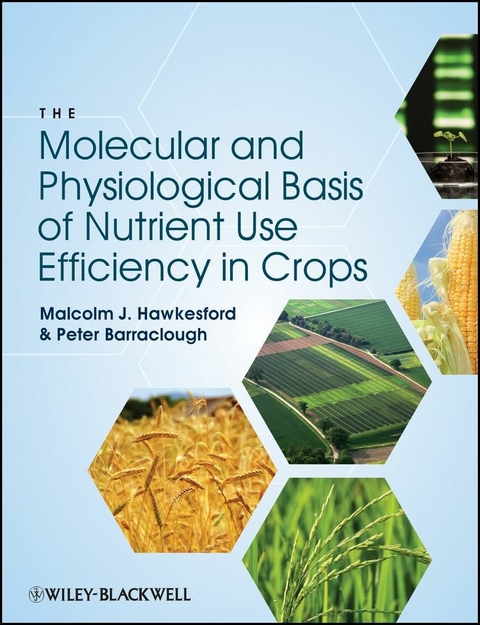
The Molecular and Physiological Basis of Nutrient Use Efficiency in Crops (eBook)
John Wiley & Sons (Verlag)
978-0-470-96068-4 (ISBN)
importance as the global demand for food, fibre and fuel increases
and competition for resources intensifies. The Molecular and
Physiological Basis of Nutrient Use Efficiency in Crops
provides both a timely summary of the latest advances in the field
as well as anticipating directions for future research.
The Molecular and Physiological Basis of Nutrient Use
Efficiency in Crops bridges the gap between agronomic practice
and molecular biology by linking underpinning molecular mechanisms
to the physiological and agronomic aspects of crop yield. These
chapters provide an understanding of molecular and physiological
mechanisms that will allow researchers to continue to target and
improve complex traits for crop improvement.
Written by leading international researchers, The Molecular
and Physiological Basis of Nutrient Use Efficiency in Crops
will be an essential resource for the crop science community for
years to come.
Special Features:
* coalesces current knowledge in the areas of efficient
acquisition and utilization of nutrients by crop plants with
emphasis on modern developments
* addresses future directions in crop nutrition in the light of
changing climate patterns including temperature and water
availability
* bridges the gap between traditional agronomy and molecular
biology with focus on underpinning molecular mechanisms and their
effects on crop yield
* includes contributions from a leading team of global experts in
both research and practical settings
Malcolm J. Hawkesford is Deputy Head of the Plant Sciences Department and Project Leader of the Nutrition Group at Rothamsted Research, UK. Peter Barraclough formerly a Group Leader in Crop Nutrition at Rothamsted Research, UK, now retired.
Preface vii
Contributors ix
Part I: Generic Aspects of Crop Nutrition 3
Chapter 1 An Overview of Nutrient Use Efficiency and Strategies for Crop Improvement 5
Malcolm J. Hawkesford
Chapter 2 Crop Root Systems and Nutrient Uptake from Soils 21
Peter J. Gregory
Chapter 3 The Role of the Rhizosphere in Nutrient Use Efficiency in Crops 47
Petra Marschner
Chapter 4 Optimizing Canopy Physiology Traits to Improve the Nutrient Utilization Efficiency of Crops 65
M. John Foulkes and Erik H. Murchie
Chapter 5 Senescence and Nutrient Remobilization in Crop Plants 83
Per L. Gregersen
Chapter 6 Effects of Nitrogen and Sulfur Nutrition on Grain Composition and Properties of Wheat and Related Cereals 103
Peter R. Shewry
Part II: Nitrogen as a Key Driver of Production 121
Chapter 7 Genetic Improvement of Nutrient Use Efficiency in Wheat 123
Jacques Le Gouis
Chapter 8 The Molecular Genetics of Nitrogen Use Efficiency in Crops 139
Bertrand Hirel and Peter J. Lea
Chapter 9 Biotechnological Approaches to Improving Nitrogen Use Efficiency in Plants: Alanine Aminotransferase as a Case Study 165
Allen G. Good and Perrin H. Beatty
Chapter 10 Transporters Involved in Nitrogen Uptake and Movement 193
Anthony J. Miller and Nick Chapman
Chapter 11 Crop Improvement for Nitrogen Use Efficiency in Irrigated Lowland Rice 211
Shaobing Peng
Part III: Other Critical Macro- and Micronutrients 227
Chapter 12 Phosphorus as a Critical Macronutrient 229
Carroll P. Vance
Chapter 13 Uptake, Distribution, and Physiological Functions of Potassium, Calcium, and Magnesium 265
Frans J.M. Maathuis and Dorina Podar
Chapter 14 Sulfur Nutrition in Crop Plants 295
Luit J. De Kok, Ineke Stulen, and Malcolm J. Hawkesford
Chapter 15 Iron Nutrition and Implications for Biomass Production and the Nutritional Quality of Plant Products 311
Jean-François Briat
Chapter 16 Zinc in Soils and Crop Nutrition 335
Behzad Sadeghzadeh and Zed Rengel
Chapter 17 Overview of the Acquisition and Utilization of Boron, Chlorine, Copper, Manganese, Molybdenum, and Nickel by Plants and Prospects for Improvement of Micronutrient Use Efficiency 377
Patrick H. Brown and Elias Bassil
Part IV: Specialized Case Studies 429
Chapter 18 Drought and Implications for Nutrition 431
Eric Ober and Martin A.J. Parry
Chapter 19 Salt Resistance of Crop Plants: Physiological Characterization of a Multigenic Trait 443
Sven Schubert
Chapter 20 Legumes and Nitrogen Fixation: Physiological, Molecular, Evolutionary Perspectives, and Applications 457
Muthusubramanian Venkateshwaran and Jean-Michel Ané
Index 491
"There are then a series of excellent individual
chapters on phosphorus, the cationic macronutrients potassium,
calcium and magnesium, sulphur, iron, zinc and the micronutrients
boron, chlorine, copper, manganese, molybdenum and
nickel." (Experimental Agriculture, 2012)
| Erscheint lt. Verlag | 20.6.2011 |
|---|---|
| Sprache | englisch |
| Themenwelt | Technik |
| Weitere Fachgebiete ► Land- / Forstwirtschaft / Fischerei | |
| Schlagworte | Agriculture • Agronomic • Basis • Competition • crops • demand • Efficiency • Efficient • efforts • Feldfrüchte • Feldfrüchte • Food • Global • growing • importance • Intensifies • Landwirtschaft • latest advances • molecular • nutrient • Physiological • resources • Timely • use |
| ISBN-10 | 0-470-96068-X / 047096068X |
| ISBN-13 | 978-0-470-96068-4 / 9780470960684 |
| Informationen gemäß Produktsicherheitsverordnung (GPSR) | |
| Haben Sie eine Frage zum Produkt? |
 EPUB (Adobe DRM)
Kopierschutz: Adobe-DRM
Adobe-DRM ist ein Kopierschutz, der das eBook vor Mißbrauch schützen soll. Dabei wird das eBook bereits beim Download auf Ihre persönliche Adobe-ID autorisiert. Lesen können Sie das eBook dann nur auf den Geräten, welche ebenfalls auf Ihre Adobe-ID registriert sind.
Details zum Adobe-DRM
Dateiformat: EPUB (Electronic Publication)
EPUB ist ein offener Standard für eBooks und eignet sich besonders zur Darstellung von Belletristik und Sachbüchern. Der Fließtext wird dynamisch an die Display- und Schriftgröße angepasst. Auch für mobile Lesegeräte ist EPUB daher gut geeignet.
Systemvoraussetzungen:
PC/Mac: Mit einem PC oder Mac können Sie dieses eBook lesen. Sie benötigen eine
eReader: Dieses eBook kann mit (fast) allen eBook-Readern gelesen werden. Mit dem amazon-Kindle ist es aber nicht kompatibel.
Smartphone/Tablet: Egal ob Apple oder Android, dieses eBook können Sie lesen. Sie benötigen eine
Geräteliste und zusätzliche Hinweise
Buying eBooks from abroad
For tax law reasons we can sell eBooks just within Germany and Switzerland. Regrettably we cannot fulfill eBook-orders from other countries.
aus dem Bereich