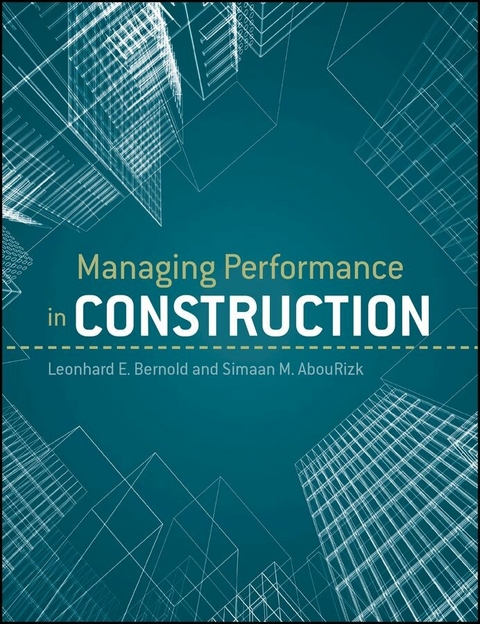
Managing Performance in Construction (eBook)
528 Seiten
John Wiley & Sons (Verlag)
978-0-470-91970-5 (ISBN)
Leonhard E. Bernold, Ph.D., Raleigh, North Carolina Associate Professor, Department of Civil Engineering, North Carolina State University. Director of the Construction Automation and Robotics Laboratory, North Carolina State University. Simaan M. AbouRizk, PE, PhD, Edmonton, Alberta, Canada; NSERC/Alberta Construction Industry Research Professor, University of Alberta. Executive Board member, Construction Research Institute of Canada.
PREFACE.
Chapter 1: Indicators of an Industry in Transition.
1.1 Interoperability Barriers are Breaking.
1.2 Construction Becomes Sustainable.
1.3 E-Construction Management.
1.4 Linking up to Smart Construction Equipment.
1.5 Highly Successful Engineering Managers.
1.6 Chapter Review.
Chapter 2: Productivity in the Spotlight.
2.1 Measuring National Productivity.
2.2 Basic Relationships Effecting Productivity.
2.3 Factors Related to Process Productivity.
2.4 Taxonomy of Work Time.
2.5 Gauging Construction Process Efficiency.
2.6 Identifying Critical Impact Factors.
2.7 Chapter Review.
Chapter 3: Corner Stones of Efficient Site Operation.
3.1 Loss and Revival of the Master-Builder.
3.2 Planning the (Re-) Supply of the Construction Process.
3.3 Top-Down Frameworks to Manage Projects.
3.4 Bottom-Up Quantitative Planning.
3.5 Synchronization of Processes in The Supply Chain.
3.6 Chapter Review.
Chapter Four: Introduction to simulation and its use inmodeling production systems.
4.1 Building Simulation Models.
4.2 Chapter Review.
Chapter Five: A case study -- Applying simulation in tunnelconstruction.
5.1 Project background.
5.2 Preparation work - understanding the constructionprocess.
Shaft Construction.
Tunnel Construction.
5.3 Developing the simulation model.
Assumptions and input.
Simulation Model.
5.4 Run the Model and derive results.
5.5 Analysis of the operation.
Chapter Review.
Chapter 6: Competencies That Drive the Company.
6.1 Generic Work Competencies for the 21 Century.
6.2 Managerial Competences of Productive Organizations.
6.3 Gaining Competence Through Learning and Training.
6.4 Job-Oriented Training and Competence Development.
6.5 Becoming a Learning Organization (LO).
6.6 Chapter Review.
Bibliography.
Chapter 7: Productive in a Healthy and Safe WorkEnvironment.
7.1 Two Strains Press on the Health of a Productive Body.
7.2 The Engine That Supports and Limits Human Work.
7.3 Ergonomics in Construction.
7.4 A Modern Debilitating Disease: Job Stress.
7.5 The Silent Epidemic: Workplace Harassment.
7.6 Chapter Review.
Chapter 8: The Complexity of Human Motivation.
8.1 Background.
8.2 Behavioral Aspects of the Human Mind.
8.3 Intrinsic versus Extrinsic Motivation.
8.4 Maslow's Need Based Motivators.
8.5 Vroom's Expectancy Theory.
8.6 Herzberg's Two-Factor Theory.
8.7 Measuring Job Satisfaction.
8.8 Job Enrichment.
8.9 Chapter Review.
Chapter 9: Performance Factors of Leaders and Teams.
9.1 Is a Manager also a Leader?
9.2 Theories About Effective Leadership.
9.3 Power and Problems of Teamwork.
9.4 Basics About Creativity.
9.5 Chapter Review.
References.
Chapter 10: Communication - The Nerve System ofConstruction.
10.1 Engineering Drawings - the Ancient Communication Media.
10.2 Communication Strategies Employed by Organizations.
10.3 Logistics of Project Information.
10.4 Chapter Review.
Key Terms and Terminologies.
Chapter 11: Performance Management.
11.1 Historical Recount of Key Management Concepts.
11.2 From Measuring to Managing Performance.
11.3 The Balanced Scorecard of a Corporation.
11.4 Performance Management of Supply Chain.
11.5 Performance Management at the Task Level.
11.6 Chapter Review.
INDEX.
| Erscheint lt. Verlag | 28.6.2010 |
|---|---|
| Sprache | englisch |
| Themenwelt | Technik ► Bauwesen |
| Wirtschaft ► Betriebswirtschaft / Management ► Unternehmensführung / Management | |
| Schlagworte | Baubetrieb • Bauingenieur- u. Bauwesen • Business & Management • Civil Engineering & Construction • Construction Management • Industrial Engineering • Industrial Engineering / Project Management • Industrielle Verfahrenstechnik • Production Operations Management • Produktionssteuerung • Projektmanagement i. d. Industriellen Verfahrenstechnik • Wirtschaft u. Management |
| ISBN-10 | 0-470-91970-1 / 0470919701 |
| ISBN-13 | 978-0-470-91970-5 / 9780470919705 |
| Informationen gemäß Produktsicherheitsverordnung (GPSR) | |
| Haben Sie eine Frage zum Produkt? |
 EPUB (Adobe DRM)
Kopierschutz: Adobe-DRM
Adobe-DRM ist ein Kopierschutz, der das eBook vor Mißbrauch schützen soll. Dabei wird das eBook bereits beim Download auf Ihre persönliche Adobe-ID autorisiert. Lesen können Sie das eBook dann nur auf den Geräten, welche ebenfalls auf Ihre Adobe-ID registriert sind.
Details zum Adobe-DRM
Dateiformat: EPUB (Electronic Publication)
EPUB ist ein offener Standard für eBooks und eignet sich besonders zur Darstellung von Belletristik und Sachbüchern. Der Fließtext wird dynamisch an die Display- und Schriftgröße angepasst. Auch für mobile Lesegeräte ist EPUB daher gut geeignet.
Systemvoraussetzungen:
PC/Mac: Mit einem PC oder Mac können Sie dieses eBook lesen. Sie benötigen eine
eReader: Dieses eBook kann mit (fast) allen eBook-Readern gelesen werden. Mit dem amazon-Kindle ist es aber nicht kompatibel.
Smartphone/Tablet: Egal ob Apple oder Android, dieses eBook können Sie lesen. Sie benötigen eine
Geräteliste und zusätzliche Hinweise
Buying eBooks from abroad
For tax law reasons we can sell eBooks just within Germany and Switzerland. Regrettably we cannot fulfill eBook-orders from other countries.
aus dem Bereich