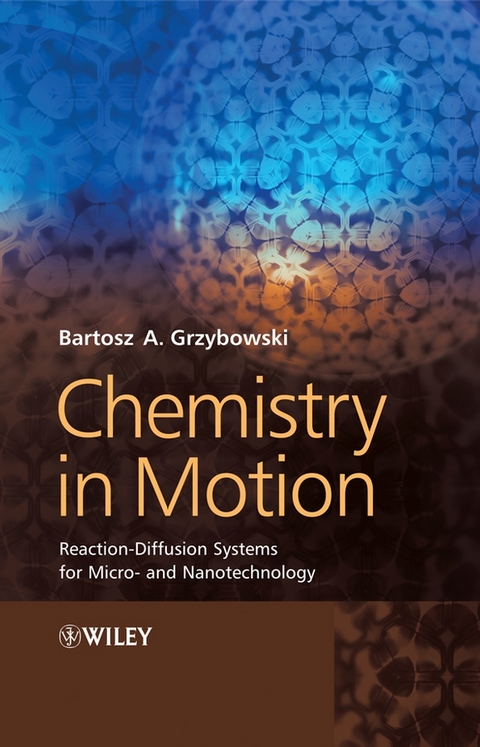
Chemistry in Motion (eBook)

Topics covered include:
- An overview and outlook of both biological and man-made reaction-diffusion systems.
- The fundamentals and mathematics of diffusion and chemical reactions.
- Reaction-diffusion equations and the methods of solving them.
- Spatial control of reaction-diffusion at small scales.
- Micro- and nanofabrication by reaction-diffusion.
- Chemical clocks and periodic precipitation structures.
- Reaction-diffusion in soft materials and at solid interfaces.
- Microstructuring of solids using RD.
- Reaction-diffusion for chemical amplification and sensing.
- RD in three dimensions and at the nanoscale, including nanosynthesis.
This book is aimed at all those who are interested in chemical processes at small scales, especially physical chemists, chemical engineers, and material scientists. The book can also be used for one-semester, graduate elective courses in chemical engineering, materials science, or chemistry classes.
Bartosz A. Grzybowski is Associate Professor of Chemical and Biological Engineering at Northwestern University in Evanston, Illinois (USA). He was educated at the University of Gdansk (Poland) and Yale University (USA) and gained his PhD at Harvard University (USA), where he also worked as a postdoctoral fellow. From 2001 to 2003, Professor Grzybowski was Director of Research (Concurrent Pharmaceuticals) and Associate of the Department of Chemistry and Chemical Biology at Harvard University. He is the recipient of several awards including the 2003 Camille and Henry Dreyfus New Faculty Award and in 2006 an ACS Division of Colloid and Surface Chemistry Unilever Award and he is the (co)author of over 70 papers.
Change and motion define and constantly reshape the world around us, on scales from the molecular to the global. In particular, the subtle interplay between chemical reactions and molecular transport gives rise to an astounding richness of natural phenomena, and often manifests itself in the emergence of intricate spatial or temporal patterns. The underlying theme of this book is that by setting chemistry in motion in a proper way, it is not only possible to discover a variety of new phenomena, in which chemical reactions are coupled with diffusion, but also to build micro-/nanoarchitectures and systems of practical importance. Although reaction and diffusion (RD) processes are essential for the functioning of biological systems, there have been only a few examples of their application in modern micro- and nanotechnology. Part of the problem has been that RD phenomena are hard to bring under experimental control, especially when the system s dimensions are small. Ultimately this book will guide the reader through all the aspects of these systems from understanding the basics to practical hints and then to applications and interpretation of results. Topics covered include: An overview and outlook of both biological and man-made reaction-diffusion systems. The fundamentals and mathematics of diffusion and chemical reactions. Reaction-diffusion equations and the methods of solving them. Spatial control of reaction-diffusion at small scales. Micro- and nanofabrication by reaction-diffusion. Chemical clocks and periodic precipitation structures. Reaction-diffusion in soft materials and at solid interfaces. Microstructuring of solids using RD. Reaction-diffusion for chemical amplification and sensing. RD in three dimensions and at the nanoscale, including nanosynthesis. This book is aimed at all those who are interested in chemical processes at small scales, especially physical chemists, chemical engineers, and material scientists. The book can also be used for one-semester, graduate elective courses in chemical engineering, materials science, or chemistry classes.
Bartosz A. Grzybowski is Associate Professor of Chemical and Biological Engineering at Northwestern University in Evanston, Illinois (USA). He was educated at the University of Gdansk (Poland) and Yale University (USA) and gained his PhD at Harvard University (USA), where he also worked as a postdoctoral fellow. From 2001 to 2003, Professor Grzybowski was Director of Research (Concurrent Pharmaceuticals) and Associate of the Department of Chemistry and Chemical Biology at Harvard University. He is the recipient of several awards including the 2003 Camille and Henry Dreyfus New Faculty Award and in 2006 an ACS Division of Colloid and Surface Chemistry Unilever Award and he is the (co)author of over 70 papers.
Preface.
1. Panta Rei - Everything Flows.
1.1. Historical Perspective.
1.2. What lies ahead?
1.3. How nature uses RD.
1.4. RD in Science and Technology.
2. Basic Ingredients: Diffusion.
2.1. Diffusion Equation.
2.2. Solving Diffusion Equations.
2.3. The Use of Symmetry and Superposition.
2.4. Cylindrical and Spherical Coordinates.
2.5. Diffusion in Nonhomogeneous Media.
3. Chemical Reactions.
3.1. Reactions and Rates.
3.2. Chemical Equilibrium and Irreversible Reactions.
3.3. Ionic Reactions and Solubility Products.
3.4. Autocatalysis, Cooperativity, and Feedback.
3.5. Oscillating Reactions.
3.6. Reactions in Gels.
4. Putting It All Together: Reaction-Diffusion Equations and the Methods of Solving Them.
4.1. General Form of RD Equations.
4.2. RD Equations That Can Be Solved Analytically.
4.3. Spatial Discretization.
4.4. Temporal Discretization and Integration.
4.5. Heuristic Rules for Selecting a Numerical Method.
4.6. Mesoscopic Models.
5. Spatial Control of Reaction-Diffusion at Small Scales -- Wet Stamping (WETS).
5.1. Choice of Gels.
5.2. Fabrication.
Appendix A: Practical Guide to Making Agarose Stamps.
6. Fabrication by Reaction-Diffusion: Curvilinear Microstructures for Optics and Fluidics.
6.1. Microfabrication: The Simple and the Difficult.
6.2. Fabricating Arrays of Microlenses by RD and WETS.
6.3. Intermezzo - Some Thoughts on Rational Design.
6.4. Guiding Microlens Fabrication by Lattice-Gas Modeling.
6.5. Disjoint Features and Microfabrication of Multilevel Structures.
6.6. Microfabrication of Microfluidic Devices.
6.7. Short Summary.
7. Multitasking: Micro- and Nanofabrication with Periodic Precipitation.
7.1. Periodic Precipitation.
7.2. Phenomenology of Periodic Precipitation.
7.3. Governing Equations.
7.4. Microscopic PP Patterns in Two Dimensions.
7.5. Two-Dimensional Patterns for Diffractive Optics.
7.6. Buckling into the Third Dimension: Periodic "Nanowrinkles".
7.7. Toward the Applications of Buckled Surfaces.
7.8. Instead of Summary: Parallel Reactions and the Nanoscale.
8. Reaction-Diffusion at Interfaces: Structuring Solid Materials.
8.1. Deposition of Metal Foils at Gel Interfaces.
8.2. Cutting into Hard Solids with Soft Gels.
8.3. The Take-Home Message.
9. Micro-Chameleons: Reaction-Diffusion for Amplification and Sensing.
9.1. Amplification of Material Properties by RD Micronetworks.
9.2. Amplifying Macromolecular Changes using Low-Symmetry Networks.
9.3. Detecting Self-Assembled Monolayers.
9.4. Sensing Chemical "Food".
9.5. Extensions: New Chemistries, Applications and Measurement.
10. RD in Three Dimensions and at the Nanoscale.
10.1. Fabrication Inside Porous Particles.
10.2. Diffusion in Solids: The Kirkendall Effect and Fabrication of Core-Shell Nanoparticles.
10.3. Galvanic Replacement and De-Alloying Reactions at the Nanoscale: Synthesis of Nanocages.
Epilogue.
Appendix 1: Nature's Art.
Appendix 2: Matlab code for the Minotaur Example 4.1.
Appendix 3: C++ Code for the Zebra Example 4.2.
"In summary, this text can be viewed as a first stepping stone into
the reaction-diffusion field. It is a quick, informative survey of
what types of syntheses are possible in reaction-diffusion systems;
it provides the necessary framework to begin an in-depth project in
the field; and most importantly, it is an enjoyable read."
(Angewandte Chemie, 2010)
| Erscheint lt. Verlag | 3.4.2009 |
|---|---|
| Sprache | englisch |
| Themenwelt | Mathematik / Informatik ► Mathematik ► Angewandte Mathematik |
| Naturwissenschaften ► Biologie | |
| Naturwissenschaften ► Chemie ► Physikalische Chemie | |
| Naturwissenschaften ► Chemie ► Technische Chemie | |
| Naturwissenschaften ► Physik / Astronomie | |
| Technik ► Maschinenbau | |
| Schlagworte | astounding • Between • Biowissenschaften • Book • Cell & Molecular Biology • Chemical • chemical engineering • Chemische Verfahrenstechnik • Chemistry • constantly • Emergence • Global • intricate • Life Sciences • manifests • Mathematical & Computational Physics • Mathematische Physik • molecular • Motion • Nanomaterialien • nanomaterials • Nanotechnologie • nanotechnology • NATURAL • Phenomena • Physics • Physik • Proper • Reactions • richness • scales • subtle interplay • temporal patterns • Theme • Transport • US • Way • World • Zell- u. Molekularbiologie |
| ISBN-13 | 9780470741634 / 9780470741634 |
| Informationen gemäß Produktsicherheitsverordnung (GPSR) | |
| Haben Sie eine Frage zum Produkt? |
 PDF (Adobe DRM)
Kopierschutz: Adobe-DRM
Adobe-DRM ist ein Kopierschutz, der das eBook vor Mißbrauch schützen soll. Dabei wird das eBook bereits beim Download auf Ihre persönliche Adobe-ID autorisiert. Lesen können Sie das eBook dann nur auf den Geräten, welche ebenfalls auf Ihre Adobe-ID registriert sind.
Details zum Adobe-DRM
Dateiformat: PDF (Portable Document Format)
Mit einem festen Seitenlayout eignet sich die PDF besonders für Fachbücher mit Spalten, Tabellen und Abbildungen. Eine PDF kann auf fast allen Geräten angezeigt werden, ist aber für kleine Displays (Smartphone, eReader) nur eingeschränkt geeignet.
Systemvoraussetzungen:
PC/Mac: Mit einem PC oder Mac können Sie dieses eBook lesen. Sie benötigen eine
eReader: Dieses eBook kann mit (fast) allen eBook-Readern gelesen werden. Mit dem amazon-Kindle ist es aber nicht kompatibel.
Smartphone/Tablet: Egal ob Apple oder Android, dieses eBook können Sie lesen. Sie benötigen eine
Geräteliste und zusätzliche Hinweise
Buying eBooks from abroad
For tax law reasons we can sell eBooks just within Germany and Switzerland. Regrettably we cannot fulfill eBook-orders from other countries.
aus dem Bereich