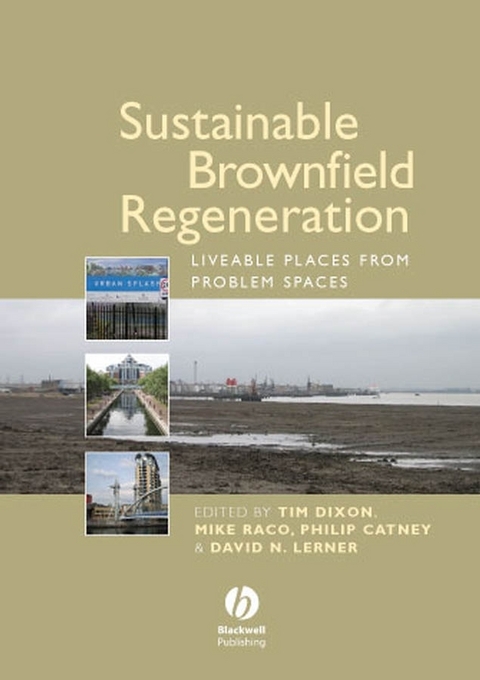
Sustainable Brownfield Regeneration (eBook)
John Wiley & Sons (Verlag)
978-0-470-69140-3 (ISBN)
Brownfield regeneration has become a major policy driver in developed countries. It is estimated that there are 64,000 hectares of brownfield land in England, much of which presents severe environmental challenges and lies alongside some of the most deprived communities in the country. Bringing such land back into active use has taken on a new urgency among policymakers, developers and other stakeholders in the development process. Frequently, however, policy thinking and practice has been underpinned by 'silo' mentalities, in which integrated and multidisciplinary approaches to problem-solving have been limited.
The book has two principal aims. The first is to examine the ways in which science and social science research disciplines can be brought together to help solve important brownfield regeneration issues, with a focus on the UK. The second is to assess the efficiency and effectiveness of different types of regeneration policy and practice, and to show how 'liveable spaces' can be produced from 'problem places'. The Thames Gateway in the south of England and Greater Manchester in the North of England are shown as examples of how brownfield regeneration projects are developing in an era where sustainability is high on the policy agenda.
From the Foreword by Paul Syms, National Brownfield Advisor, English Partnerships:
'Ensuring the effective and efficient reuse of brownfield land is an essential part of the British Government's land use policies in support of sustainable communities. [This book] recognises that reusing brownfield land is not just about over-coming technical issues to remove contamination or other physical problems with the ground. It highlights the importance of engaging with the many different stakeholders whose opinions and concerns need to be taken into account if sustainable outcomes are to be achieved. The authors also recognise that brownfield land reuse is not just about building new homes or places of employment - the creation of new green spaces can be just as important.'
Tim Dixon, Professor of Real Estate, Co-Director of Oxford Institute for Sustainable Development, Oxford Brookes University
David Lerner, Head of Civil and Structural Engineering, University of Sheffield
Mike Raco, Lecturer in Economic Geography, University of Reading
Philip Catney, Research Associate, Department of Town and Regional Planning, University of Sheffield
Sustainable Brownfield Regeneration presents a comprehensive account of UK policies, processes and practices in brownfield regeneration and takes an integrated and theoretically-grounded approach to highlight best practice. Brownfield regeneration has become a major policy driver in developed countries. It is estimated that there are 64,000 hectares of brownfield land in England, much of which presents severe environmental challenges and lies alongside some of the most deprived communities in the country. Bringing such land back into active use has taken on a new urgency among policymakers, developers and other stakeholders in the development process. Frequently, however, policy thinking and practice has been underpinned by silo mentalities, in which integrated and multidisciplinary approaches to problem-solving have been limited. The book has two principal aims. The first is to examine the ways in which science and social science research disciplines can be brought together to help solve important brownfield regeneration issues, with a focus on the UK. The second is to assess the efficiency and effectiveness of different types of regeneration policy and practice, and to show how liveable spaces can be produced from problem places . The Thames Gateway in the south of England and Greater Manchester in the North of England are shown as examples of how brownfield regeneration projects are developing in an era where sustainability is high on the policy agenda. From the Foreword by Paul Syms, National Brownfield Advisor, English Partnerships: Ensuring the effective and efficient reuse of brownfield land is an essential part of the British Government s land use policies in support of sustainable communities. [This book] recognises that reusing brownfield land is not just about over-coming technical issues to remove contamination or other physical problems with the ground. It highlights the importance of engaging with the many different stakeholders whose opinions and concerns need to be taken into account if sustainable outcomes are to be achieved. The authors also recognise that brownfield land reuse is not just about building new homes or places of employment the creation of new green spaces can be just as important.
Tim Dixon, Professor of Real Estate, Co-Director of Oxford Institute for Sustainable Development, Oxford Brookes University David Lerner, Head of Civil and Structural Engineering, University of Sheffield Mike Raco, Lecturer in Economic Geography, University of Reading Philip Catney, Research Associate, Department of Town and Regional Planning, University of Sheffield
| Erscheint lt. Verlag | 15.4.2008 |
|---|---|
| Sprache | englisch |
| Themenwelt | Naturwissenschaften ► Biologie ► Ökologie / Naturschutz |
| Naturwissenschaften ► Geowissenschaften ► Geografie / Kartografie | |
| Technik ► Bauwesen | |
| Schlagworte | Account • Approach • Bauingenieur- u. Bauwesen • Best • Brownfield • Brownfield land • Business & Management • Civil Engineering & Construction • Comprehensive • Construction: Sustainability • Countries • developed • Driver • England • hectares • Immobilien u. Grundbesitz • major policy • Nachhaltiges Bauen • Practice • Practices • Property & Real Estate • Regeneration • Sustainable • theoreticallygrounded • UK • Wirtschaft u. Management |
| ISBN-10 | 0-470-69140-9 / 0470691409 |
| ISBN-13 | 978-0-470-69140-3 / 9780470691403 |
| Informationen gemäß Produktsicherheitsverordnung (GPSR) | |
| Haben Sie eine Frage zum Produkt? |
 PDF (Adobe DRM)
Kopierschutz: Adobe-DRM
Adobe-DRM ist ein Kopierschutz, der das eBook vor Mißbrauch schützen soll. Dabei wird das eBook bereits beim Download auf Ihre persönliche Adobe-ID autorisiert. Lesen können Sie das eBook dann nur auf den Geräten, welche ebenfalls auf Ihre Adobe-ID registriert sind.
Details zum Adobe-DRM
Dateiformat: PDF (Portable Document Format)
Mit einem festen Seitenlayout eignet sich die PDF besonders für Fachbücher mit Spalten, Tabellen und Abbildungen. Eine PDF kann auf fast allen Geräten angezeigt werden, ist aber für kleine Displays (Smartphone, eReader) nur eingeschränkt geeignet.
Systemvoraussetzungen:
PC/Mac: Mit einem PC oder Mac können Sie dieses eBook lesen. Sie benötigen eine
eReader: Dieses eBook kann mit (fast) allen eBook-Readern gelesen werden. Mit dem amazon-Kindle ist es aber nicht kompatibel.
Smartphone/Tablet: Egal ob Apple oder Android, dieses eBook können Sie lesen. Sie benötigen eine
Geräteliste und zusätzliche Hinweise
Buying eBooks from abroad
For tax law reasons we can sell eBooks just within Germany and Switzerland. Regrettably we cannot fulfill eBook-orders from other countries.
aus dem Bereich