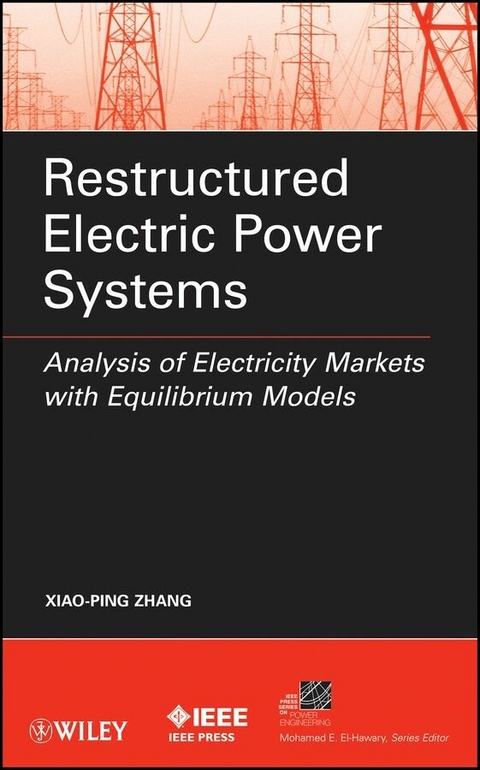
Restructured Electric Power Systems (eBook)
John Wiley & Sons (Verlag)
978-0-470-60854-8 (ISBN)
Electricity market deregulation is driving the power energy production from a monopolistic structure into a competitive market environment. The development of electricity markets has necessitated the need to analyze market behavior and power. Restructured Electric Power Systems reviews the latest developments in electricity market equilibrium models and discusses the application of such models in the practical analysis and assessment of electricity markets.
Drawing upon the extensive involvement in the research and industrial development of the leading experts in the subject area, the book starts by explaining the current developments of electrical power systems towards smart grids and then relates the operation and control technologies to the aspects in electricity markets. It explores:
The problems of electricity market behavior and market power
Mathematical programs with equilibrium constraints (MPEC) and equilibrium problems with equilibrium constraints (EPEC)
Tools and techniques for solving the electricity market equilibrium problems
Various electricity market equilibrium models
State-of-the-art techniques for computing the electricity market equilibrium problems
The application of electricity market equilibrium models in assessing the economic benefits of transmission expansions for market environments, forward and spot markets, short-term power system security, and analysis of reactive power impact
Also featured are computational resources to allow readers to develop algorithms on their own, as well as future research directions in modeling and computational techniques in electricity market analysis. Restructured Electric Power Systems is an invaluable reference for electrical engineers and power system economists from power utilities and for professors, postgraduate students, and undergraduate students in electrical power engineering, as well as those responsible for the design, engineering, research, and development of competitive electricity markets and electricity market policy.
Xiao-Ping Zhang, PhD, is a reader and director of the Institute for Energy Research and Policy at the University of Birmingham, United Kingdom. He is a senior member of the IEEE, as well as an IEEE PES Distinguished Lecturer.
The latest practical applications of electricity market equilibrium models in analyzing electricity markets Electricity market deregulation is driving the power energy production from a monopolistic structure into a competitive market environment. The development of electricity markets has necessitated the need to analyze market behavior and power. Restructured Electric Power Systems reviews the latest developments in electricity market equilibrium models and discusses the application of such models in the practical analysis and assessment of electricity markets. Drawing upon the extensive involvement in the research and industrial development of the leading experts in the subject area, the book starts by explaining the current developments of electrical power systems towards smart grids and then relates the operation and control technologies to the aspects in electricity markets. It explores: The problems of electricity market behavior and market power Mathematical programs with equilibrium constraints (MPEC) and equilibrium problems with equilibrium constraints (EPEC) Tools and techniques for solving the electricity market equilibrium problems Various electricity market equilibrium models State-of-the-art techniques for computing the electricity market equilibrium problems The application of electricity market equilibrium models in assessing the economic benefits of transmission expansions for market environments, forward and spot markets, short-term power system security, and analysis of reactive power impact Also featured are computational resources to allow readers to develop algorithms on their own, as well as future research directions in modeling and computational techniques in electricity market analysis. Restructured Electric Power Systems is an invaluable reference for electrical engineers and power system economists from power utilities and for professors, postgraduate students, and undergraduate students in electrical power engineering, as well as those responsible for the design, engineering, research, and development of competitive electricity markets and electricity market policy.
Xiao-Ping Zhang, PhD, is a reader and director of the Institute for Energy Research and Policy at the University of Birmingham, United Kingdom. He is a senior member of the IEEE, as well as an IEEE PES Distinguished Lecturer.
PREFACE.
CONTRIBUTORS.
1 FUNDAMENTALS OF ELECTRIC POWER SYSTEMS (Xiao-PingZhang).
1.1 Introduction of Electric Power Systems.
1.2 Electric Power Generation.
1.3 Structure of Electric Power Systems.
1.4 Ultra-High Voltage Power Transmission.
1.5 Modeling of Electric Power Systems.
1.6 Power Flow Analysis.
1.7 Optimal Operation of Electric Power Systems.
1.8 Operation and Control of Electric PowerSystems--SCADA/EMS.
1.9 Active Power and Frequency Control.
1.10 Voltage Control and Reactive Power Management.
1.11 Applications of Power Electronics to Power SystemControl.
References.
2 RESTRUCTURED ELECTRIC POWER SYSTEMS AND ELECTRICITY MARKETS(Kwok W. Cheung, Gary W. Rosenwald, Xing Wang, and David I.Sun).
2.1 History of Electric Power Systems Restructuring.
2.2 Structure of Electricity Markets.
2.3 Design of Electricity Markets.
2.4 Operation of Electricity Markets.
2.5 Computation Tools for Electricity Markets.
2.6 Final Remarks.
References.
3 OVERVIEW OF ELECTRICITY MARKET EQUILIBRIUM PROBLEMS AND MARKETPOWER ANALYSIS (Xiao-Ping Zhang).
3.1 Game Theory and Its Applications.
3.2 Electricity Markets and Market Power.
3.3 Market Power Monitoring, Modeling, and Analysis.
3.4 Application of the Equilibrium Models in the ElectricityMarkets.
3.5 Computational Tools for Electricity Market EquilibriumModeling and Market Power Analysis.
3.6 Solution Techniques for MPECs.
3.7 Solution Techniques for EPECs.
3.8 Technical Challenges for Solving MPECs and EPECs.
3.9 Software Resources for Large-Scale NonlinearOptimization.
References.
4 COMPUTING THE ELECTRICITY MARKET EQUILIBRIUM: USES OF MARKETEQUILIBRIUM MODELS (Ross Baldick).
4.1 Introduction.
4.2 Model Formulation.
4.3 Market Operation and Price Formation.
4.4 Equilibrium Defi nition.
4.5 Computation.
4.6 Diffi culties with Equilibrium Models.
4.7 Uses of Equilibrium Models.
4.8 Conclusion.
Acknowledgment.
References.
5 HYBRID BERTRAND-COURNOT MODELS OF ELECTRICITY MARKETS WITHMULTIPLE STRATEGIC SUBNETWORKS AND COMMON KNOWLEDGE CONSTRAINTS(Jian Yao, Shmuel S. Oren, and Benjamin F. Hobbs).
5.1 Introduction.
5.2 Role of the ISO.
5.3 The Hybrid Subnetwork Model.
5.4 Numerical Example for the Subnetworks Model.
5.5 Bertrand Model with Common Knowledge Constraints.
5.6 Numerical Example of Equilibrium with Common KnowledgeConstraints.
5.7 Concluding Remarks.
Acknowledgments.
References.
6 ELECTRICITY MARKET EQUILIBRIUM WITH REACTIVE POWER CONTROL(Xiao-Ping Zhang).
6.1 Introduction.
6.2 AC Power Flow Model in the Rectangular Coordinates.
6.3 Electricity Market Analysis Using AC Optimal Power Flow inthe Rectangular Coordinates.
6.4 Electricity Market Equilibrium Analysis.
6.5 Computing the Electricity Market Equilibrium with AC NetworkModel.
6.6 Implementation Issues of Electricity Market EquilibriumAnalysis with AC Network Model.
6.7 Numerical Examples.
6.8 Conclusions.
6.9 Appendix.
Acknowledgments.
References.
7 USING MARKET SIMULATIONS FOR ECONOMIC ASSESSMENT OFTRANSMISSION UPGRADES: APPLICATION OF THE CALIFORNIA ISO APPROACH(Mohamed Labib Awad, Keith E. Casey, Anna S. Geevarghese,Jeffrey C. Miller, A. Farrokh Rahimi, Anjali Y. Sheffrin, MingxiaZhang, Eric Toolson, Glenn Drayton, Benjamin F. Hobbs, and Frank A.Wolak).
7.1 Introduction.
7.2 Five Principles.
7.3 Palo Verde-Devers NO. 2 Study.
7.4 Recent Applications of Team to Renewables.
7.5 Conclusion.
Acknowledgments.
References.
INDEX.
"Restructured Electric Power Systems is an invaluable reference for electrical engineers and power system economists from power utilities and for professors, postgraduate students, and undergraduate students in electrical power engineering, as well as those responsible for the design, engineering, research, and development of competitive electricity markets and electricity market policy." (PR-inside.com, 28 October 2010)
| Erscheint lt. Verlag | 29.9.2010 |
|---|---|
| Reihe/Serie | IEEE Press Series on Power and Energy Systems |
| IEEE Press Series on Power Engineering | IEEE Press Series on Power Engineering |
| Zusatzinfo | Charts: 50 B&W, 0 Color; Graphs: 50 B&W, 0 Color |
| Sprache | englisch |
| Themenwelt | Technik ► Elektrotechnik / Energietechnik |
| Wirtschaft | |
| Schlagworte | analyzing electricity market behavior • assessing electricity market behavior • Competitive Electricity Market • Electricity Market • electricity market analysis • Electricity market behavior • electricity market equilibrium models • electricity market equilibrium problems • electricity market power • electricity market problems • Energie • Energietechnik • Energy • Finance & Investments • Finanz- u. Anlagewesen • Institutional & Corporate Finance • Institutionelle Finanzplanung • interpreting electricity market behavior • Power Technology & Power Engineering • solving electricity market equilibrium problems • solving electricity market problems |
| ISBN-10 | 0-470-60854-4 / 0470608544 |
| ISBN-13 | 978-0-470-60854-8 / 9780470608548 |
| Informationen gemäß Produktsicherheitsverordnung (GPSR) | |
| Haben Sie eine Frage zum Produkt? |
 PDF (Adobe DRM)
Kopierschutz: Adobe-DRM
Adobe-DRM ist ein Kopierschutz, der das eBook vor Mißbrauch schützen soll. Dabei wird das eBook bereits beim Download auf Ihre persönliche Adobe-ID autorisiert. Lesen können Sie das eBook dann nur auf den Geräten, welche ebenfalls auf Ihre Adobe-ID registriert sind.
Details zum Adobe-DRM
Dateiformat: PDF (Portable Document Format)
Mit einem festen Seitenlayout eignet sich die PDF besonders für Fachbücher mit Spalten, Tabellen und Abbildungen. Eine PDF kann auf fast allen Geräten angezeigt werden, ist aber für kleine Displays (Smartphone, eReader) nur eingeschränkt geeignet.
Systemvoraussetzungen:
PC/Mac: Mit einem PC oder Mac können Sie dieses eBook lesen. Sie benötigen eine
eReader: Dieses eBook kann mit (fast) allen eBook-Readern gelesen werden. Mit dem amazon-Kindle ist es aber nicht kompatibel.
Smartphone/Tablet: Egal ob Apple oder Android, dieses eBook können Sie lesen. Sie benötigen eine
Geräteliste und zusätzliche Hinweise
Buying eBooks from abroad
For tax law reasons we can sell eBooks just within Germany and Switzerland. Regrettably we cannot fulfill eBook-orders from other countries.
aus dem Bereich