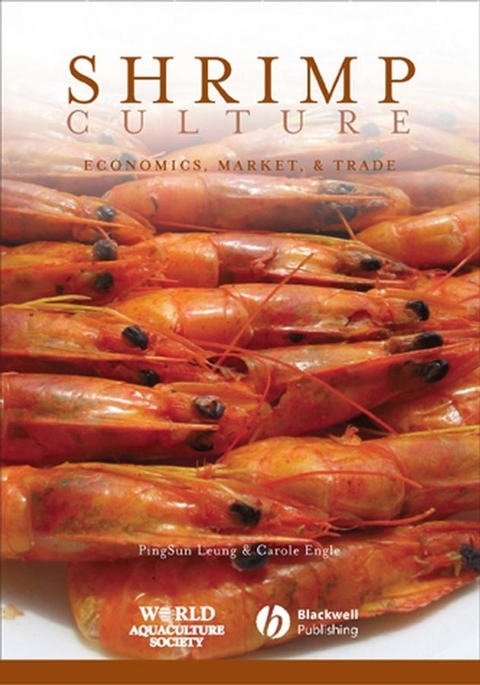
Shrimp Culture (eBook)
354 Seiten
John Wiley & Sons (Verlag)
978-0-470-27656-3 (ISBN)
Shrimp is the most important commodity, by value, in the
international seafood trade. The shrimp industry has grown
exponentially in the last decades, and growth is expected to
continue for years to come. For future success in the shrimp
industry, shrimp farmers and aquaculture scientists will find a
thorough knowledge of the economics, market, and trade as important
as an understanding of disease management or husbandry.
Shrimp Culture: Economics, Market, and Trade brings
together recent findings of researchers from around the world
working in various aspects of the economics of shrimp farming. This
volume covers all major aspects of the economics, trade, and
markets for shrimp worldwide, with chapters written by experts from
major consuming countries such as the U.S.A. and major providers
such as China, Thailand and Brazil. The book has been carefully
edited by PingSun Leung and Carole Engle, both well known and
respected internationally for their work in this area.
Shrimp Culture is an essential purchase for everyone
involved in this massive industry across the globe.
PingSun Leung is a Professor at the College of Tropical Agriculture and Human Resources at the University of Hawaii, Manoa. Carole Engle is Director of the Aquaculture and Fisheries Center at the University of Arkansas, Pine Bluff.
List of Contributors.
Preface.
Part I: Market and Trade.
1. An Overview of Global Shrimp Market and Trade.
2. Export Performance of Frozen Cultured Shrimp in the Japan,
U.S. and EU Markets: A Global Assessment.
3. WTO Trade Rules with an Update and the DOHA Round
Negotiations and a Short Reference to Anti-Dumping Actions.
4. Structural Changes and Regulations of Imported Shrimps in
Japan.
5. Integrating Supply and Demand Factors in the Diffusion Rates
of Aquaculture Technology for the International Shrimp
Industry.
Part II: Economics of Sustainable Shrimp Development.
6. Economic Effects of Components of Best Management Practices
(BMPs) for Small-Scale Shrimp Farms in Honduras and Cooperatives in
Nicaragua.
7. Production Performance Economic Indicators and their Role in
the Planning and Assessment of the Sustainable Development of
Aquaculture.
8. Vietnamese Shrimp Farming at a Key Point in its Development:
A Review of Issues Examining Whether Development is Being Carried
Out in a Sustainable Way.
9. Economic Issues in Promoting Sustainable Shrimp Farming: A
Case Study of the Rice Shrimp System in the Mekong Delta.
10. Utilization of Coastal Areas for Shrimp Farming in Southern
Thailand.
11. A Review of Shrimp Farming in Central Thailand and its
Environmental Implications.
Part III: Economics of Shrimp Farming in Selected
Regions.
12. Economics of Gei Wei Shrimp Culture in Hong Kong: From
Commercial Aquaculture to Bird Production.
13. An Economic Evaluation of Shrimp Farming Industry in
Taiwan.
14. Economics of Shrimp Farming in China.
15. Practices and Economics of Successful Shrimp Farms in the
Philippines.
16. Socio-Economics of Shrimp Farming in Asia: A Cross-Country
Comparison.
17. Economics and Management of Freshwater Prawn Culture in
Western Hemisphere.
Part IV: Economics of Recirculating Systems, Feeding, and
Production Management.
18. Economic Implications of Integrating Nursery in Indoor
Bio-Secure. Recirculating Saltwater Shrimp Growout Systems.
19. Comparative Cost of Shrimp Production: Earthen Ponds versus
Recirculating Aquaculture Systems.
20. Overview of Farming Systems for Marine Shrimp with
Particular Reference to Feeds And Feeding.
21. A Decision Support System for Efficient Scheduling of
Multi-Pond and Multi-Cycle Commercial Shrimp Culture.
Index.
'...it is still a very important contribution to the global body
of knowledge on shrimp culture and, more peripherally, on the
shrimp business.'
Ausmarine Magazine, October 2007
'...it is still a very important contribution to the global
body of knowledge on shrimp culture and, more peripherally, on the
shrimp business.'
Work Boat World, November 2007
| Erscheint lt. Verlag | 29.2.2008 |
|---|---|
| Reihe/Serie | World Aquaculture Society Book Series | World Aquaculture Society Book Series |
| Sprache | englisch |
| Themenwelt | Technik |
| Wirtschaft | |
| Weitere Fachgebiete ► Land- / Forstwirtschaft / Fischerei | |
| Schlagworte | Ãkonomie u. Management in Fischereiwesen u. Aquakultur • Aquaculture, Fisheries & Fish Science • Aquakultur, Fischereiwesen u. Fischforschung • Fisch u. Fischfang • Fish & Fisheries • Fisheries & Aquaculture Economics & Management • Ökonomie u. Management in Fischereiwesen u. Aquakultur |
| ISBN-10 | 0-470-27656-8 / 0470276568 |
| ISBN-13 | 978-0-470-27656-3 / 9780470276563 |
| Informationen gemäß Produktsicherheitsverordnung (GPSR) | |
| Haben Sie eine Frage zum Produkt? |
 PDF (Adobe DRM)
Kopierschutz: Adobe-DRM
Adobe-DRM ist ein Kopierschutz, der das eBook vor Mißbrauch schützen soll. Dabei wird das eBook bereits beim Download auf Ihre persönliche Adobe-ID autorisiert. Lesen können Sie das eBook dann nur auf den Geräten, welche ebenfalls auf Ihre Adobe-ID registriert sind.
Details zum Adobe-DRM
Dateiformat: PDF (Portable Document Format)
Mit einem festen Seitenlayout eignet sich die PDF besonders für Fachbücher mit Spalten, Tabellen und Abbildungen. Eine PDF kann auf fast allen Geräten angezeigt werden, ist aber für kleine Displays (Smartphone, eReader) nur eingeschränkt geeignet.
Systemvoraussetzungen:
PC/Mac: Mit einem PC oder Mac können Sie dieses eBook lesen. Sie benötigen eine
eReader: Dieses eBook kann mit (fast) allen eBook-Readern gelesen werden. Mit dem amazon-Kindle ist es aber nicht kompatibel.
Smartphone/Tablet: Egal ob Apple oder Android, dieses eBook können Sie lesen. Sie benötigen eine
Geräteliste und zusätzliche Hinweise
Buying eBooks from abroad
For tax law reasons we can sell eBooks just within Germany and Switzerland. Regrettably we cannot fulfill eBook-orders from other countries.
aus dem Bereich