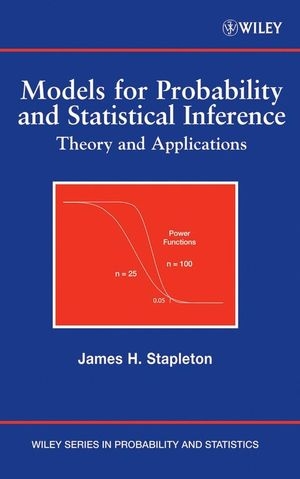
Models for Probability and Statistical Inference (eBook)
464 Seiten
John Wiley & Sons (Verlag)
9780470183403 (ISBN)
graphs to build the intuition of readers
Models for Probability and Statistical Inference was written over a
five-year period and serves as a comprehensive treatment of the
fundamentals of probability and statistical inference. With
detailed theoretical coverage found throughout the book, readers
acquire the fundamentals needed to advance to more specialized
topics, such as sampling, linear models, design of experiments,
statistical computing, survival analysis, and bootstrapping.
Ideal as a textbook for a two-semester sequence on probability and
statistical inference, early chapters provide coverage on
probability and include discussions of: discrete models and random
variables; discrete distributions including binomial,
hypergeometric, geometric, and Poisson; continuous, normal, gamma,
and conditional distributions; and limit theory. Since limit theory
is usually the most difficult topic for readers to master, the
author thoroughly discusses modes of convergence of sequences of
random variables, with special attention to convergence in
distribution. The second half of the book addresses statistical
inference, beginning with a discussion on point estimation and
followed by coverage of consistency and confidence intervals.
Further areas of exploration include: distributions defined in
terms of the multivariate normal, chi-square, t, and F (central and
non-central); the one- and two-sample Wilcoxon test, together with
methods of estimation based on both; linear models with a linear
space-projection approach; and logistic regression.
Each section contains a set of problems ranging in difficulty from
simple to more complex, and selected answers as well as proofs to
almost all statements are provided. An abundant amount of figures
in addition to helpful simulations and graphs produced by the
statistical package S-Plus(r) are included to help build the
intuition of readers.
James H. Stapleton, PhD, has recently retired after forty-nine years as professor in the Department of Statistics and Probability at Michigan State University, including eight years as chairperson and almost twenty years as graduate director. Dr. Stapleton is the author of Linear Statistical Models (Wiley), and he received his PhD in mathematical statistics from Purdue University.
1. Probability Models.
1.1 Discrete Probability Models.
1.2 Conditional Probability and Independence.
1.3 Random Variables.
1.4 Expectation.
1.5 The Variance.
1.6 Covariance and Correlation.
2. Special Discrete Distributions.
2.1 The Binomial Distribution.
2.2 The Hypergeometric Distribution.
2.3 The Geometric and Negative Binomial Distributions.
2.4 The Poisson Distribution.
3. Continuous Random Variables.
4.1 Continuous RV's and Their Distributions.
4.2 Expected Values and Variances.
4.3 Transformations of Random Variables.
4.4Joint Densities.
4 Special Continuous Distributions.
4.1 The Normal Distribution.
4.2 The Gamma Distribution.
5. Conditional Distributions.
5.1 The Discrete Case.
5.2 Conditional Expectations for the Discrete Case.
5.3 Conditional Densities and Expectations for Continuous
RV's.
6. Limit Laws.
6.1 Moment Generating Functions.
6.2 Convergence in Probability and in Distribution.
6.3 The Central Limit Theorem.
6.4 The Delta-Method.
7. Estimation.
7.1 Point Estimation.
7.2 The Method of Moments.
7.3 Maximum Likelihood.
7.4 Consistency.
7.5 The Ω-Method.
7.6 Confidence Intervals.
7.7 Fisher Information, The Cramer-Rao Bound, and Asymptotic
Normality of MLE's.
7.8 Sufficiency.
8. Testing Hypotheses.
8.1 Introduction.
8.2 The Neyman-Pearson Lemma.
8.3 The Likelihood Ratio Test.
8.4 The p-Value and the Relationship Between Tests of Hypotheses
and Confidence Intervals.
9. The Multivariate Normal, Chi-square, t, and
F-Distributions.
9.1 The Multivariate Normal Distribution.
9.2 The Central and Noncentral Chi-Square Distributions.
9.3 Student's t-Distribution.
9.4 The F-Distribution.
10.3 Nonparametric Statistics.
10.1 The Wilcoxon Test and Estimator.
10.2 One Sample Methods.
10.3 The Kolmogorov-Smirnov Tests.
11. Linear Models.
11.1 The Principle of Least Squares.
11.2 Linear Models.
11.3 F-Tests for H0.
11.4 Two-Way Analysis of Variance..
12. Frequency Data.
12.1 Logistic Regression.
12.2 Two-Way Frequency Tables.
12.3 Chi-Square Goodness of Fit Tests.
13. Miscellaneous Topics.
13.1 Survival Analysis.
13.2 Bootstrapping.
13.3 Bayesian Statistics.
13.4 Sampling.
"The prose throughout the book is clear and well aimed at
first-year master's student who is intelligent but not yet
statistically sophisticated. Examples are clear and well chosen."
(Biometrics, March 2009)
"Highly recommended. Graduate students through professionals."
(CHOICE, May 2008)
| Erscheint lt. Verlag | 28.6.2008 |
|---|---|
| Reihe/Serie | Wiley Series in Probability and Statistics | Wiley Series in Probability and Statistics |
| Sprache | englisch |
| Themenwelt | Mathematik / Informatik ► Mathematik ► Statistik |
| Mathematik / Informatik ► Mathematik ► Wahrscheinlichkeit / Kombinatorik | |
| Technik | |
| Schlagworte | Angew. Wahrscheinlichkeitsrechn. u. Statistik / Modelle • Applied Probability & Statistics - Models • Mathematik / Wahrscheinlichkeitstheorie, Statistik • Probability & Mathematical Statistics • Statistics • Statistik • Wahrscheinlichkeitsrechnung u. mathematische Statistik |
| ISBN-13 | 9780470183403 / 9780470183403 |
| Informationen gemäß Produktsicherheitsverordnung (GPSR) | |
| Haben Sie eine Frage zum Produkt? |
 PDF (Adobe DRM)
Kopierschutz: Adobe-DRM
Adobe-DRM ist ein Kopierschutz, der das eBook vor Mißbrauch schützen soll. Dabei wird das eBook bereits beim Download auf Ihre persönliche Adobe-ID autorisiert. Lesen können Sie das eBook dann nur auf den Geräten, welche ebenfalls auf Ihre Adobe-ID registriert sind.
Details zum Adobe-DRM
Dateiformat: PDF (Portable Document Format)
Mit einem festen Seitenlayout eignet sich die PDF besonders für Fachbücher mit Spalten, Tabellen und Abbildungen. Eine PDF kann auf fast allen Geräten angezeigt werden, ist aber für kleine Displays (Smartphone, eReader) nur eingeschränkt geeignet.
Systemvoraussetzungen:
PC/Mac: Mit einem PC oder Mac können Sie dieses eBook lesen. Sie benötigen eine
eReader: Dieses eBook kann mit (fast) allen eBook-Readern gelesen werden. Mit dem amazon-Kindle ist es aber nicht kompatibel.
Smartphone/Tablet: Egal ob Apple oder Android, dieses eBook können Sie lesen. Sie benötigen eine
Geräteliste und zusätzliche Hinweise
Buying eBooks from abroad
For tax law reasons we can sell eBooks just within Germany and Switzerland. Regrettably we cannot fulfill eBook-orders from other countries.
aus dem Bereich