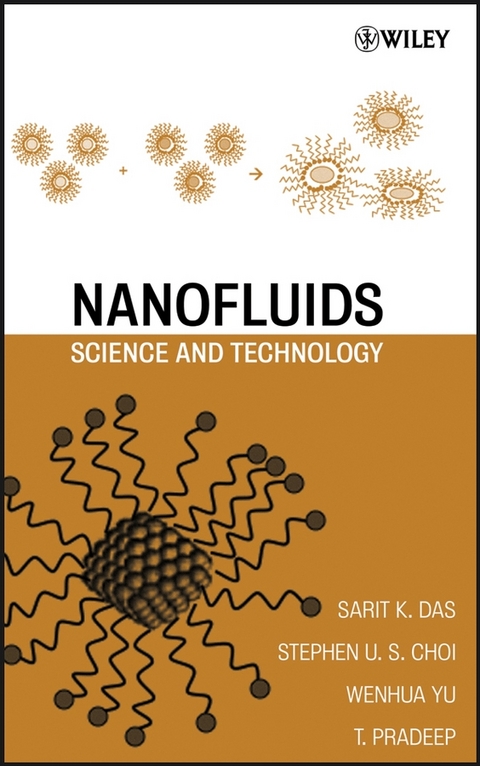
Nanofluids (eBook)
416 Seiten
John Wiley & Sons (Verlag)
978-0-470-18068-6 (ISBN)
characterization, and applications
Nanofluids are attracting a great deal of interest with their
enormous potential to provide enhanced performance properties,
particularly with respect to heat transfer. In response, this text
takes you on a complete journey into the science and technology of
nanofluids. The authors cover both the chemical and physical
methods for synthesizing nanofluids, explaining the techniques for
creating a stable suspension of nanoparticles. You get an overview
of the existing models and experimental techniques used in studying
nanofluids, alongside discussions of the challenges and problems
associated with some of these models.
Next, the authors set forth and explain the heat transfer
applications of nanofluids, including microelectronics, fuel cells,
and hybrid-powered engines. You also get an introduction to
possible future applications in large-scale cooling and
biomedicine.
This book is the work of leading pioneers in the field, one of whom
holds the first U.S. patent for nanofluids. They have combined
their own first-hand knowledge with a thorough review of
theliterature. Among the key topics are:
* Synthesis of nanofluids, including dispersion techniques and
characterization methods
* Thermal conductivity and thermo-physical properties
* Theoretical models and experimental techniques
* Heat transfer applications in microelectronics, fuel cells, and
vehicle engines
This text is written for researchers in any branch of science and
technology, without any prerequisite.It therefore includes some
basic information describing conduction, convection, and boiling of
nanofluids for those readers who may not have adequate background
in these areas. Regardless of your background, you'll learn to
develop nanofluids not only as coolants, but also for a host ofnew
applications on the horizon.
SARIT K. DAS, PhD, is a Professor of the Mechanical Engineering Department at the Indian Institute of Technology Madras. He has authored two books, Engineering Heat and Mass Transfer and Process Heat Transfer, and more than 120 research papers. He is an editor of the International Journal of Heat Exchangers and Heat Transfer Engineering. He is a recipient of the Alexander von Humboldt Research Fellowship of Germany and is a Fellow with the Indian National Academy of Engineering. Dr. Das held visiting positions in Helmut Schmidt University, Germany, Lund University, Sweden, andthe Massachusetts Institute of Technology, USA. STEPHEN U. S. CHOI, PhD, is a ResearchProfessor in the Department of Mechanical and Industrial Engineering at the Universityof Illinois at Chicago. He was previously the project leader and principal investigator for the nanofluids program at Argonne National Laboratory. Currently, he is a Visiting Fellow at the Korea Institute of Energy Research. Dr. Choi has authored or coauthored more than 100 publications and holds three U.S. patents, including the first U.S. patent for nanofluids. WENHUA YU, PhD, is a Mechanical Engineer in the Energy Systems Division at Argonne National Laboratory. He was previously an associate professor in the Department of Mechanical Engineering at Zhejiang University,China. Dr. Yu has authored or coauthored more than fifty publications and holds six patents. T. PRADEEP, PhD, is a Professor of Chemistry at the Indian Institute of Technology Madras.He has held visiting positions at Purdue University, USA; Leiden University, Netherlands; EPFL, Switzerland; Institute of Chemistry, Taiwan; Pohang Institute of Science and Technology, South Korea; and Hyogo University, Japan. He has 160 research papers and seven patents to his credit. He is the author of Nano: The Essentials.
1. Introduction (S. K. Das, S. U. S. Choi, W. Yu, and T. Pradeep).
2. Synthesis of Nanofluids (S. K. Das).
3. Conduction Heat Transfer in Nano-Fluids (S. K. Das).
4. Part 2: Theoretical Modeling of Thermal Conductivity of
Nanofluids (S. K. Das, S. U. S. Choi, W. Yu, and T. Pradeep).
5. Convection in Nanofluids (S. K. Das).
6. Boiling of Nano-Fluids (S. K. Das).
7. Applications and Future Directions (S. K. Das, S. U. S. Choi,
W. Yu, and T. Pradeep).
| Erscheint lt. Verlag | 28.6.2008 |
|---|---|
| Sprache | englisch |
| Themenwelt | Naturwissenschaften ► Chemie |
| Naturwissenschaften ► Physik / Astronomie ► Strömungsmechanik | |
| Technik ► Maschinenbau | |
| Schlagworte | Chemie • Chemistry • Maschinenbau • mechanical engineering • Nanomaterialien • nanomaterials • Nanotechnologie • nanotechnology • Oberflächen- u. Kolloidchemie • Oberflächen- u. Kolloidchemie • Surface & Colloid Chemistry • thermodynamics • Thermodynamik |
| ISBN-10 | 0-470-18068-4 / 0470180684 |
| ISBN-13 | 978-0-470-18068-6 / 9780470180686 |
| Informationen gemäß Produktsicherheitsverordnung (GPSR) | |
| Haben Sie eine Frage zum Produkt? |
 PDF (Adobe DRM)
Kopierschutz: Adobe-DRM
Adobe-DRM ist ein Kopierschutz, der das eBook vor Mißbrauch schützen soll. Dabei wird das eBook bereits beim Download auf Ihre persönliche Adobe-ID autorisiert. Lesen können Sie das eBook dann nur auf den Geräten, welche ebenfalls auf Ihre Adobe-ID registriert sind.
Details zum Adobe-DRM
Dateiformat: PDF (Portable Document Format)
Mit einem festen Seitenlayout eignet sich die PDF besonders für Fachbücher mit Spalten, Tabellen und Abbildungen. Eine PDF kann auf fast allen Geräten angezeigt werden, ist aber für kleine Displays (Smartphone, eReader) nur eingeschränkt geeignet.
Systemvoraussetzungen:
PC/Mac: Mit einem PC oder Mac können Sie dieses eBook lesen. Sie benötigen eine
eReader: Dieses eBook kann mit (fast) allen eBook-Readern gelesen werden. Mit dem amazon-Kindle ist es aber nicht kompatibel.
Smartphone/Tablet: Egal ob Apple oder Android, dieses eBook können Sie lesen. Sie benötigen eine
Geräteliste und zusätzliche Hinweise
Buying eBooks from abroad
For tax law reasons we can sell eBooks just within Germany and Switzerland. Regrettably we cannot fulfill eBook-orders from other countries.
aus dem Bereich