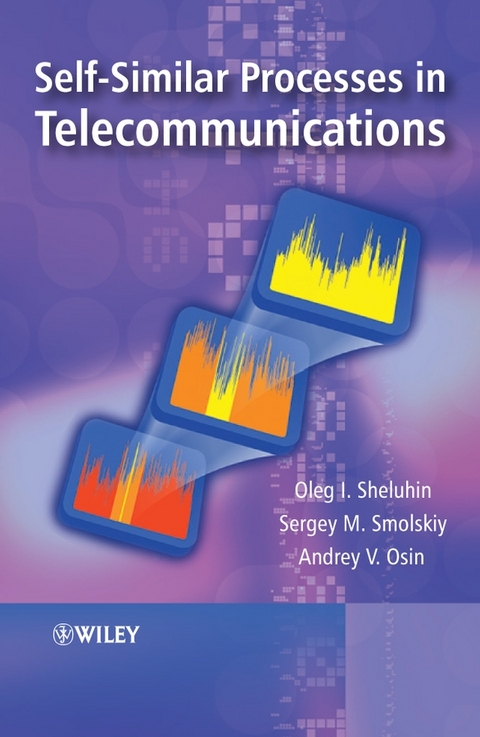
Self-Similar Processes in Telecommunications considers the self-similar (fractal and multifractal) models of telecommunication traffic and efficiency based on the assumption that its traffic has fractal or multifractal properties (is self-similar). The theoretical aspects of the most well-known traffic models demonstrating self-similar properties are discussed in detail and the comparative analysis of the different models' efficiency for self-similar traffic is presented.
This book demonstrates how to use self-similar processes for designing new telecommunications systems and optimizing existing networks so as to achieve maximum efficiency and serviceability. The approach is rooted in theory, describing the algorithms (the logical arithmetical or computational procedures that define how a task is performed) for modeling these self-similar processes. However, the language and ideas are essentially accessible for those who have a general knowledge of the subject area and the advice is highly practical: all models, problems and solutions are illustrated throughout using numerous real-world examples.
- Adopts a detailed, theoretical, yet broad-based and practical mathematical approach for designing and operating numerous types of telecommunications systems and networks so as to achieve maximum efficiency
- Places the subject in context, describing the current algorithms that make up the fractal or self-similar processes while pointing to the future development of the technology
- Offers a comparative analysis of the different types of self-similar process usage within the context of local area networks, wide area networks and in the modeling of video traffic and mobile communications networks
- Describes how mathematical models are used as a basis for building numerous types of network, including voice, audio, data, video, multimedia services and IP (Internet Protocol) telephony
The book will appeal to the wide range of specialists dealing with the design and exploitation of telecommunication systems. It will be useful for the post-graduate students, lecturers and researchers connected with communication networks disciplines.
Oleg I. Sheluhin is Head of Department of the Radio Engineering and Systems department of Moscow State Technical University of Service (MSTUS). He specializes in the areas of statistical radio engineering, radio systems theory and information systems simulation.
Sergey M. Smolskiy is Head of the Department of Radio Receivers in the Moscow Power Engineering Institute (MPEI). He has extensive experience in the field of telecommunications and is an active member of IEEE. His recent research topics include low distance radar systems and radio measuring systems.
Andrey V. Osin is currently Assistant Professor in the Department of Radio Engineering and Radio Systems at MSTUC. His PhD thesis focused on imitation modeling of self-similar processes in telecommunications and he has since published widely on the subject in numerous articles and conference journals.
For the first time the problems of voice services self-similarity are discussed systematically and in detail with specific examples and illustrations. Self-Similar Processes in Telecommunications considers the self-similar (fractal and multifractal) models of telecommunication traffic and efficiency based on the assumption that its traffic has fractal or multifractal properties (is self-similar). The theoretical aspects of the most well-known traffic models demonstrating self-similar properties are discussed in detail and the comparative analysis of the different models efficiency for self-similar traffic is presented. This book demonstrates how to use self-similar processes for designing new telecommunications systems and optimizing existing networks so as to achieve maximum efficiency and serviceability. The approach is rooted in theory, describing the algorithms (the logical arithmetical or computational procedures that define how a task is performed) for modeling these self-similar processes. However, the language and ideas are essentially accessible for those who have a general knowledge of the subject area and the advice is highly practical: all models, problems and solutions are illustrated throughout using numerous real-world examples. Adopts a detailed, theoretical, yet broad-based and practical mathematical approach for designing and operating numerous types of telecommunications systems and networks so as to achieve maximum efficiency Places the subject in context, describing the current algorithms that make up the fractal or self-similar processes while pointing to the future development of the technology Offers a comparative analysis of the different types of self-similar process usage within the context of local area networks, wide area networks and in the modeling of video traffic and mobile communications networks Describes how mathematical models are used as a basis for building numerous types of network, including voice, audio, data, video, multimedia services and IP (Internet Protocol) telephony The book will appeal to the wide range of specialists dealing with the design and exploitation of telecommunication systems. It will be useful for the post-graduate students, lecturers and researchers connected with communication networks disciplines.
Oleg I. Sheluhin is Head of Department of the Radio Engineering and Systems department of Moscow State Technical University of Service (MSTUS). He specializes in the areas of statistical radio engineering, radio systems theory and information systems simulation. Sergey M. Smolskiy is Head of the Department of Radio Receivers in the Moscow Power Engineering Institute (MPEI). He has extensive experience in the field of telecommunications and is an active member of IEEE. His recent research topics include low distance radar systems and radio measuring systems. Andrey V. Osin is currently Assistant Professor in the Department of Radio Engineering and Radio Systems at MSTUC. His PhD thesis focused on imitation modeling of self-similar processes in telecommunications and he has since published widely on the subject in numerous articles and conference journals.
| Erscheint lt. Verlag | 13.3.2007 |
|---|---|
| Sprache | englisch |
| Themenwelt | Technik ► Elektrotechnik / Energietechnik |
| Technik ► Nachrichtentechnik | |
| Schlagworte | Aspects • assumption • Communication Technology - Networks • Computational & Graphical Statistics • Detail • Drahtlose Kommunikation • Electrical & Electronics Engineering • Elektrotechnik u. Elektronik • Examples • First • Geometrie u. Topologie • Geometry & Topology • Kommunikationsnetze • Mathematics • Mathematik • Mobile & Wireless Communications • Models • Multifractal • Problems • processes • Properties • Rechnergestützte u. graphische Statistik • Rechnergestützte u. graphische Statistik • selfsimilar • selfsimilarity • specific • Statistics • Statistik • systematically • Telecommunication • telecommunications • Time • Traffic • Voice • wellknown |
| ISBN-13 | 9780470062104 / 9780470062104 |
| Informationen gemäß Produktsicherheitsverordnung (GPSR) | |
| Haben Sie eine Frage zum Produkt? |
 PDF (Adobe DRM)
Kopierschutz: Adobe-DRM
Adobe-DRM ist ein Kopierschutz, der das eBook vor Mißbrauch schützen soll. Dabei wird das eBook bereits beim Download auf Ihre persönliche Adobe-ID autorisiert. Lesen können Sie das eBook dann nur auf den Geräten, welche ebenfalls auf Ihre Adobe-ID registriert sind.
Details zum Adobe-DRM
Dateiformat: PDF (Portable Document Format)
Mit einem festen Seitenlayout eignet sich die PDF besonders für Fachbücher mit Spalten, Tabellen und Abbildungen. Eine PDF kann auf fast allen Geräten angezeigt werden, ist aber für kleine Displays (Smartphone, eReader) nur eingeschränkt geeignet.
Systemvoraussetzungen:
PC/Mac: Mit einem PC oder Mac können Sie dieses eBook lesen. Sie benötigen eine
eReader: Dieses eBook kann mit (fast) allen eBook-Readern gelesen werden. Mit dem amazon-Kindle ist es aber nicht kompatibel.
Smartphone/Tablet: Egal ob Apple oder Android, dieses eBook können Sie lesen. Sie benötigen eine
Geräteliste und zusätzliche Hinweise
Buying eBooks from abroad
For tax law reasons we can sell eBooks just within Germany and Switzerland. Regrettably we cannot fulfill eBook-orders from other countries.
aus dem Bereich