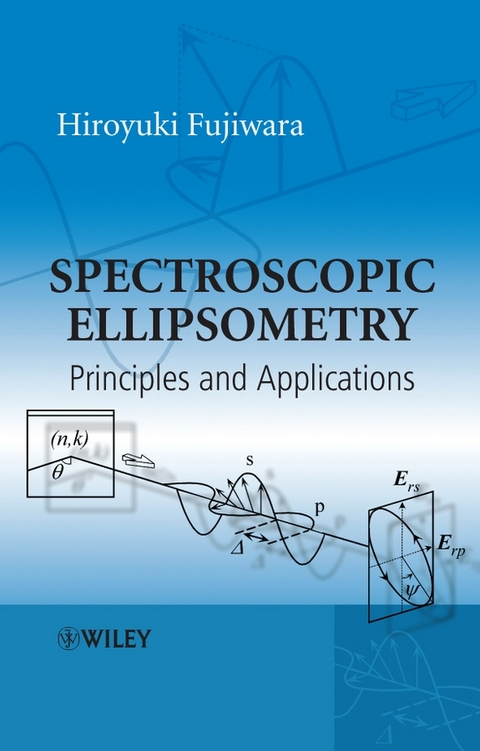
Spectroscopic Ellipsometry (eBook)
John Wiley & Sons (Verlag)
978-0-470-06018-6 (ISBN)
Dr Hiroyuki Fujiwara is based at the National Institute of Advanced Industrial Science and Technology, Ibaraki, Japan. He received his PhD at the Tokyo Institute of Technology in 1996 and carried out post-doctoral research with Professor R.W. Collins at Penn State University. From 1998 to present he has been working as a senior research scientist at the Research Center for Photovoltaics at NIAIST. He received the 'Most Promising Young Scientist Award' from the Japan Society of Applied Physics and the 'Young Researcher Award' at the World Conference on Photovoltaic Energy Conversion in 2003.
Ellipsometry is a powerful tool used for the characterization of thin films and multi-layer semiconductor structures. This book deals with fundamental principles and applications of spectroscopic ellipsometry (SE). Beginning with an overview of SE technologies the text moves on to focus on the data analysis of results obtained from SE, Fundamental data analyses, principles and physical backgrounds and the various materials used in different fields from LSI industry to biotechnology are described. The final chapter describes the latest developments of real-time monitoring and process control which have attracted significant attention in various scientific and industrial fields.
Dr Hiroyuki Fujiwara is based at the National Institute of Advanced Industrial Science and Technology, Ibaraki, Japan. He received his PhD at the Tokyo Institute of Technology in 1996 and carried out post-doctoral research with Professor R.W. Collins at Penn State University. From 1998 to present he has been working as a senior research scientist at the Research Center for Photovoltaics at NIAIST. He received the 'Most Promising Young Scientist Award' from the Japan Society of Applied Physics and the 'Young Researcher Award' at the World Conference on Photovoltaic Energy Conversion in 2003.
Spectroscopic Ellipsometry 3
Contents 9
Foreword 15
Preface 17
Acknowledgments 19
1 Introduction to Spectroscopic Ellipsometry 21
1.1 Features of Spectroscopic Ellipsometry 21
1.2 Applications of Spectroscopic Ellipsometry 23
1.3 Data Analysis 25
1.4 History of Development 27
1.5 Future Prospects 29
References 30
2 Principles of Optics 33
2.1 Propagation of Light 33
2.1.1 Propagation of One-Dimensional Waves 33
2.1.2 Electromagnetic Waves 38
2.1.3 Refractive Index 39
2.2 Dielectrics 44
2.2.1 Dielectric Polarization 44
2.2.2 Dielectric Constant 45
2.2.3 Dielectric Function 49
2.3 Reflection and Transmission of Light 52
2.3.1 Refraction of Light 52
2.3.2 p- and s-Polarized Light Waves 53
2.3.3 Reflectance and Transmittance 59
2.3.4 Brewster Angle 60
2.3.5 Total Reflection 62
2.4 Optical Interference 63
2.4.1 Optical Interference in Thin Films 63
2.4.2 Multilayers 66
References 68
3 Polarization of Light 69
3.1 Representation of Polarized Light 69
3.1.1 Phase of Light 69
3.1.2 Polarization States of Light Waves 70
3.2 Optical Elements 72
3.2.1 Polarizer (Analyzer) 73
3.2.2 Compensator (Retarder) 77
3.2.3 Photoelastic Modulator 78
3.2.4 Depolarizer 79
3.3 Jones Matrix 80
3.3.1 Jones Vector 80
3.3.2 Transformation of Coordinate Systems 82
3.3.3 Jones Matrices of Optical Elements 86
3.3.4 Representation of Optical Measurement by Jones Matrices 88
3.4 Stokes Parameters 90
3.4.1 Definition of Stokes Parameters 90
3.4.2 Poincaré Sphere 92
3.4.3 Partially Polarized Light 95
3.4.4 Mueller Matrix 97
References 98
4 Principles of Spectroscopic Ellipsometry 101
4.1 Principles of Ellipsometry Measurement 101
4.1.1 Measured Values in Ellipsometry 101
4.1.2 Coordinate System in Ellipsometry 104
4.1.3 Jones and Mueller Matrices of Samples 106
4.2 Ellipsometry Measurement 107
4.2.1 Measurement Methods of Ellipsometry 107
4.2.2 Rotating-Analyzer Ellipsometry (RAE) 113
4.2.3 Rotating-Analyzer Ellipsometry with Compensator 117
4.2.4 Rotating-Compensator Ellipsometry (RCE) 119
4.2.5 Phase-Modulation Ellipsometry (PME) 124
4.2.6 Infrared Spectroscopic Ellipsometry 126
4.2.7 Mueller Matrix Ellipsometry 131
4.2.8 Null Ellipsometry and Imaging Ellipsometry 133
4.3 Instrumentation for Ellipsometry 137
4.3.1 Installation of Ellipsometry System 137
4.3.2 Fourier Analysis 140
4.3.3 Calibration of Optical Elements 142
4.3.4 Correction of Measurement Errors 147
4.4 Precision and Error of Measurement 150
4.4.1 Variation of Precision and Error with Measurement Method 151
4.4.2 Precision of (?, ?) 155
4.4.3 Precision of Film Thickness and Absorption Coefficient 157
4.4.4 Depolarization Effect of Samples 159
References 161
5 Data Analysis 167
5.1 Interpretation of (?, ?) 167
5.1.1 Variations of (?, ?) with Optical Constants 167
5.1.2 Variations of (?, ?) in Transparent Films 170
5.1.3 Variations of (?, ?) in Absorbing Films 175
5.2 Dielectric Function Models 178
5.2.1 Lorentz Model 180
5.2.2 Interpretation of the Lorentz Model 182
5.2.3 Sellmeier and Cauchy Models 190
5.2.4 Tauc–Lorentz Model 190
5.2.5 Drude Model 193
5.2.6 Kramers–Kronig Relations 196
5.3 Effective Medium Approximation 197
5.3.1 Effective Medium Theories 197
5.3.2 Modeling of Surface Roughness 201
5.3.3 Limitations of Effective Medium Theories 204
5.4 Optical Models 207
5.4.1 Construction of Optical Models 207
5.4.2 Pseudo-Dielectric Function 209
5.4.3 Optimization of Sample Structures 211
5.4.4 Optical Models for Depolarizing Samples 211
5.5 Data Analysis Procedure 216
5.5.1 Linear Regression Analysis 216
5.5.2 Fitting Error Function 219
5.5.3 Mathematical Inversion 220
References 224
6 Ellipsometry of Anisotropic Materials 229
6.1 Reflection and Transmission of Light by Anisotropic Materials 229
6.1.1 Light Propagation in Anisotropic Media 229
6.1.2 Index Ellipsoid 233
6.1.3 Dielectric Tensor 235
6.1.4 Jones Matrix of Anisotropic Samples 237
6.2 Fresnel Equations for Anisotropic Materials 242
6.2.1 Anisotropic Substrate 242
6.2.2 Anisotropic Thin Film on Isotropic Substrate 244
6.3 4×4 Matrix Method 246
6.3.1 Principles of the 4×4 Matrix Method 246
6.3.2 Calculation Method of Partial Transfer Matrix 252
6.3.3 Calculation Methods of Incident and Exit Matrices 253
6.3.4 Calculation Procedure of the 4×4 Matrix Method 256
6.4 Interpretation of (?, ?) for Anisotropic Materials 257
6.4.1 Variations of (?, ?) in Anisotropic Substrates 257
6.4.2 Variations of (?, ?) in Anisotropic Thin Films 261
6.5 Measurement and Data Analysis of Anisotropic Materials 263
6.5.1 Measurement Methods 263
6.5.2 Data Analysis Methods 265
References 266
7 Data Analysis Examples 269
7.1 Insulators 269
7.1.1 Analysis Examples 269
7.1.2 Advanced Analysis 272
7.2 Semiconductors 276
7.2.1 Optical Transitions in Semiconductors 276
7.2.2 Modeling of Dielectric Functions 278
7.2.3 Analysis Examples 282
7.2.4 Analysis of Dielectric Functions 288
7.3 Metals/Semiconductors 296
7.3.1 Dielectric Function of Metals 296
7.3.2 Analysis of Free-Carrier Absorption 301
7.3.3 Advanced Analysis 306
7.4 Organic Materials/Biomaterials 307
7.4.1 Analysis of Organic Materials 307
7.4.2 Analysis of Biomaterials 312
7.5 Anisotropic Materials 314
7.5.1 Analysis of Anisotropic Insulators 315
7.5.2 Analysis of Anisotropic Semiconductors 316
7.5.3 Analysis of Anisotropic Organic Materials 319
References 323
8 Real-Time Monitoring by Spectroscopic Ellipsometry 331
8.1 Data Analysis in Real-Time Monitoring 331
8.1.1 Procedures for Real-Time Data Analysis 332
8.1.2 Linear Regression Analysis (LRA) 333
8.1.3 Global Error Minimization (GEM) 337
8.1.4 Virtual Substrate Approximation (VSA) 343
8.2 Observation of Thin-Film Growth by Real-Time Monitoring 348
8.2.1 Analysis Examples 348
8.2.2 Advanced Analysis 351
8.3 Process Control by Real-Time Monitoring 353
8.3.1 Data Analysis in Process Control 354
8.3.2 Process Control by Linear Regression Analysis (LRA) 354
8.3.3 Process Control by Virtual Substrate Approximation (VSA) 360
References 362
Appendices 365
1 Trigonometric Functions 365
2 Definitions of Optical Constants 367
3 Maxwell’s Equations for Conductors 369
4 Jones–Mueller Matrix Conversion 373
5 Kramers–Kronig Relations 377
Index 381
| Erscheint lt. Verlag | 27.9.2007 |
|---|---|
| Sprache | englisch |
| Themenwelt | Naturwissenschaften ► Chemie |
| Naturwissenschaften ► Physik / Astronomie ► Optik | |
| Technik ► Maschinenbau | |
| Schlagworte | Chemie • Chemistry • difficult • Due • Ellipsometry • fundamental • highprecision • Knowledge • Lack • light • materials characterization • Materials Science • Materialwissenschaften • nevertheless • Objective • often • opticalcharacterization • Partly • Position • Principles • Probe • Proper • Spectroscopic • spectroscopy • Spektroskopie • technique • Werkstoffprüfung • Werkstoffprüfung |
| ISBN-10 | 0-470-06018-2 / 0470060182 |
| ISBN-13 | 978-0-470-06018-6 / 9780470060186 |
| Informationen gemäß Produktsicherheitsverordnung (GPSR) | |
| Haben Sie eine Frage zum Produkt? |
 PDF (Adobe DRM)
Kopierschutz: Adobe-DRM
Adobe-DRM ist ein Kopierschutz, der das eBook vor Mißbrauch schützen soll. Dabei wird das eBook bereits beim Download auf Ihre persönliche Adobe-ID autorisiert. Lesen können Sie das eBook dann nur auf den Geräten, welche ebenfalls auf Ihre Adobe-ID registriert sind.
Details zum Adobe-DRM
Dateiformat: PDF (Portable Document Format)
Mit einem festen Seitenlayout eignet sich die PDF besonders für Fachbücher mit Spalten, Tabellen und Abbildungen. Eine PDF kann auf fast allen Geräten angezeigt werden, ist aber für kleine Displays (Smartphone, eReader) nur eingeschränkt geeignet.
Systemvoraussetzungen:
PC/Mac: Mit einem PC oder Mac können Sie dieses eBook lesen. Sie benötigen eine
eReader: Dieses eBook kann mit (fast) allen eBook-Readern gelesen werden. Mit dem amazon-Kindle ist es aber nicht kompatibel.
Smartphone/Tablet: Egal ob Apple oder Android, dieses eBook können Sie lesen. Sie benötigen eine
Geräteliste und zusätzliche Hinweise
Buying eBooks from abroad
For tax law reasons we can sell eBooks just within Germany and Switzerland. Regrettably we cannot fulfill eBook-orders from other countries.
aus dem Bereich