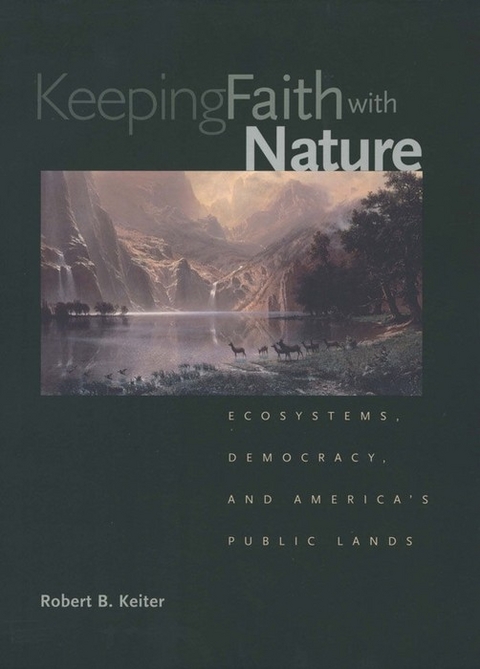
As the twenty-first century dawns, public land policy is entering a new era. This timely book examines the historical, scientific, political, legal, and institutional developments that are changing management priorities and policies—developments that compel us to view the public lands as an integrated ecological entity and a key biodiversity stronghold.
Once the background is set, each chapter opens with a specific natural resource controversy, ranging from the Pacific Northwest's spotted owl imbroglio to the struggle over southern Utah's Colorado Plateau country. Robert Keiter uses these case histories to analyze the ideas, forces, and institutions that are both fomenting and retarding change.
Although Congress has the final say in how the public domain is managed, the public land agencies, federal courts, and western communities are each playing important roles in the transformation to an ecological management regime. At the same time, a newly emergent and homegrown collaborative process movement has given the public land constituencies a greater role in administering these lands. Arguing that we must integrate the new imperatives of ecosystem science with our devolutionary political tendencies, Keiter outlines a coherent new approach to natural resources policy.
As the twenty-first century dawns, public land policy is entering a new era. This timely book examines the historical, scientific, political, legal, and institutional developments that are changing management priorities and policies—developments that compel us to view the public lands as an integrated ecological entity and a key biodiversity stronghold.Once the background is set, each chapter opens with a specific natural resource controversy, ranging from the Pacific Northwest’s spotted owl imbroglio to the struggle over southern Utah’s Colorado Plateau country. Robert Keiter uses these case histories to analyze the ideas, forces, and institutions that are both fomenting and retarding change.Although Congress has the final say in how the public domain is managed, the public land agencies, federal courts, and western communities are each playing important roles in the transformation to an ecological management regime. At the same time, a newly emergent and homegrown collaborative process movement has given the public land constituencies a greater role in administering these lands. Arguing that we must integrate the new imperatives of ecosystem science with our devolutionary political tendencies, Keiter outlines a coherent new approach to natural resources policy.
| Erscheint lt. Verlag | 1.10.2008 |
|---|---|
| Sprache | englisch |
| Themenwelt | Naturwissenschaften ► Biologie ► Ökologie / Naturschutz |
| Naturwissenschaften ► Geowissenschaften ► Geografie / Kartografie | |
| Technik | |
| ISBN-10 | 0-300-12827-4 / 0300128274 |
| ISBN-13 | 978-0-300-12827-7 / 9780300128277 |
| Informationen gemäß Produktsicherheitsverordnung (GPSR) | |
| Haben Sie eine Frage zum Produkt? |
 PDF (Wasserzeichen)
Größe: 2,1 MB
DRM: Digitales Wasserzeichen
Dieses eBook enthält ein digitales Wasserzeichen und ist damit für Sie personalisiert. Bei einer missbräuchlichen Weitergabe des eBooks an Dritte ist eine Rückverfolgung an die Quelle möglich.
Dateiformat: PDF (Portable Document Format)
Mit einem festen Seitenlayout eignet sich die PDF besonders für Fachbücher mit Spalten, Tabellen und Abbildungen. Eine PDF kann auf fast allen Geräten angezeigt werden, ist aber für kleine Displays (Smartphone, eReader) nur eingeschränkt geeignet.
Systemvoraussetzungen:
PC/Mac: Mit einem PC oder Mac können Sie dieses eBook lesen. Sie benötigen dafür einen PDF-Viewer - z.B. den Adobe Reader oder Adobe Digital Editions.
eReader: Dieses eBook kann mit (fast) allen eBook-Readern gelesen werden. Mit dem amazon-Kindle ist es aber nicht kompatibel.
Smartphone/Tablet: Egal ob Apple oder Android, dieses eBook können Sie lesen. Sie benötigen dafür einen PDF-Viewer - z.B. die kostenlose Adobe Digital Editions-App.
Buying eBooks from abroad
For tax law reasons we can sell eBooks just within Germany and Switzerland. Regrettably we cannot fulfill eBook-orders from other countries.
 EPUB (Adobe DRM)
Kopierschutz: Adobe-DRM
Adobe-DRM ist ein Kopierschutz, der das eBook vor Mißbrauch schützen soll. Dabei wird das eBook bereits beim Download auf Ihre persönliche Adobe-ID autorisiert. Lesen können Sie das eBook dann nur auf den Geräten, welche ebenfalls auf Ihre Adobe-ID registriert sind.
Details zum Adobe-DRM
Dateiformat: EPUB (Electronic Publication)
EPUB ist ein offener Standard für eBooks und eignet sich besonders zur Darstellung von Belletristik und Sachbüchern. Der Fließtext wird dynamisch an die Display- und Schriftgröße angepasst. Auch für mobile Lesegeräte ist EPUB daher gut geeignet.
Systemvoraussetzungen:
PC/Mac: Mit einem PC oder Mac können Sie dieses eBook lesen. Sie benötigen eine
eReader: Dieses eBook kann mit (fast) allen eBook-Readern gelesen werden. Mit dem amazon-Kindle ist es aber nicht kompatibel.
Smartphone/Tablet: Egal ob Apple oder Android, dieses eBook können Sie lesen. Sie benötigen eine
Geräteliste und zusätzliche Hinweise
Buying eBooks from abroad
For tax law reasons we can sell eBooks just within Germany and Switzerland. Regrettably we cannot fulfill eBook-orders from other countries.
aus dem Bereich